Secure Multi-Path Routing with All-or-Nothing Transform for Network-on-Chip Architectures
By Hansika Weerasena, Matthew Randall and Prabhat Mishra
University of Florida, Gainesville, Florida, USA
Abstract
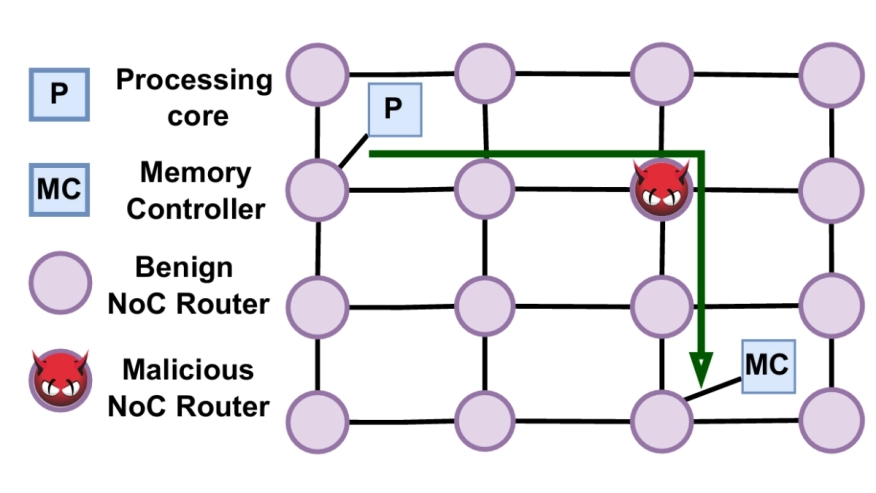
Ensuring Network-on-Chip (NoC) security is crucial to design trustworthy NoC-based System-on-Chip (SoC) architectures. While there are various threats that exploit on-chip communication vulnerabilities, eavesdropping attacks via malicious nodes are among the most common and stealthy. Although encryption can secure packets for confidentiality, it may introduce unacceptable overhead for resource-constrained SoCs. In this paper, we propose a lightweight confidentiality-preserving framework that utilizes a quasi-group based All-Or-Nothing Transform (AONT) combined with secure multi-path routing in NoC-based SoCs. By applying AONT to each packet and distributing its transformed blocks across multiple non-overlapping routes, we ensure that no intermediate router can reconstruct the original data without all blocks. Extensive experimental evaluation demonstrates that our method effectively mitigates eavesdropping attacks by malicious routers with negligible area and performance overhead. Our results also reveal that AONT-based multi-path routing can provide 7.3x reduction in overhead compared to traditional encryption for securing against eavesdropping attacks.
To read the full article, click here
Related Semiconductor IP
- Network-on-Chip (NoC)
- NoC Verification IP
- Smart Network-on-Chip (NoC) IP
- NoC System IP
- Cloud-active NOC configuration tool for generating and simulating Coherent and Non-Coherent NoCs
Related Articles
- A Methodology for Performance Analysis of Network-on-Chip Architectures for Video SoC
- The case for integrating FPGA fabrics with CPU architectures
- Configure, Confirm, Ship: Build Secure Processor-Based Systems with Faster Time-to-Market
- Optimize SoC Design with a Network-on-Chip Strategy
Latest Articles
- RISC-V Functional Safety for Autonomous Automotive Systems: An Analytical Framework and Research Roadmap for ML-Assisted Certification
- Emulation-based System-on-Chip Security Verification: Challenges and Opportunities
- A 129FPS Full HD Real-Time Accelerator for 3D Gaussian Splatting
- SkipOPU: An FPGA-based Overlay Processor for Large Language Models with Dynamically Allocated Computation
- TensorPool: A 3D-Stacked 8.4TFLOPS/4.3W Many-Core Domain-Specific Processor for AI-Native Radio Access Networks