RISCover: Automatic Discovery of User-exploitable Architectural Security Vulnerabilities in Closed-Source RISC-V CPUs
By Fabian Thomas, Eric García Arribas, Lorenz Hetterich, Daniel Weber, Lukas Gerlach, Ruiyi Zhang and Michael Schwarz
CISPA Helmholtz Center for Information Security Saarbrücken, Saarland, Germany
Abstract
The open and extensible RISC-V instruction set has enabled many new CPU vendors and implementations, but most commercial CPUs are closed-source, significantly hindering vulnerability analysis—especially for bugs exploitable from unprivileged user space.
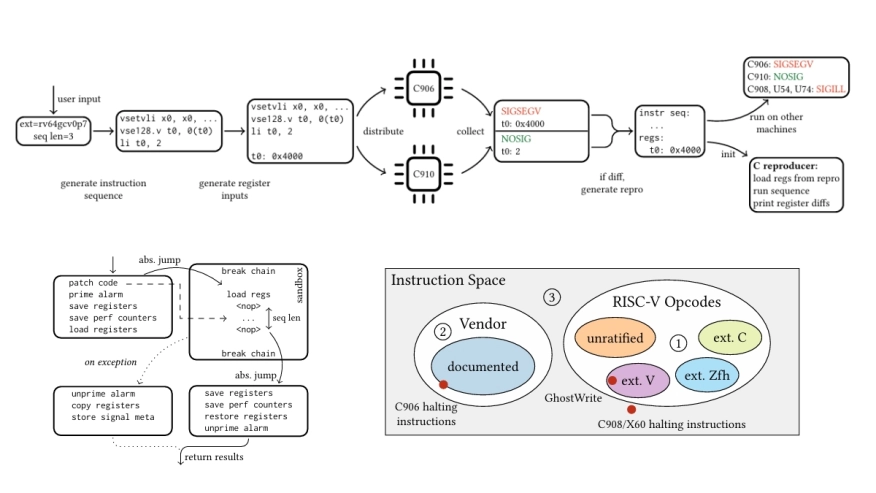
We present RISCover, a user-space framework for detecting architectural vulnerabilities in closed-source RISC-V CPUs. It compares instruction-sequence behavior across CPUs, identifying deviations without source code, hardware changes, or models, and achieving orders-of-magnitude speedups over RTL-based methods. Unlike prior work, RISCover runs user code on Linux directly on real hardware, exposing vulnerabilities exploitable by unprivileged attackers. Evaluated on 8 off-the-shelf CPUs from 3 different vendors, it uncovers 4 previously unknown vulnerabilities.
Notably, GhostWrite lets unprivileged code write chosen bytes to physical memory, enabling arbitrary data leakage and full machine-mode execution, while 3 unprivileged ''halt-and-catch-fire'' bugs halt CPUs and misaligned zero-stores silently corrupt data. Our results highlight the pressing need for post-silicon fuzzing techniques. RISCover complements existing RTL-level fuzzers by enabling rapid and automated security analysis of closed-source CPUs.
Keywords: CPUFuzzing; RISC-V; Architectural CPU Vulnerabilities
To read the full article, click here
Related Semiconductor IP
- RISC-V IOPMP IP
- RISC-V Debug & Trace IP
- Gen#2 of 64-bit RISC-V core with out-of-order pipeline based complex
- 64-bit RISC-V core with in-order single issue pipeline. Tiny Linux-capable processor for IoT applications.
- Tiny, Ultra-Low-Power Embedded RISC-V Processor
Related Articles
- An AUTOSAR-Aligned Architectural Study of Vulnerabilities in Automotive SoC Software
- RISC-V's CPU Verification Challenge
- LLM Inference with Codebook-based Q4X Quantization using the Llama.cpp Framework on RISC-V Vector CPUs
- Reconfiguring Design -> How to extend configurable CPU performance
Latest Articles
- RISC-V Functional Safety for Autonomous Automotive Systems: An Analytical Framework and Research Roadmap for ML-Assisted Certification
- Emulation-based System-on-Chip Security Verification: Challenges and Opportunities
- A 129FPS Full HD Real-Time Accelerator for 3D Gaussian Splatting
- SkipOPU: An FPGA-based Overlay Processor for Large Language Models with Dynamically Allocated Computation
- TensorPool: A 3D-Stacked 8.4TFLOPS/4.3W Many-Core Domain-Specific Processor for AI-Native Radio Access Networks