What Does a GPU Have to Do With Automotive Security?

The automotive industry is undergoing the most significant transformation since the advent of electronics in cars. Vehicles are becoming software-defined, connected, AI-driven, and continuously updated. This evolution brings extraordinary new capability – but it also brings greater levels of cybersecurity and functional-safety risks.
The GPU, once only a graphics accelerator for infotainment screens, is now also a primary compute engine for safety-critical tasks like vehicle perception, driver monitoring and camera stitching. The modern GPU is no longer a passive block in the SoC, or something you provision for; it is cyber-relevant, safety-relevant - and increasingly a point of focus for OEMs, Tier-1s and safety assessors.
At Imagination Technologies, we believe customer-trusted platforms start with evidence-based, secure IP, ‘certified’ with the relevant standards, that enable apple-to-apple comparisons with other products in the market. In this article we explore why GPUs have become relevant to automotive cybersecurity and the dual role that they play.
Cybersecurity and GPUs – who cares?
As vehicles converge with cloud services, AI, and IoT ecosystems, the attack surface obviously, or rather intuitively, grows significantly. Automotive platforms have now evolved from isolated ECUs to domain and zonal controllers interconnected over high-bandwidth networks, running mixed-criticality workloads, and increasingly reliant on GPU-accelerated compute.
Today you’ll find automotive GPUs involved in AI perception and sensor-fusion workloads, neural-network inference and complex 3D interfaces and real-time visualisation tools like surround-view cameras. A common theme across the above is ‘data’, with different level of value and sensitivity. And with those, attackers normally follow suit.
The GPU as Both an Attack Surface—and a Defensive Asset
The duality of the GPU is one of the most important shifts in automotive compute.
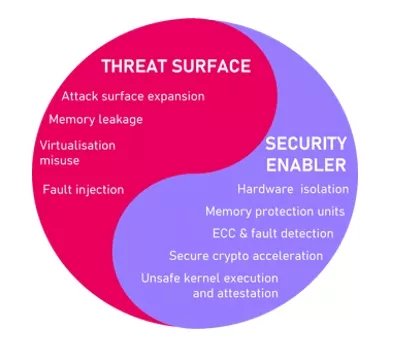
The GPU as an Attack Surface
Increasingly, GPUs deal with challenges such as:
- Side-channel leakage from massively parallel compute (read more)
- Privilege escalation through GPU memory or scheduling (read more)
- Manipulation of GPU-processed AI inputs (read more)
- Fault injection or data corruption (read more)
- Malicious workloads exploiting shared GPU pipelines (read more)
This is why any automotive GPU requires secure memory boundaries, robust virtualisation, privilege levels, and fault detection engineered directly into the architecture.
The GPU as a Security Accelerator
At the same time, GPUs are extremely efficient for handling a variety of algorithms for encryption and decryption, hashing, digital signing, key generation, and post-quantum cryptography. By offloading these tasks, GPUs can reduce CPU load and preserve the tight real-time constraints that are an essential requirement in modern automotive systems.
Explore GPU IP:
- E-Series GPU IP
- Advanced graphics and compute acceleration on power constrained devices
- Ray tracing GPU
Functional Safety and Cybersecurity: Interlinked, Not Identical
Because it handles perception data, model execution, and visual outputs, a compromised GPU can indirectly influence safety-critical behaviour. For example, tampering with perception inputs can mislead ADAS decision-making.
Cybersecurity and functional safety reinforce each other, but they serve different purposes. All safety-critical functions rely on cybersecurity, because a cyber attack can force a system into a hazardous state. But not all cybersecurity events create immediate safety hazards, such as personal-data leakage.
However, a compromised GPU can indirectly influence safety logic—especially in AI-based perception and decision-making systems. This makes it essential that ISO 26262 (functional safety) and ISO 21434 (cybersecurity) objectives are addressed together from concept through deployment.
Security as a Lifecycle Discipline: Imagination’s CSMS
Cybersecurity is not a bolt-on feature. It is a continuous discipline governed by a Cybersecurity Management System (CSMS) that spans threat analysis and risk assessment, secure design and architecture, secure coding and verification, vulnerability monitoring, incident response and supply-chain assurance. Imagination operates an externally certified CSMS, enabling our partners to build compliance arguments on top of a robust, audited foundation.
PowerVR GPU Security & Safety Features
Across our BXS and DXS GPU families, Imagination integrates a comprehensive set of hardware and architectural protections, including:
- Memory protection and integrity checking
- Hardware-based virtualisation for domain isolation
- Privilege boundaries and secure task separation
- Deterministic compute paths for safety-critical workloads
- Fault detection and diagnostics, such as Tile Region Protection or Idle Cycle Stealing
- Secure-boot integration and alignment with system-wide trust anchors
These features are backed by ISO 26262-certified safety documentation and - for future functionally safe products - by security documentation that accelerate customer development activities and assessments.
Importantly, some of our safety mechanisms also reinforce cybersecurity. For example, Tile Region Protection, originally designed to detect accidental data corruption in safety contexts, can also reveal abnormal access patterns characteristic of fault-injection or data-manipulation attacks. By monitoring unexpected behaviour at the hardware level, the GPU raises the difficulty of successfully executing low-level tampering attacks.
This dual benefit follows the duality explained earlier. Safety mechanisms strengthening cybersecurity pedigree is a key advantage of integrating protection directly into the architecture rather than relying on external layers.
Conclusion
GPUs now sit at the heart of automotive compute—and therefore at the heart of automotive safety and cybersecurity. As perception, AI, and real-time visualisation become central to vehicle behaviour and driver interfaces, the GPU must evolve from a performance component into a certifiable, cyber-resilient compute engine.
At Imagination Technologies, we embed safety, security, lifecycle engineering, and certified processes directly into our GPU IP—providing OEMs and Tier-1s with the foundation to build secure, high-performance, real-time systems. To find out more about our solutions, reach out to the team and book a meeting.
Related Semiconductor IP
- E-Series GPU IP
- Advanced graphics and compute acceleration on power constrained devices
- Ray tracing GPU
- Arm's most performance and efficient GPU till date, offering unparalled mobile gaming and ML performance
- Highest performance automotive GPU IP, with revolutionary functional safety technology
Related Blogs
- Why we've created a safety-critical driver for automotive GPU acceleration
- Rambus CryptoManager Root of Trust Cores Certified ASIL-B/D Ready for Enhanced Security in Automotive Applications
- Unveiling XS: the ultimate GPU family for automotive
- NextChip Win Signals Growing Momentum for Rambus Automotive Security IP
Latest Blogs
- A Bench-to-In-Field Telemetry Platform for Datacenter Power Management
- IDS-Verify™: From Specification to Sign-Off – Automated CSR, Hardware Software Interface and CPU-Peripheral Interface Verification
- RISC-V and GPU Synergy in Practice: A Path Towards High-Performance SoCs from SpacemiT K3
- EDA AI Agents: Intelligent Automation in Semiconductor & PCB Design
- Why Security Can't Exist Without Trust