World First: Synopsys MACsec IP Receives ISO/PAS 8800 Certification for Automotive and Physical AI Security

The automotive industry is entering the age of physical AI.
Vehicles are rapidly transforming into intelligent, software-defined systems that perceive their environment, make real-time decisions, and act in the physical world. As autonomy expands and AI workloads move to the edge, one reality is becoming clear:
If the data cannot be trusted, the AI cannot be trusted.
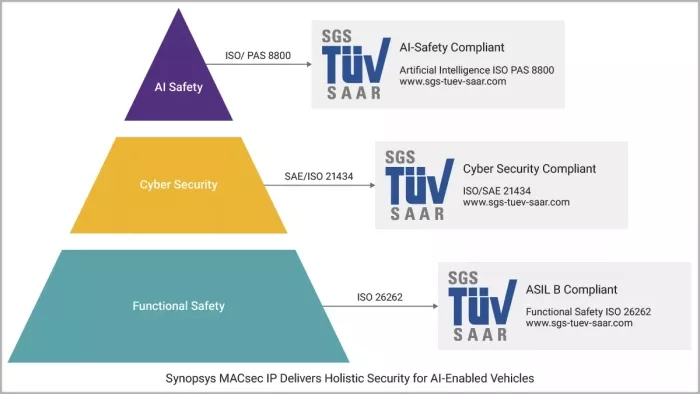
Today, Synopsys announced a global first. Following independent evaluation by SGS TÜV Saar, we have become the first company in the world to achieve product certification for ISO/PAS 8800, which outlines the safety requirements for AI in road vehicles.
This milestone sets a new benchmark for secure, predictable communication inside next-generation vehicles and signals a broader shift in how the industry defines and ensures AI safety.
AI safety starts with the data path
Much of the conversation around automotive AI focuses on perception models, neural networks, and compute performance.
But AI in vehicles doesn’t operate in isolation. It receives and processes continuous streams of sensor data traveling across the vehicle’s internal network.
If that data is delayed, altered, or replayed even for milliseconds, the vehicle can react incorrectly. A braking decision can be late. A lane change maneuver can be miscalculated. A safety system can behave unpredictably.
That’s why secure, real-time communication is now a prerequisite for automotive safety.
MACsec is the industry-standard technology used to protect Ethernet communication inside vehicles. It ensures that data moving between sensors, processors, and control systems remains authentic and untampered.
With the ISO/PAS 8800 certification — which bolsters our ISO 26262 and ISO/SAE 21434 certifications — we have demonstrated that our MACsec IP not only secures data but does so in a way that preserves the predictable timing behavior required for AI-driven systems.
In AI-enabled vehicles, timing and integrity are inseparable.
What this means for OEMs
For automotive manufacturers, this certification delivers tangible advantages:
- Reduced risk in AI and autonomous vehicle programs
- Increased confidence in real-time vehicle decision systems
- Easier integration with zonal and centralized E/E architectures
- Stronger positioning for regulatory and safety assessments
- Independent third-party validation of product behavior
- Faster time to market
As vehicles transition to centralized compute platforms and zonal architectures, internal networks are carrying more critical traffic than ever before. This includes AI perception data, over-the-air updates, diagnostics, and infotainment all sharing the same backbone.
Without built-in communication safeguards, safety assumptions can silently degrade.
By embedding certified security at the hardware IP level, OEMs gain a scalable, reusable foundation that supports multiple vehicle programs and future autonomy upgrades.
Strengthening the automotive supply chain
The impact extends beyond OEMs. For Tier 1 suppliers, semiconductor companies, and system integrators, ISO/PAS 8800-certified MACsec IP provides:
- A pre-validated building block for secure SoC designs
- Reduced certification complexity downstream
- Clear alignment with evolving automotive safety expectations
- A competitive differentiator in AI-enabled vehicle programs
In addition, our certified MACsec IP is delivered with a quality manual, AI safety analysis, AI safety manual, AI safety assurance argument, and the ISO/PAS 8800 assessment report.
As the industry moves toward embodied intelligence platforms, every layer of the supply chain must demonstrate trustworthiness, not just performance. This certification delivers a credible, independently validated assurance of trustworthiness — addressing a critical requirement for every participant in the automotive supply chain.

A broader industry signal
The future of mobility is physical AI — vehicles that sense, decide, and act in real time. But intelligence alone is not enough. If the data flowing through the vehicle cannot be trusted, neither can the decisions it makes.
ISO/PAS 8800 focuses on verified product behavior, not just development processes. And that distinction matters. It represents a shift from “how it was built” to “how it performs in real-world operation.”
By achieving the world’s first ISO/PAS 8800 certification under this framework and pairing it with our ISO 26262 functional safety and ISO/SAE 21434 cyber security certifications, we are reinforcing our leadership in automotive security IP and signaling that AI infrastructure must meet the same rigor as AI algorithms.
Physical AI demands trusted infrastructure. Trusted infrastructure demands certified communication integrity.
As vehicles continue evolving into intelligent, decision-making systems, secure data movement will become as critical as compute performance itself.
Related Semiconductor IP
- ASIL B / ISO 26262 and ISO 21434 Compliant 1G-25G MACsec Security Module
- MACsec Protocol Engine for 1G/10G+ Ethernet
- HPC MACsec Security Modules for Ethernet
- P1619 / 802.1ae (MACSec) GCM/XTS/CBC-AES Core
- 1.6T/3.2T Multi-Channel MACsec Engine with TDM Interface (MACsec-IP-364)
Related Blogs
- Synopsys Secures Connected Vehicles with Industry's First IP Product to Achieve Third-Party Certification for ISO/SAE 21434 Cybersecurity Standard
- The Industry’s First USB4 Device IP Certification Will Speed Innovation and Edge AI Enablement
- XConn Revitalizes Next-Gen Data Centers with CXL 2.0 Switch Designed with Synopsys IP
- Unveiling Ultra-Compact MACsec IP Core with optimized Flexible Crypto Block for 5X Size Reduction and Unmatched Efficiency from Comcores
Latest Blogs
- A Bench-to-In-Field Telemetry Platform for Datacenter Power Management
- IDS-Verify™: From Specification to Sign-Off – Automated CSR, Hardware Software Interface and CPU-Peripheral Interface Verification
- RISC-V and GPU Synergy in Practice: A Path Towards High-Performance SoCs from SpacemiT K3
- EDA AI Agents: Intelligent Automation in Semiconductor & PCB Design
- Why Security Can't Exist Without Trust