FPGAs vs. eFPGAs: Understanding the Key Differences

Summary:
As chip architecture evolves toward heterogeneous SoCs and chiplets, engineers face a growing challenge: balancing flexibility with efficiency. Traditional FPGAs remain essential for rapid prototyping and field reconfigurability, but embedded FPGAs (eFPGAs) are increasingly becoming a smart choice for adding flexibility to ASIC and SoC devices. This article breaks down the key differences between FPGAs and eFPGAs, and how QuickLogic’s open, customizable eFPGA IP is helping customers achieve ASIC-level performance with FPGA-like adaptability.
FPGA vs eFPGA: Two Approaches to Programmable Logic
FPGAs (Field-Programmable Gate Arrays) have been the backbone of hardware flexibility for decades. They’re standalone, reprogrammable devices that allow engineers to iterate quickly, adapt to new standards, and extend product lifecycles through field updates.
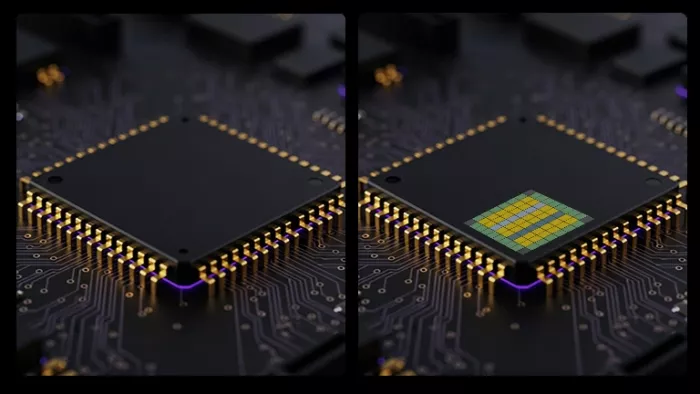
An embedded FPGA (eFPGA) takes that same programmable logic fabric, the configurable logic blocks (CLBs), LUTs, DSPs, and interconnect, and integrates it inside a custom ASIC or SoC. Instead of mounting a separate FPGA chip on your board, you bake the reconfigurable fabric right into your silicon.
QuickLogic’s Australis™ eFPGA IP generator automates the creation of optimized eFPGA fabrics across multiple foundries and process nodes. It gives engineers fine-grained control over array size, routing, and power — all while integrating seamlessly with standard ASIC design flows. For aerospace and defense applications, QuickLogic also provides radiation-hardened eFPGA IP that delivers reliable performance in extreme environments.
(Learn more: Australis eFPGA IP Generator | Rad-Hard eFPGA IP)
The Key Differences Between FPGAs and eFPGAs
1. Integration and Form Factor
FPGAs are standalone chips that require board space, I/O pins, and additional power delivery components.
eFPGAs are IP cores integrated directly into an ASIC or SoC.
That integration eliminates external parts and routing complexity, cutting board costs, and shrinking system footprint.
Result: Lower BOM, improved signal integrity, and simpler supply chain management.
2. Performance and Power Efficiency
FPGAs communicate off-chip — every signal crosses I/O boundaries, adding delay and consuming power.
An eFPGA communicates on-die, directly with nearby logic and memory blocks, reducing latency and energy consumption.
Result: Higher throughput, lower power, and reduced thermal stress — ideal for real-time AI, sensor fusion, and mission-critical systems.
3. Flexibility and Post-Manufacturing Updates
FPGAs excel in R&D and prototyping due to unlimited reprogrammability.
eFPGAs bring that adaptability inside the ASIC, enabling updates to algorithms, security logic, or standards after tape-out — extending the product’s life without a redesign.
Result: ASIC-class efficiency with FPGA-style agility for long-lifecycle products.
4. Cost, Volume, and Supply Chain Stability
FPGAs make sense for low- and mid-volume production, where eliminating NRE (non-recurring engineering) costs is key.
Once designs stabilize and scale, embedding eFPGA logic directly in the SoC reduces per-unit cost and mitigates supply chain risks — no separate FPGA sourcing, no part obsolescence, no multi-vendor logistics.
Result: Predictable supply, smaller BOM, and ASIC economics for high-volume applications.
5. Security and Long-Term Survivability
Standalone FPGAs are more exposed to physical and bitstream-based tampering.
An eFPGA resides within the SoC’s trusted security perimeter, benefiting from secure boot, encrypted configuration data, and hardware-level authentication.
This makes eFPGAs the go-to choice for systems that must remain secure, upgradeable, and field-resilient over decades of operation. QuickLogic’s radiation-hardened eFPGA IP supports secure bitstream updates, tamper detection, and triple-modular redundancy (TMR) strategies to enhance reliability under extreme conditions.
Result: Enhanced security, longevity, and resilience, built into the silicon itself.
6. Mission-Specific and Regional Adaptability
One overlooked benefit of eFPGA integration is post-production customization.
A single SoC design can serve multiple regions, missions, or product variants by reconfiguring the embedded fabric.
That means a manufacturer can support different communication standards, encryption algorithms, or hardware feature sets — all from one base ASIC — without a redesign.
Result: Lower development cost and faster adaptation to changing market or regulatory requirements.
7. Toolchains and Ecosystem Support
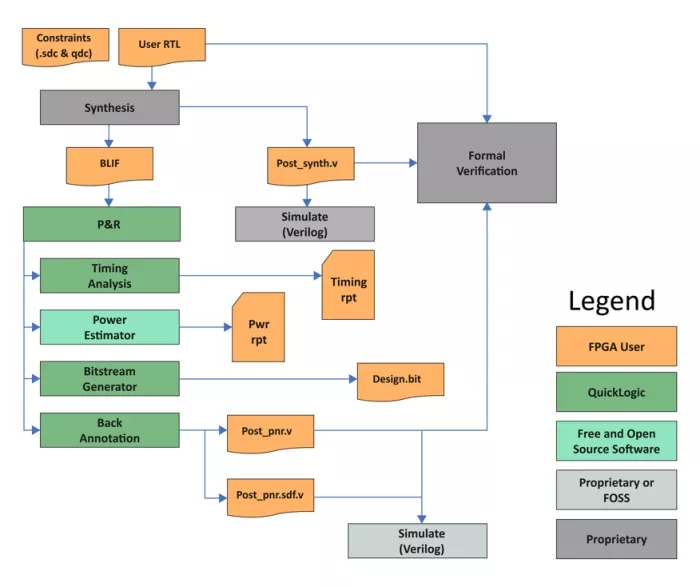
Traditional FPGA tools are self-contained but proprietary.
eFPGA flows require integration with ASIC design tools — which can sound complex, but we’ve solved that. QuickLogic’s open-source toolchain, built around multiple open-source projects integrated into the Aurora ecosystem, makes eFPGA design accessible, portable, and verifiable.
Our Australis IP generator automates the process of creating and characterizing eFPGA blocks for your chosen foundry and process node, delivering custom IP in weeks — not months.
(More info: QuickLogic Open-Source Tools)
| Feature | FPGA | eFPGA |
| Integration | External chip | Embedded IP core |
| Power | Higher (I/O overhead) | Lower (on-die interconnect) |
| Update Flexibility | Full field reprogrammability | On-chip algorithm updates |
| Cost (Volume) | No NRE, higher per-unit | Higher NRE, lower per-unit |
When to Choose FPGA vs eFPGA
Choose an FPGA for rapid prototyping, early development, or applications requiring frequent in-field updates.
Choose an eFPGA for higher-volume, power-sensitive, or long-lifecycle systems that benefit from ASIC integration and on-chip reconfigurability.
Many of our customers prototype in traditional FPGAs, then migrate their logic to a QuickLogic eFPGA IP block for production — preserving flexibility while maximizing performance and cost efficiency.
Beyond Flexibility: Longevity, Security, and Confidence
At QuickLogic, we understand that aerospace, defense, and industrial systems must last for decades — often under mission-critical conditions. Our eFPGA IP supports secure lifecycle management, cryptographic agility, and firmware-level adaptability, giving system architects the confidence to update, harden, and future-proof their designs without costly re-spins.
We also offer evaluation programs, reference designs, and collaborative partnerships to accelerate adoption — ensuring teams can explore eFPGA integration with minimal risk and maximum support.
Result: Faster design cycles, secure updates, and hardware that evolves with your mission.
The Big Picture
- FPGAs and eFPGAs aren’t competing technologies — they’re complementary tools in the engineer’s toolbox
- FPGAs deliver maximum flexibility for fast-moving development
- eFPGAs bring that flexibility inside the chip for scalable, efficient, and secure products
As the semiconductor industry embraces custom SoCs, chiplets, and AI-driven workloads, eFPGAs are emerging as a foundational element — combining performance, adaptability, and design freedom.
At QuickLogic, we’re empowering engineers in this transition with open, customizable, and secure eFPGA IP, backed by decades of programmable logic expertise.
To learn more about QuickLogic’s eFPGA IP, open-source tools, and support programs, visit: https://www.quicklogic.com/efpga-ip
Explore eFPGA IP:
Related Semiconductor IP
- Radiation-Hardened eFPGA
- eFPGA Hard IP Generator
- eFPGA on GlobalFoundries GF12LP
- eFPGA IP — Flexible Reconfigurable Logic Acceleration Core
- Heterogeneous eFPGA architecture with LUTs, DSPs, and BRAMs on GlobalFoundries GF12LP
Related Blogs
- FPGAs or ASICs - What Are Their Differences and Similarities and How to Use Them for Security?
- DisplayPort 2.1 vs DisplayPort 1.4: A Detailed Comparison of Key Features
- UA Link vs Interlaken: What you need to know about the right protocol for AI and HPC interconnect fabrics
- Five Architectural Reasons Why FPGAs Are the Ultimate AI Inference Engines
Latest Blogs
- Area, Pipelining, Integration: A Comparison of SHA-2 and SHA-3 for embedded Systems.
- Why Your Next Smartphone Needs Micro-Cooling
- Teaching AI Agents to Speak Hardware
- SOCAMM: Modernizing Data Center Memory with LPDDR6/5X
- Bridging the Gap: Why eFPGA Integration is a Managed Reality, Not a Schedule Risk