Veri-Sure: A Contract-Aware Multi-Agent Framework with Temporal Tracing and Formal Verification for Correct RTL Code Generation
By Jiale Liu 1, Taiyu Zhou 2, Tianqi Jiang 3
1 School of Physics and Astronomy, The University of Edinburgh, Edinburgh, UK
2 State Key Laboratory of Analog and Mixed-Signal VLSI, University of Macau, Macau
3 School of Science and Engineering, The Chinese University of Hong Kong, Shenzhen, Shenzhen, China.
Abstract
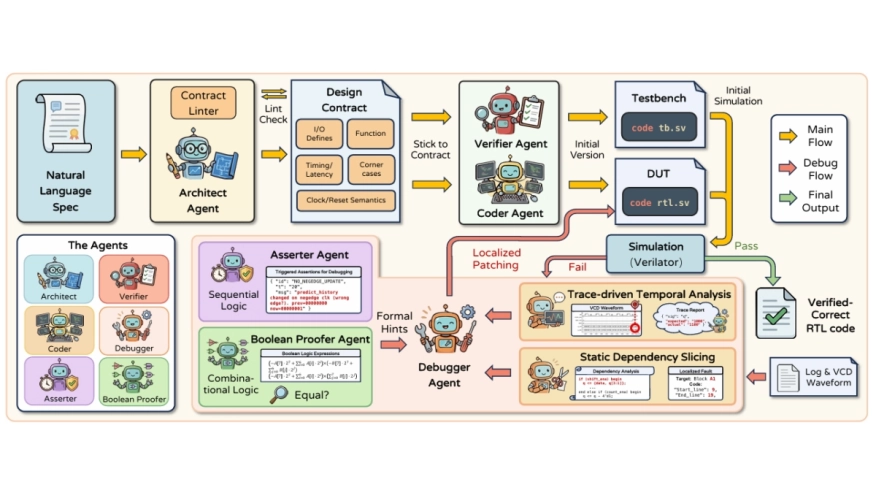
In the rapidly evolving field of Electronic Design Automation (EDA), the deployment of Large Language Models (LLMs) for Register-Transfer Level (RTL) design has emerged as a promising direction. However, silicon-grade correctness remains bottlenecked by: (i) limited test coverage and reliability of simulation-centric evaluation, (ii) regressions and repair hallucinations introduced by iterative debugging, and (iii) semantic drift as intent is reinterpreted across agent handoffs. In this work, we propose Veri-Sure, a multi-agent framework that establishes a design contract to align agents' intent and uses a patching mechanism guided by static dependency slicing to perform precise, localized repairs. By integrating a multi-branch verification pipeline that combines trace-driven temporal analysis with formal verification consisting of assertion-based checking and boolean equivalence proofs, Veri-Sure enables functional correctness beyond pure simulations. We also introduce VerilogEval-v2-EXT, extending the original benchmark with 53 more industrial-grade design tasks and stratified difficulty levels, and show that Veri-Sure achieves state-of-the-art verified-correct RTL code generation performance, surpassing standalone LLMs and prior agentic systems.
To read the full article, click here
Related Semiconductor IP
- UCIe D2D Adapter & PHY Integrated IP
- Low Dropout (LDO) Regulator
- 16-Bit xSPI PSRAM PHY
- MIPI CSI-2 CSE2 Security Module
- ASIL B Compliant MIPI CSI-2 CSE2 Security Module
Related Articles
- A RISC-V Multicore and GPU SoC Platform with a Qualifiable Software Stack for Safety Critical Systems
- Automatically Retargeting Hardware and Code Generation for RISC-V Custom Instructions
- OmniSim: Simulating Hardware with C Speed and RTL Accuracy for High-Level Synthesis Designs
- Lyra: A Hardware-Accelerated RISC-V Verification Framework with Generative Model-Based Processor Fuzzing
Latest Articles
- RISC-V Functional Safety for Autonomous Automotive Systems: An Analytical Framework and Research Roadmap for ML-Assisted Certification
- Emulation-based System-on-Chip Security Verification: Challenges and Opportunities
- A 129FPS Full HD Real-Time Accelerator for 3D Gaussian Splatting
- SkipOPU: An FPGA-based Overlay Processor for Large Language Models with Dynamically Allocated Computation
- TensorPool: A 3D-Stacked 8.4TFLOPS/4.3W Many-Core Domain-Specific Processor for AI-Native Radio Access Networks