Multimodal Chip Physical Design Engineer Assistant
By Yun-Da Tsai 1,2, Chang-Yu Chao 1, Liang-Yeh Shen 1, Tsung-Han Lin 3, Haoyu Yang 2, Mark Ho 2, Yi-Chen Lu 2, Wen-Hao Liu 2, Shou-De Lin 1, Haoxing Ren 2
1 National Taiwan University
2 NVIDIA Research
3 University of California, Los Angeles
Abstract
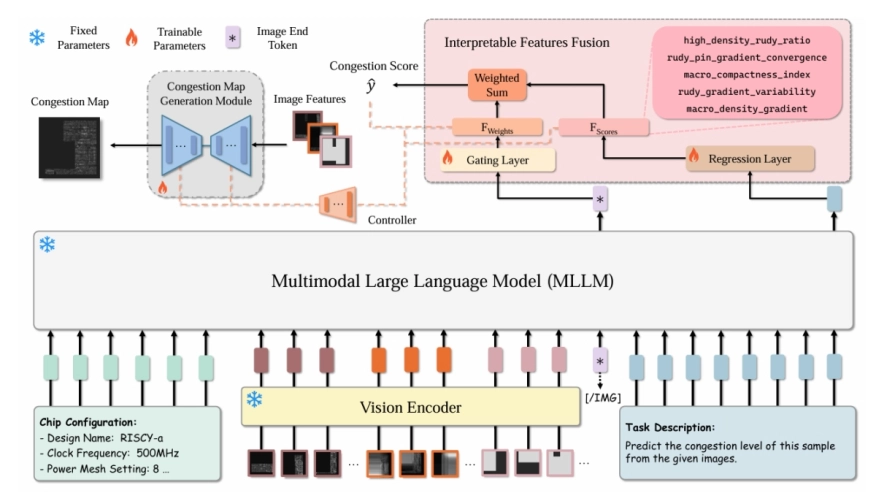
Modern chip physical design relies heavily on Electronic Design Automation (EDA) tools, which often struggle to provide interpretable feedback or actionable guidance for improving routing congestion. In this work, we introduce a Multimodal Large Language Model Assistant (MLLMA) that bridges this gap by not only predicting congestion but also delivering human-interpretable design suggestions. Our method combines automated feature generation through MLLM-guided genetic prompting with an interpretable preference learning framework that models congestion-relevant tradeoffs across visual, tabular, and textual inputs. We compile these insights into a "Design Suggestion Deck" that surfaces the most influential layout features and proposes targeted optimizations. Experiments on the CircuitNet benchmark demonstrate that our approach outperforms existing models on both accuracy and explainability. Additionally, our design suggestion guidance case study and qualitative analyses confirm that the learned preferences align with real-world design principles and are actionable for engineers. This work highlights the potential of MLLMs as interactive assistants for interpretable and context-aware physical design optimization.
To read the full article, click here
Related Semiconductor IP
- UCIe D2D Adapter & PHY Integrated IP
- Low Dropout (LDO) Regulator
- 16-Bit xSPI PSRAM PHY
- MIPI CSI-2 CSE2 Security Module
- ASIL B Compliant MIPI CSI-2 CSE2 Security Module
Related Articles
- Scaling AI Chip Design With NoC Soft Tiling
- VLSI Physical Design Methodology for ASIC Development with a Flavor of IP Hardening
- The Future Of Chip Design
- The Complicated Chip Design Verification Landscape
Latest Articles
- RISC-V Functional Safety for Autonomous Automotive Systems: An Analytical Framework and Research Roadmap for ML-Assisted Certification
- Emulation-based System-on-Chip Security Verification: Challenges and Opportunities
- A 129FPS Full HD Real-Time Accelerator for 3D Gaussian Splatting
- SkipOPU: An FPGA-based Overlay Processor for Large Language Models with Dynamically Allocated Computation
- TensorPool: A 3D-Stacked 8.4TFLOPS/4.3W Many-Core Domain-Specific Processor for AI-Native Radio Access Networks