CQ-CiM: Hardware-Aware Embedding Shaping for Robust CiM-Based Retrieval
By Xinzhao Li 1, Alptekin Vardar 3, Franz Müller 3, Navya Goli 2, Umamaheswara Tida 2, Kai Ni 4, X. Sharon Hu 4, Thomas Kämpfe 3, Ruiyang Qin 1
1 Villanova University,
2 NDSU,
3 Fraunhofer IPMS,
4 University of Notre Dame
Abstract
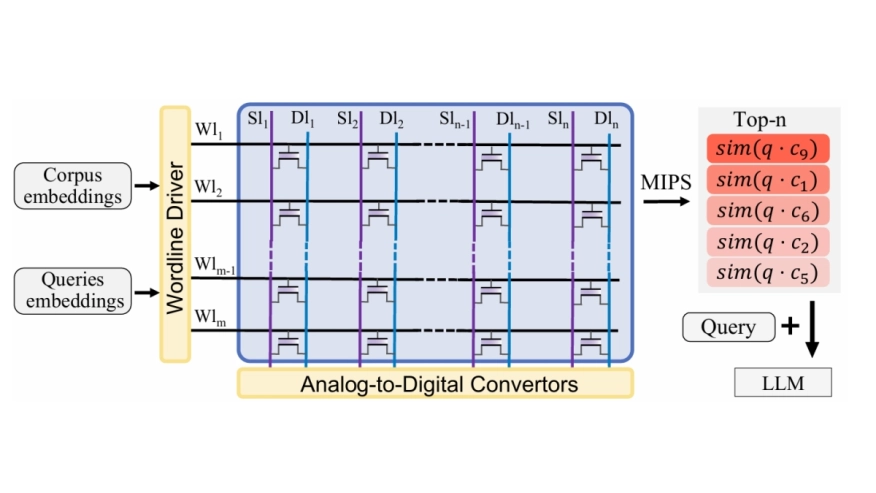
Deploying Retrieval-Augmented Generation (RAG) on edge devices is in high demand, but is hindered by the latency of massive data movement and computation on traditional architectures. Compute-in-Memory (CiM) architectures address this bottleneck by performing vector search directly within their crossbar structure. However, CiM's adoption for RAG is limited by a fundamental ``representation gap,'' as high-precision, high-dimension embeddings are incompatible with CiM's low-precision, low-dimension array constraints. This gap is compounded by the diversity of CiM implementations (e.g., SRAM, ReRAM, FeFET), each with unique designs (e.g., 2-bit cells, 512x512 arrays). Consequently, RAG data must be naively reshaped to fit each target implementation. Current data shaping methods handle dimension and precision disjointly, which degrades data fidelity. This not only negates the advantages of CiM for RAG but also confuses hardware designers, making it unclear if a failure is due to the circuit design or the degraded input data. As a result, CiM adoption remains limited. In this paper, we introduce CQ-CiM, a unified, hardware-aware data shaping framework that jointly learns Compression and Quantization to produce CiM-compatible low-bit embeddings for diverse CiM designs. To the best of our knowledge, this is the first work to shape data for comprehensive CiM usage on RAG.
To read the full article, click here
Related Semiconductor IP
- Low Dropout (LDO) Regulator
- 16-Bit xSPI PSRAM PHY
- ASIL B Compliant MIPI CSI-2 CSE2 Security Module
- SHA-256 Secure Hash Algorithm IP Core
- EdDSA Curve25519 signature generation engine
Related Articles
- Leveraging FPGAs for Homomorphic Matrix-Vector Multiplication in Oblivious Message Retrieval
- Dataquest forecasts robust IP market growth
- Robust verification deserves an audit
- Robust designs cut vendor hype
Latest Articles
- A 129FPS Full HD Real-Time Accelerator for 3D Gaussian Splatting
- SkipOPU: An FPGA-based Overlay Processor for Large Language Models with Dynamically Allocated Computation
- TensorPool: A 3D-Stacked 8.4TFLOPS/4.3W Many-Core Domain-Specific Processor for AI-Native Radio Access Networks
- Assertain: Automated Security Assertion Generation Using Large Language Models
- VolTune: A Fine-Grained Runtime Voltage Control Architecture for FPGA Systems