Morphlux: Programmable chip-to-chip photonic fabrics in multi-accelerator servers for ML
By Abhishek Vijaya Kumar 1, Eric Ding 1, Arjun Devraj 1, Darius Bunandar 2, Rachee Singh 1
1 Cornell University
2 Lightmatter
Abstract
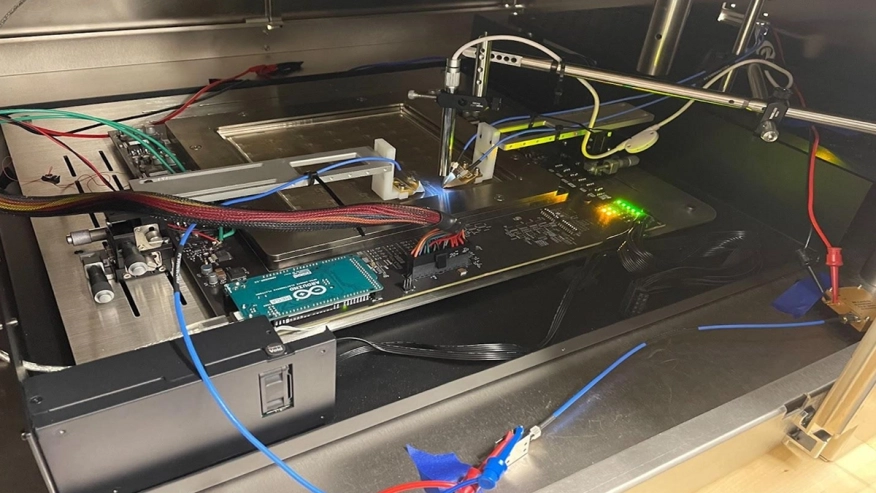
We optically interconnect accelerator chips (e.g., GPUs, TPUs) within compute servers using newly viable programmable chip-to-chip photonic fabrics. In contrast, today, commercial multi-accelerator compute servers that are workhorses of ML, use electrical interconnects to network accelerator chips in the server. However, recent trends have shown an interconnect bandwidth wall caused by accelerator FLOPS scaling at a faster rate than the bandwidth of the interconnect between accelerators in the same server. This has led to under-utilization and idling of GPU resources in cloud datacenters. We develop Morphlux, a server-scale programmable photonic fabric, to interconnect accelerators within servers. We show that augmenting state-of-the-art photonic ML-centric datacenters with Morphlux can improve the bandwidth of tenant compute allocations by up to 66% and reduce compute fragmentation by up to 70%. We develop a novel end-to-end hardware prototype of Morphlux to demonstrate these performance benefits, which translate to 1.72x improvement in training throughput of ML models. By rapidly programming the server-scale fabric in our hardware testbed, Morphlux can logically replace a failed accelerator chip in 1.2 seconds.
To read the full article, click here
Related Semiconductor IP
- ReRAM NVM in DB HiTek 130nm BCD
- UFS 5.0 Host Controller IP
- PDM Receiver/PDM-to-PCM Converter
- Voltage and Temperature Sensor with integrated ADC - GlobalFoundries® 22FDX®
- 8MHz / 40MHz Pierce Oscillator - X-FAB XT018-0.18µm
Related Articles
- FPGAs: Embedded Apps : Building mesh-based distributed switch fabrics with programmable logic
- New programmable processors will displace ASICs in communications designs, says CEO
- Embedded Systems: Programmable Logic -> Programming enters designer's core
- Embedded Systems: Programmable Logic -> Common gateway networks enable remote programs
Latest Articles
- An FPGA-Based SoC Architecture with a RISC-V Controller for Energy-Efficient Temporal-Coding Spiking Neural Networks
- Enabling RISC-V Vector Code Generation in MLIR through Custom xDSL Lowerings
- A Scalable Open-Source QEC System with Sub-Microsecond Decoding-Feedback Latency
- SNAP-V: A RISC-V SoC with Configurable Neuromorphic Acceleration for Small-Scale Spiking Neural Networks
- An FPGA Implementation of Displacement Vector Search for Intra Pattern Copy in JPEG XS