The Quest for Reliable AI Accelerators: Cross-Layer Evaluation and Design Optimization
By Meng Li 1,2,3, Tong Xie 2,1, Zuodong Zhang 4, and Runsheng Wang 2,3,4
1 Institute for Artificial Intelligence & 2 School of Integrated Circuits, Peking University, Beijing, China
3 Beijing Advanced Innovation Center for Integrated Circuits, Beijing, China
4 Institute of Electronic Design Automation, Peking University, Wuxi, China
Abstract
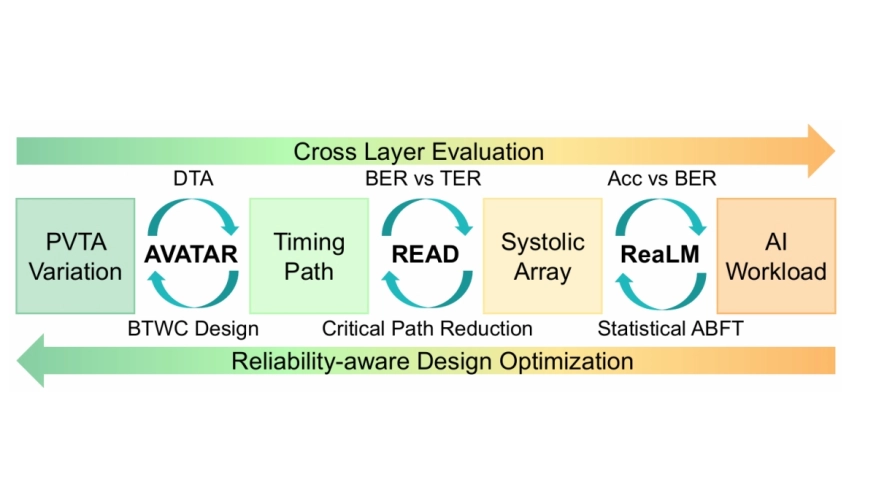
As the CMOS technology pushes to the nanoscale, aging effects and process variations have become increasingly pronounced, posing significant reliability challenges for AI accelerators. Traditional guardband-based design approaches, which rely on pessimistic timing margin, sacrifice significant performance and computational efficiency, rendering them inadequate for high-performance AI computing demands. Current reliability-aware AI accelerator design faces two core challenges: (1) the lack of systematic cross-layer analysis tools to capture coupling reliability effects across device, circuit, architecture, and application layers; and (2) the fundamental trade-off between conventional reliability optimization and computational efficiency. To address these challenges, this paper systematically presents a series of reliability-aware accelerator designs, encompassing (1) aging and variation-aware dynamic timing analyzer, (2) accelerator dataflow optimization using critical input pattern reduction, and (3) resilience characterization and novel architecture design for large language models (LLMs). By tightly integrating cross-layer reliability modeling and AI workload characteristics, these co-optimization approaches effectively achieve reliable and efficient AI acceleration.
To read the full article, click here
Related Semiconductor IP
- RISC-V-Based, Open Source AI Accelerator for the Edge
- Embedded AI accelerator IP
- AI Accelerator Specifically for CNN
- Performance AI Accelerator for Edge Computing
- Performance Efficiency AI Accelerator
Related Articles
- Why Software is Critical for AI Inference Accelerators
- Programmable accelerators: hardware performance with software flexibility
- H.264 Baseline Decoder With ADI Blackfin DSP and Hardware Accelerators
- Reducing Power in Embedded Systems by Adding Hardware Accelerators
Latest Articles
- RISC-V Functional Safety for Autonomous Automotive Systems: An Analytical Framework and Research Roadmap for ML-Assisted Certification
- Emulation-based System-on-Chip Security Verification: Challenges and Opportunities
- A 129FPS Full HD Real-Time Accelerator for 3D Gaussian Splatting
- SkipOPU: An FPGA-based Overlay Processor for Large Language Models with Dynamically Allocated Computation
- TensorPool: A 3D-Stacked 8.4TFLOPS/4.3W Many-Core Domain-Specific Processor for AI-Native Radio Access Networks