A Scalable Open-Source QEC System with Sub-Microsecond Decoding-Feedback Latency
By Junyi Liu ∗, Yi Lee ∗, Yilun Xu †, Gang Huang †, and Xiaodi Wu ∗
∗ Joint Center for Quantum Information and Computer Science, University of Maryland, College Park, MD
† Lawrence Berkeley National Laboratory, Berkeley, CA
Abstract
Quantum error correction (QEC) is essential for realizing large-scale, fault-tolerant quantum computation, yet its practical implementation remains a major engineering challenge. In particular, QEC demands precise real-time control of a large number of qubits and low-latency, high-throughput and accurate decoding of error syndromes. While most prior work has focused primarily on decoder design, the overall performance of any QEC system depends critically on all its subsystems including control, communication, and decoding, as well as their integration.
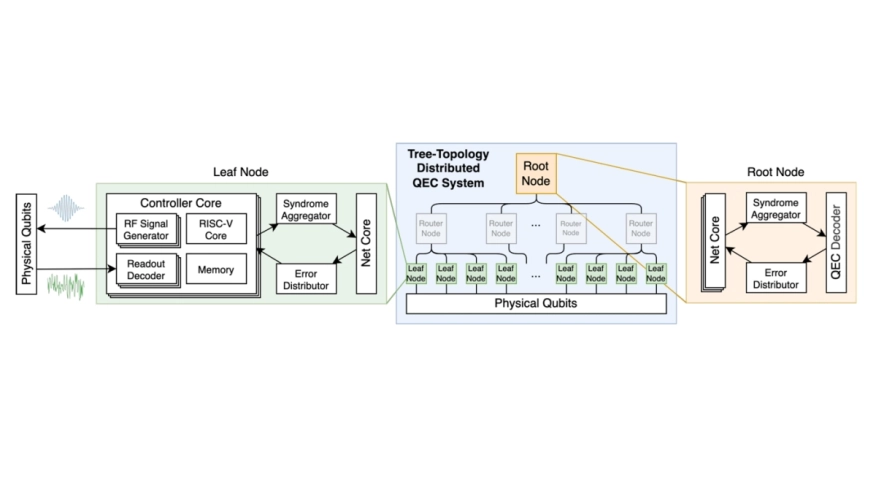
To address this challenge, we present an open-source, fully integrated QEC system built on RISC-Q, a generator for RISC-V-based quantum control architectures. Implemented on RFSoC FPGAs, our system prototype integrates real-time qubit control, a scalable distributed multi-board architecture, and the state-of-the-art hardware QEC decoder within a low-latency, high-throughput decoding pipeline, forming a complete hardware platform ready for deployment with superconducting qubits.
Experimental evaluation on a three-board prototype based on AMD ZCU216 RFSoCs demonstrates an end-to-end QEC decoding-feedback latency of 446 ns for a distance-3 surface code, including syndrome aggregation, network communication, syndrome decoding, and error distribution. Extrapolating from measured subsystem performance and state-of-the-art decoder benchmarks, the architecture can achieve sub-microsecond decoding-feedback latency up to a distance-21 surface code (∼881 physical qubits) when scaled to larger hardware configurations.
To read the full article, click here
Related Semiconductor IP
- UCIe D2D Adapter & PHY Integrated IP
- Low Dropout (LDO) Regulator
- 16-Bit xSPI PSRAM PHY
- ASIL B Compliant MIPI CSI-2 CSE2 Security Module
- SHA-256 Secure Hash Algorithm IP Core
Related Articles
- An Open-Source Approach to Developing a RISC-V Chip with XiangShan and Mulan PSL v2
- Portable and scalable solution for off-screen video frame composition and decomposition using OpenGL ES
- The need for speed in low latency video system designs
- Convey UHD 4K Video over 1Gbit Ethernet with the intoPIX JPEG 2000 "Ultra Low Latency" compression profile
Latest Articles
- A 129FPS Full HD Real-Time Accelerator for 3D Gaussian Splatting
- SkipOPU: An FPGA-based Overlay Processor for Large Language Models with Dynamically Allocated Computation
- TensorPool: A 3D-Stacked 8.4TFLOPS/4.3W Many-Core Domain-Specific Processor for AI-Native Radio Access Networks
- Assertain: Automated Security Assertion Generation Using Large Language Models
- VolTune: A Fine-Grained Runtime Voltage Control Architecture for FPGA Systems