Assertain: Automated Security Assertion Generation Using Large Language Models
By Shams Tarek, Dipayan Saha, Khan Thamid Hasan, Sujan Kumar Saha, Mark Tehranipoor, Farimah Farahmandi
Department of Electrical and Computer Engineering, University of Florida, Gainesville, FL, USA
Abstract
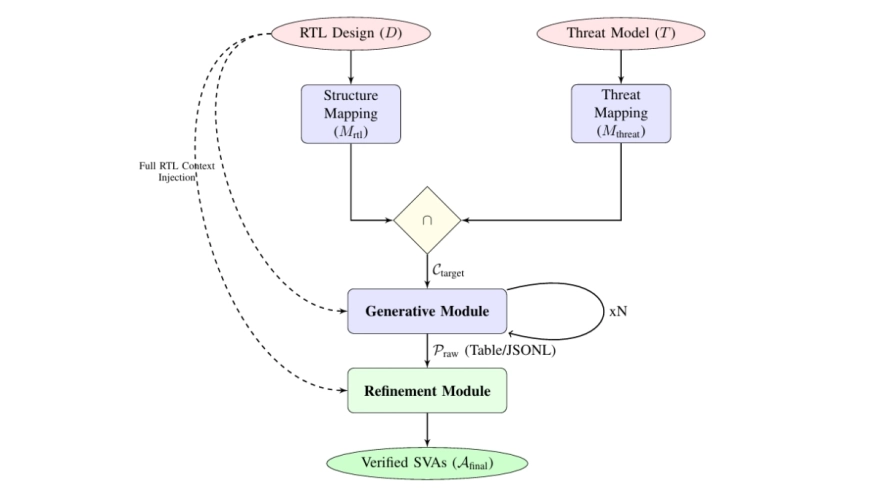
The increasing complexity of modern system-on-chip designs amplifies hardware security risks and makes manual security property specification a major bottleneck in formal property verification. This paper presents Assertain, an automated framework that integrates RTL design analysis, Common Weakness Enumeration (CWE) mapping, and threat model intelligence to automatically generate security properties and executable SystemVerilog Assertions. Assertain leverages large language models with a self-reflection refinement mechanism to ensure both syntactic correctness and semantic consistency. Evaluated on 11 representative hardware designs, Assertain outperforms GPT-5 by 61.22%, 59.49%, and 67.92% in correct assertion generation, unique CWE coverage, and architectural flaw detection, respectively. These results demonstrate that Assertain significantly expands vulnerability coverage, improves assertion quality, and reduces manual effort in hardware security verification.
Index Terms — Hardware security, formal property verification, SystemVerilog Assertions, CWE, large language models
To read the full article, click here
Related Semiconductor IP
- UCIe D2D Adapter & PHY Integrated IP
- Low Dropout (LDO) Regulator
- 16-Bit xSPI PSRAM PHY
- MIPI CSI-2 CSE2 Security Module
- ASIL B Compliant MIPI CSI-2 CSE2 Security Module
Related Articles
- SV-LLM: An Agentic Approach for SoC Security Verification using Large Language Models
- RoMe: Row Granularity Access Memory System for Large Language Models
- SkipOPU: An FPGA-based Overlay Processor for Large Language Models with Dynamically Allocated Computation
- SOC: Submicron Issues -> Large PLDs need own physical models
Latest Articles
- RISC-V Functional Safety for Autonomous Automotive Systems: An Analytical Framework and Research Roadmap for ML-Assisted Certification
- Emulation-based System-on-Chip Security Verification: Challenges and Opportunities
- A 129FPS Full HD Real-Time Accelerator for 3D Gaussian Splatting
- SkipOPU: An FPGA-based Overlay Processor for Large Language Models with Dynamically Allocated Computation
- TensorPool: A 3D-Stacked 8.4TFLOPS/4.3W Many-Core Domain-Specific Processor for AI-Native Radio Access Networks