Embedded FPGA reaches a new stage of industrial maturity – Menta at Embedded World 2026
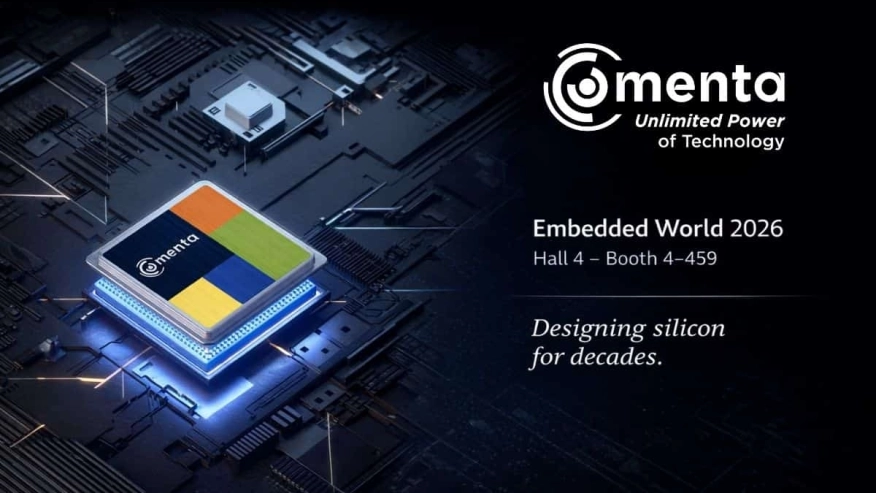
Sophia-Antipolis, France – February 24, 2026 – At Embedded World 2026 (March 11–13, 2026 | Nuremberg, Germany), Menta will join the global semiconductor and embedded systems community to address a structural shift redefining custom silicon architecture: the transition from static silicon platforms to adaptable, long-lifecycle systems.
 Across industrial, mobility, aerospace, defense, edge AI, and security-critical markets, silicon is expected to remain qualified and reliable for decades. Yet the systems it supports continue to evolve — in algorithms, standards, connectivity, and security requirements.
This growing tension is reshaping architecture decisions. Embedded hardware reconfigurability is moving from optional capability to foundational design discipline.
At Embedded World 2026, Menta will present its standard-cell embedded FPGA (eFPGA) IP, enabling hardware reprogrammability to be integrated directly into production-grade ASIC and SoC platforms using industrial-grade design flows — without proprietary macros and without foundry constraints.
As heterogeneous architectures become mainstream, the ability to manage post-silicon evolution in a controlled and governable manner is becoming a defining competitive factor.
Explore eFPGA IP:
Menta’s approach focuses on:
- Integrating embedded FPGA IP within qualified ASIC and SoC flows
- Preserving long-term reliability and lifecycle governance
- Enabling heterogeneous acceleration within industrial constraints
- Supporting adaptable silicon platforms across critical markets
“Silicon used to be optimized for performance at tape-out,” said Vincent Markus, CEO of Menta. “Today, it must also be optimized for controlled evolution over decades. Embedded reconfigurability is no longer a feature — it is infrastructure.”
Menta’s team will welcome media, analysts, and industry partners at Hall 4 – Booth 4-459 throughout the event.
Press & Analyst Invitation
Menta’s executive and technical leadership will be available for interviews during and after Embedded World 2026 to discuss:
- The architectural shift toward adaptable silicon platforms
- Managing long-lifecycle ASIC and SoC evolution
- Embedded FPGA integration in industrial-grade semiconductor design
- The future of heterogeneous embedded systems
Related Semiconductor IP
- eFPGA Soft IP
- eFPGA on GlobalFoundries GF12LP
- eFPGA IP — Flexible Reconfigurable Logic Acceleration Core
- Heterogeneous eFPGA architecture with LUTs, DSPs, and BRAMs on GlobalFoundries GF12LP
- Radiation-Hardened eFPGA
Related News
- Menta Unveils 'Launch Pad' Low-Cost Embedded FPGA (eFPGA) Technology Access Program For Defense And Aerospace Customers
- Menta Licenses Menta Embedded FPGA Programmable IP To Renesas For Its ForgeFPGA Product Line
- Menta Brings its Pioneering eFPGA Technology to Embedded World North America 2025
- MIPI Specifications for Embedded Audio, Ambient AI, Smart Camera, IoT and Medical to be Featured at 2026 embedded world Exhibition & Conference
Latest News
- Cadence and NVIDIA Expand Partnership to Reinvent Engineering for the Age of AI and Accelerated Computing
- Cadence and Google Collaborate to Scale AI-Driven Chip Design with ChipStack AI Super Agent on Google Cloud
- Analog Bits Demonstrates Real-Time On-Chip Power Sensing and Delivery on TSMC N2P Process at TSMC 2026 Technology Symposiums
- TES offers a High-Frequency Synthesizer and Clock Generator IP for X-FAB XT018 - 0.18µm BCD-on-SOI technology
- Faraday Delivers IP Solutions to Enable Endpoint AI Based on UMC’s 28nm SST eFlash