Rivian Unveils Custom Silicon, Next-Gen Autonomy Platform, and Deep AI Integration
PALO ALTO, Calif. – December 11, 2025 – Rivian (NASDAQ: RIVN) today announced significant breakthroughs in vertically integrated automotive technology at its first Autonomy & AI Day. During the event at its Palo Alto offices, the company unveiled its proprietary, purpose-built silicon, outlined its roadmap for next-generation vehicle autonomy, and introduced an evolved software architecture underpinned by artificial intelligence (AI).
 “I couldn’t be more excited for the work our teams are driving in autonomy and AI. Our updated hardware platform, which includes our in-house 1600 sparse TOPS inference chip, will enable us to achieve dramatic progress in self-driving to ultimately deliver on our goal of delivering L4. This represents an inflection point for the ownership experience – ultimately being able to give customers their time back when in the car,” said Rivian Founder and CEO RJ Scaringe.
Rivian Autonomy Processor and Gen 3 Autonomy Computer
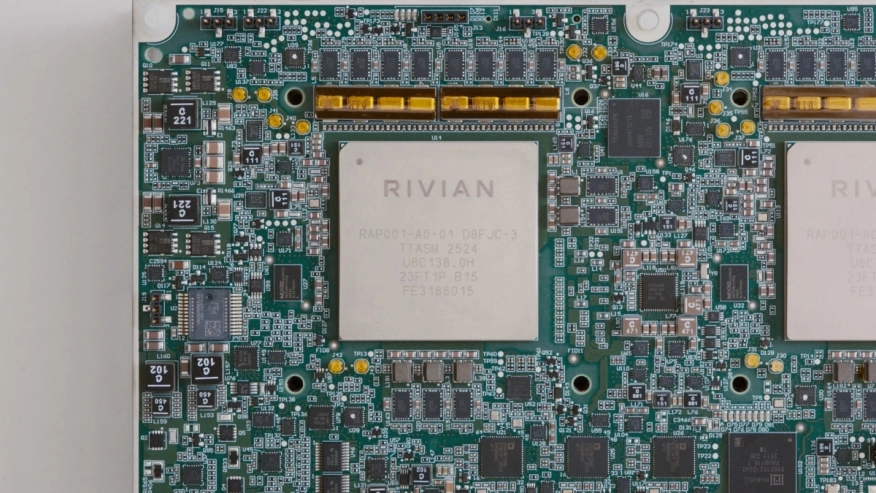
At the core of Rivian’s technology roadmap is the transition to in-house silicon, designed specifically for the vision-centric physical AI. The first generation Rivian Autonomy Processor (RAP1) is a custom 5nm processor that integrates processing and memory onto a single multi-chip module. This architecture delivers advanced levels of efficiency, performance, and Automotive Safety Integrity Level compliance.
RAP1 powers the company’s third-generation Autonomy computer, the Autonomy Compute Module 3 (ACM3). Key specifications of the ACM3 include:
- 1600 sparse INT8 TOPS (Trillion Operations Per Second).
- The processing power of 5 billion pixels per second.
- RAP1 features RivLink, a low latency interconnect technology allowing chips to be connected to multiply processing power, making it inherently extensible.
- RAP1 is enabled by an in-house developed AI compiler and platform software.
In addition to ACM3, Rivian plans to integrate LiDAR into future R2 models. LiDAR will augment the company’s multi-modal sensor strategy, providing detailed, three-dimensional spatial data and redundant sensing, and improving real-time detection for the edge cases of driving.
Our Gen 3 Autonomy hardware including ACM3 and LiDAR is currently undergoing validation and we expect it to ship on R2 models starting at the end of 2026.
Rivian Autonomy Platform
Rivian also detailed its software-first approach to autonomy, powered by the Rivian Autonomy Platform and an end-to-end data loop used for training. The company introduced its Large Driving Model (LDM), a foundational autonomous model trained like a Large Language Model (LLM). Utilizing Group-Relative Policy Optimization (GRPO), the LDM will distill superior driving strategies from massive datasets into the vehicle.
Software advancements are coming to the company’s second generation R1 vehicles in the near term with the addition of Universal Hands-Free (UHF), bringing hands-free assisted driving for extended periods to significantly more places.
- Available on over 3.5 million miles of roads across the USA and Canada.
- Capable of operating off-highway on roads with clearly painted lines.
Rivian announced its autonomy subscription, Autonomy+, with continuously expanding capabilities, launching in early 2026 and priced at $2,500 (one-time) or $49.99 (per month). These features have the potential to make the roads safer, address customer demand and become veritable drivers for the business.
Rivian also detailed plans to continuously improve the autonomy capabilities of its Gen 2 R1 and future R2 vehicles, with a clear trajectory including point-to-point, eyes off and personal L4.
Rivian Unified Intelligence and Rivian Assistant
Beyond vehicle autonomy, Rivian is harnessing AI across the business with the Rivian Unified Intelligence (RUI). The shared, multi-modal and multi-LLM data foundation is helping the company develop powerful new features, improve service infrastructure, and even power predictive maintenance. The highlight of this new architecture is the Rivian Assistant, a next-generation voice interface launching in early 2026 on Gen 1 and Gen 2 R1 vehicles.
- Built on Rivian’s edge models to understand your vehicle, your digital life and the world around you.
- Connects vehicle systems with third-party apps using an in-house agentic framework, with Google Calendar named as the first integration.
- Augmented by frontier large language models for grounded data, natural conversation and powerful reasoning.
RUI will fundamentally change service by embedding AI into diagnostics. It’s an expert assistant for technicians, scanning telemetry and history to pinpointing complex issues. This same advanced intelligence will soon power Rivian’s mobile app, improving self-service diagnostics.
Rivian’s unique, vertically integrated strategy allows the company to rapidly evolve the entire vehicle experience—from user-facing features to foundational technology. In the company’s next stage of growth, integration meets acceleration as this next-generation hardware and software come to market.
About Rivian:
Rivian (NASDAQ: RIVN) is an American automotive technology company that develops and builds category-defining electric vehicles as well as vertically integrated technologies and services. Through innovation across its electrical architecture, end-to-end software, autonomous driving platform, artificial intelligence and propulsion, the company creates vehicles that excel at work and play while accelerating the global transition to zero-emission transportation and energy. Rivian vehicles are manufactured in the United States and are sold directly to consumer and commercial customers. Whether taking families on new adventures or electrifying fleets at scale, Rivian vehicles all share a common goal — preserving the natural world for generations to come.
Related Semiconductor IP
- UCIe D2D Adapter & PHY Integrated IP
- Low Dropout (LDO) Regulator
- 16-Bit xSPI PSRAM PHY
- ASIL B Compliant MIPI CSI-2 CSE2 Security Module
- SHA-256 Secure Hash Algorithm IP Core
Related News
- GlobalFoundries to Acquire Synopsys’ Processor IP Solutions Business, Expanding Capabilities to Accelerate Physical AI Applications
- RaiderChip showcases the evolution of its local Generative AI processor at ISE 2026
- Andes Technology Unveils the AndesCore™ D23, a Feature-Rich, Low-Power and Highly-Secured Entry-Level RISC-V Processor
- Andes Announces RISC-V Multicore 1024-bit Vector Processor: AX45MPV
Latest News
- EU DARE Project Is Scrambling to Replace Codasip
- Sofics and Alcyon Photonics Partner to Support Next-Generation Photonic Systems
- QuickLogic Appoints Quantum Leap Solutions as Authorized Sales Representative
- Cadence and NVIDIA Expand Partnership to Reinvent Engineering for the Age of AI and Accelerated Computing
- Cadence and Google Collaborate to Scale AI-Driven Chip Design with ChipStack AI Super Agent on Google Cloud