Despite Export Ban on Equipment, China's Semiconductor Expansion in Mature Processes Remains Strong, Says TrendForce
July 6, 2023 -- On June 30th, the Netherlands introduced new export restrictions on advanced semiconductor manufacturing equipment. Despite facing export controls from the US, Japan, and the Netherlands, TrendForce anticipates the market share of Chinese foundries in terms of 12-inch wafer production capacity will likely increase from 24% in 2022 to an estimated 26% in 2026. Moreover, if the exports of 40/28nm equipment eventually receive approval, there’s a chance that this market share could expand even further, possibly reaching 28% by 2026. This growth potential should not be dismissed.
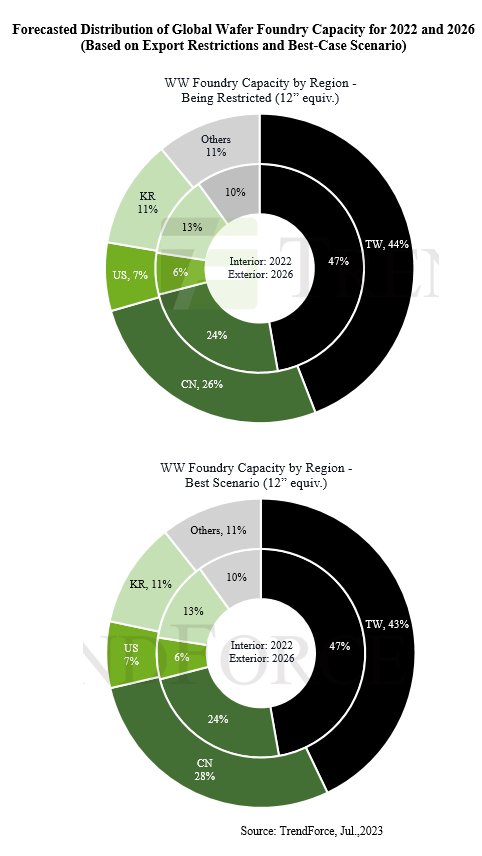
Several manufacturing processes including photolithography, deposition, and epitaxy will be subject to these recent export restrictions. Beginning September 1st, the export of all controlled items will require formal authorization. TrendForce reports that Chinese foundries have been primarily developing mature processes like 55nm, 40nm, and 28nm. Furthermore, demand for deposition equipment can be largely met by local Chinese vendors, meaning concerns regarding expansion and development are minimal. The main limiting factor, however, remains the equipment used in photolithography.
TrendForce research indicates that businesses to be impacted first include SMIC’s Beijing and Shanghai fabs, as well as Nexchip’s A3/A4 fabs in Hefei. TrendForce assesses that Nexchip’s Hefei fabs may experience far less disruption, as their short-term production focus remains on more mature processes. Conversely, SMIC’s Beijing and Shanghai fabs may be forced to delay their expansion plans, pending permission for their equipment vendors to proceed with shipments.
The US Export Administration Regulations (EAR) is primarily aimed at limiting China’s growth in advanced process, rather than mature ones. Although export regulations from the US, Japan, and the Netherlands cover equipment used across both mature and advanced process generations, it’s namely equipment used in 45nm to more advanced processes which will require inspection. However, mainstream equipment for mature processes ranging from 45–28nm could potentially still require export authorization as well. Even though Chinese foundries will likely face a lengthy equipment review process, forcing them to delay their expansion plans for 40nm and 28nm processes, their ambitious positioning in the 28nm market ensures their development pace remains strong.
It’s worth noting that, while advanced processes such as 1Xnm are currently not the primary focus of Chinese foundries, China’s potential for further development in this area is anticipated to face increased obstacles with the enforcement of more comprehensive export regulations.
For more information on reports and market data from TrendForce’s Department of Semiconductor Research, please click here, or email Ms. Latte Chung from the Sales Department at lattechung@trendforce.com
For additional insights from TrendForce analysts on the latest tech industry news, trends, and forecasts, please visit our blog at https://insider.trendforce.com/
Related Semiconductor IP
- DeWarp IP
- 6-bit, 12 GSPS Flash ADC - GlobalFoundries 22nm
- LunaNet AFS LDPC Encoder and Decoder IP Core
- ReRAM NVM in DB HiTek 130nm BCD
- UFS 5.0 Host Controller IP
Related News
- Progress in Importation of US Equipment Dispels Doubts on SMIC's Capacity Expansion for Mature Nodes for Now, Says TrendForce
- Silvaco Opens Chengdu Office to Support Company's China Expansion and Growing Demand for Power Semiconductor Design Solutions
- 2022 a Focus for 12-inch Capacity Expansion, 20% Annual Growth Expected in Mature Process Capacity, Says TrendForce
- U.S. Ban on Huawei Seen Widening China Chip War
Latest News
- Ultra Accelerator Link™ (UALink™) Consortium Publishes Four Specifications Defining In-Network Compute, Chiplets, Manageability and 200G Performance
- GUC Monthly Sales Report – March 2026
- Qualitas Semiconductor Licenses 2nm Process-Based MIPI C/D-PHY IP to U.S. Edge AI SoC Company
- Global Semiconductor Sales Increase Substantially in February
- Hardware Root of Trust Essential for AI Chip Integrity