Arrow Devices Announces USB 3.0 Host Emulation Testing Suite
February 23, 2011 -- USB 3.0 Host controller development is a challenge due to the many complexities of the USB 3.0 system such as electrical challenges, link management and protocol complexities, and the XHCI driver interface. With short design cycles becoming the norm, the Explorer 3.0 suite can de-risk your USB development effort by providing a high degree of confidence over various design features before shipping silicon.
Arrow Device’s Explorer 3.0 USB 3.0 Host Emulation Suite is a comprehensive solution for emulation and post-silicon testing of USB 3.0 Host implementations. Capable of running “atspeed”, it can provide hours of regression coverage where standard simulation provides a few microseconds.
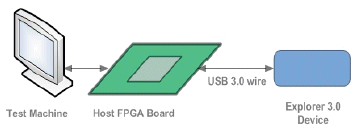
The Explorer 3.0 Emulation Suite consists of the Explorer Device along with a software API to control the Explorer Device. A suite of pre-written tests run on a test machine that has an XHCI driver installed. The suite provides a wide range of pre-written tests that cover Bulk and Isochronous transfers with configurations that cover various aspects such as link and protocol error injection, bursting of data, flow control cases, STALL cases, low power cases, concurrent operation of endpoints, Bulk stream protocol etc. These tests can run with production software (drivers, firmware and operating system) and hence provide comprehensive testing and high degree of confidence over your design.
The Explorer 3.0 Emulation Suite provides a comprehensive and convenient environment for:
- Emulation Testing
- Firmware Development
- Protocol Compliance
- Performance Benchmarking
The Explorer 3.0 Emulation Suite helps you shorten your design cycle and also reduces the risk of bugs being shipped with silicon:
- Run hours of regressions covering billions of cycles
- Quickly test Host behavior using pre-written tests
- Test your design with real software – firmware as well as drivers
- Lightning fast emulation debug cycles as issues can be quickly re-created
Testing with the Explorer 3.0 Emulation Suite has many benefits over testing with off the shelf USB devices. Off the shelf USB devices do not provide features such as:
- Link level error injection (inject CRC errors, framing errors, link retry, recovery, etc)
- Protocol level error injection (cause data retry, STALL/endpoint reset, flow control cases, etc)
- Advanced Features (such as Bulk-Streaming)
- Enables concurrent testing of multiple endpoints
- Controllable device behavior to create specific test scenarios
About Arrow Devices:
Arrow Devices provides Design & Verification Products and services for ASIC/SOC development to corporations globally. We are experts in high-speed interfaces (USB 3.0 and DDR2/DDR3) as well as popular system buses (AXI, AHB, PLB). We leverage our strong skill set to deliver high quality intellectual property solutions.
Related Semiconductor IP
- 250nA-88μA Current Reference - X-FAB XT018-0.18μm BCD-on-SOI CMOS
- UCIe D2D Adapter & PHY Integrated IP
- Low Dropout (LDO) Regulator
- 16-Bit xSPI PSRAM PHY
- MIPI CSI-2 CSE2 Security Module
Related News
- Cadence USB 3.0 Host Solution on TSMC 16nm FinFET Plus Process Achieves Industry Certification
- Innovative Logic Inc. and M31 Technology Introduce a USB-IF Certified Complete SuperSpeed USB 3.0/2.0 Dual Role IP Solution
- Orange Tree announces SuperSpeed USB 3.0 FPGA module
- USB 4.0, USB 3.2, USB 3.1, USB 3.0, USB 2.0, Device, Hub, Host & Dual Mode proven Interface IP Controllers are available immediately to License
Latest News
- Crypto Quantique and Attopsemi Unite PUF and I-fuse® OTP technology to Deliver Zero-Overhead Device Enrollment on FinFET Technology
- Arasan Announces immediate availability of its UFS 5.0 Host controller IP
- Bolt Graphics Completes Tape-Out of Test Chip for Its High-Performance Zeus GPU, A Major Milestone in Reducing Computing Costs By 17x
- NEO Semiconductor Demonstrates 3D X-DRAM Proof-of-Concept, Secures Strategic Investment to Advance AI Memory
- M31 Collaborates with TSMC to Achieve Tapeout of eUSB2V2 on N2P Process, Advancing Design IP Ecosystem