How Europe Navigates Geopolitics in Pursuit of Semiconductor Sovereignty
By Anne-Françoise Pelé, EETimes | December 2, 2025
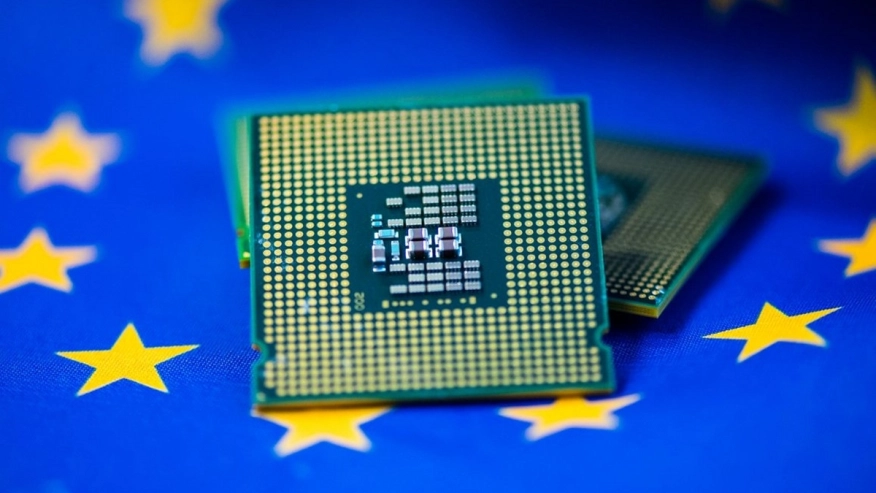
The global semiconductor industry is on track to reach $1 trillion in revenue by 2030. Acknowledging the strategic value of semiconductor technologies and aiming to reduce external dependencies, governments around the world have introduced “chips acts” and sizable incentive packages to support the return of chip design and manufacturing to their own regions.
In Europe, the quest for technological sovereignty has become a major investment focus. The €43 billion EU Chips Act is catalyzing national projects and multinational alliances to build continental capacity across chip design, manufacturing, and advanced packaging. For example, ESMC, a joint venture among TSMC, NXP Semiconductors, Infineon Technologies, and Robert Bosch, is pursuing construction of a €10 billion 300-mm wafer fab in Dresden, Germany; GlobalFoundries anticipates a €1.1 billion investment to increase production capacity at its Dresden site to over 1 million wafers per year by 2028; and Infineon is expanding its Dresden operations, investing €4.46 billion in a fab for discrete power devices and analog/mixed-signal ICs. Looking south, STMicroelectronics is investing €5 billion in a SiC chip fab in Catania, Sicily, with €2 billion in approved state funding, while Singapore’s Silicon Box is setting up a €3.2 billion chiplet fab in Novara, Italy.
To read the full article, click here
Related Semiconductor IP
- DeWarp IP
- 6-bit, 12 GSPS Flash ADC - GlobalFoundries 22nm
- LunaNet AFS LDPC Encoder and Decoder IP Core
- ReRAM NVM in DB HiTek 130nm BCD
- UFS 5.0 Host Controller IP
Related News
- Intel Retreat Shifts Europe Semiconductor Reality
- The 2025 deals reshaping the semiconductor industry
- NEC Electronics Europe introduces µClinux operating system for System-on-Chip Lite+
- ARC Technology Chosen by Fujitsu Microelectronics Europe For Next-Generation Consumer Applications
Latest News
- Global Semiconductor Sales Increase Substantially in February
- Hardware Root of Trust Essential for AI Chip Integrity
- AI Compute Demand Drives 44% YoY Growth for Top 10 Global Fabless IC Firms in 2025
- IBM Announces Strategic Collaboration with Arm to Shape the Future of Enterprise Computing
- Rambus Unveils HBM4E Controller: 16 GT/s, 2,048-Bit Interface, Enabling C-HBM4E