NB-IoT Transceiver IP
Filter
Compare
15
IP
from
5
vendors
(1
-
10)
-
NB-IoT (LTE Cat NB1) Transceiver
- The NB-IoT (LTE Cat NB1) Transceiver is built to comply with the Release 13 standard from 3GPP. It can also operate in a Release-14-compliant mode.
- Both the transmitter and the receiver offer performances that meets or exceeds the 3GPP specifications with comfortable margin.
-
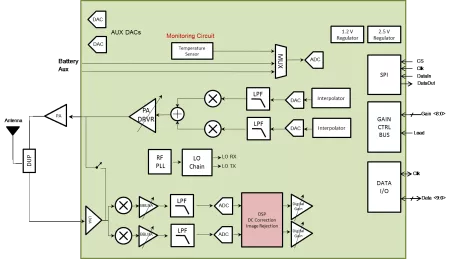
Narrow band - IoT Ultra-Low power UE RF Transceiver IP
- Frequency Range: 100MHz - 2.6GHz
- Bandwidth Range: 180KHz ~ 20MHz
- Silicon proven in TSMC 40ULP
- Supports both HD-FDD/TDD modes.
-
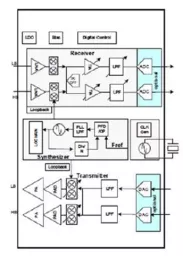
LTE Cat-1 bis (200 MHz – 2.5 GHz) wideband transceiver supporting TDD, FD-FDD, and HD-FDD operation—suitable for SDR implementations requiring flexible duplexing architecture.
- The SDR transceiver IP provides wideband, programmable RF front-ends for multi-standard wireless platforms
- These architectures support NB-IoT, Cat-M, custom modem protocols, and future-proof waveform development
- Features include dynamic bandwidth scaling, reconfigurable synthesizers, and digitally assisted calibration for robust performance across process, voltage, temperature, and environmental variations.
-
Low-power SDR 200 MHz – 2.5 GHz TRX + PA, supporting Cat-M, NB-IoT, 802.15.4g, 802.11ah, and other programmable modem back-ends.
- The SDR transceiver IP provides wideband, programmable RF front-ends for multi-standard wireless platforms
- These architectures support NB-IoT, Cat-M, custom modem protocols, and future-proof waveform development
- Features include dynamic bandwidth scaling, reconfigurable synthesizers, and digitally assisted calibration for robust performance across process, voltage, temperature, and environmental variations.
-
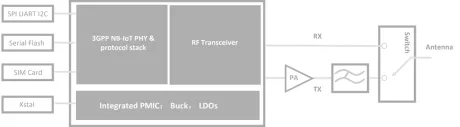
NB-IoT IP
- Single supply voltage: 1.1V to 1.8V
- Operating junction temperature: -40ºC to 85ºC
- RF output power: +5dBm
-
Narrow band - IoT Release-14 e-NodeB PHY. (L1) IP
- 3GPP Rel-14 Cat-NB UE Solution
- FDD Support
- Single Antenna Tx and Rx
- 200 KHz Bandwidth
-
UE LTE (Cat-0 – Cat-5) / 3G + GPS multi-mode transceiver suitable for SDR frameworks requiring GNSS integration, 400 MHz – 2.8 GHz.
- The SDR transceiver IP provides wideband, programmable RF front-ends for multi-standard wireless platforms
- These architectures support NB-IoT, Cat-M, custom modem protocols, and future-proof waveform development
- Features include dynamic bandwidth scaling, reconfigurable synthesizers, and digitally assisted calibration for robust performance across process, voltage, temperature, and environmental variations.
-
UE LTE (Cat-0 – Cat-5) / 3G wideband transceiver for flexible SDR pipelines, 400 MHz – 2.8 GHz.
- The SDR transceiver IP provides wideband, programmable RF front-ends for multi-standard wireless platforms
- These architectures support NB-IoT, Cat-M, custom modem protocols, and future-proof waveform development
- Features include dynamic bandwidth scaling, reconfigurable synthesizers, and digitally assisted calibration for robust performance across process, voltage, temperature, and environmental variations.
-
Wideband 2×2 MIMO transceiver, 400 MHz – 3.6 GHz, suitable for SDR-style eNodeB designs.
- The SDR transceiver IP provides wideband, programmable RF front-ends for multi-standard wireless platforms
- These architectures support NB-IoT, Cat-M, custom modem protocols, and future-proof waveform development
- Features include dynamic bandwidth scaling, reconfigurable synthesizers, and digitally assisted calibration for robust performance across process, voltage, temperature, and environmental variations.
-
4th Generation Software Defined Radio RF IP
- Frequency Range: 200MHz - 7.3GHz
- Supports HD-FDD/TDD modes.
- Low phase-noise Frac-N synthesizer
- Fast PLL for frequency hopping