Overview
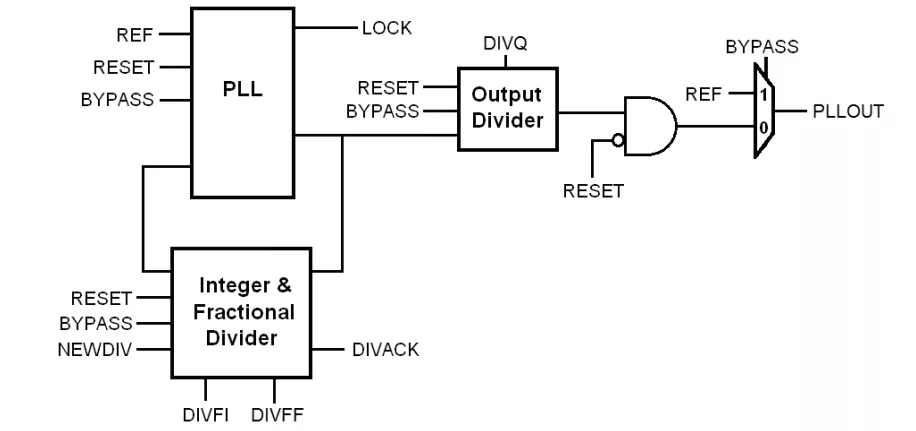
A programmable on-the-fly Fractional-N PLL is required to lock to an incoming clock source and produce an output clock. The generated clock needs to be locked to the input source but maintain a high-degree of precision, hence an on-the-fly programmable fractional feedback divider is required (“on the fly” meaning the frequency transition and re-obtaining lock process for small frequency adjustment is glitch free and contains limited frequency over/undershoot).
The Fractional-N PLL macro is implemented in Analog Bits’ proprietary architecture that uses core and IO devices. The PLL resides inside the IO ring that includes two analog power supply pads, occupying no core area. In order to minimize noise coupling and maximize ease of use, the PLL incorporates a proprietary ESD structure, which is proven in several generations of processes. Eliminating band-gaps and integrating all on-chip components such as capacitors and ESD structures, helps the jitter performance significantly and reduces stand-by power. The Fractional-N PLL macro fits into any standard IO pad pitch and can be implemented in staggered and in-line IO configurations.
PLL Operational Range Description Symbol Min Typ Max Units Input Frequency FREF 5 60 MHz Post-Divide Reference frequency FPFD 7 200 MHz VCO Frequency FVCO 2400 MHz Output Frequency FOUT 20 1200 MHz Output Duty Cycle tDO 45 55 % Total area of macro (excluding bond pad area) A 0.024 sq. mm May vary depending on size of IO slots Chip core area requirement CA 0 sq. mm Total Power IDD 3 mA Operational Voltage (Digital) VDIG 0.99 1.1 1.21 V Operational Voltage (Analog) VANA 3.0 3.3 3.6 V Operational Temperature TOP -40C 25 175 C Table 1: PLL Operational Range
Learn more about PLL IP core
How do you ensure that every part of a system receives the clock it needs—without wasting power or sacrificing performance? The answer lies in creating a well-structured frequency plan built around a PLL.
Jian Yang, Sween Kang (Synopsys)
This white paper is aimed at system architects and physical implementation leaders working on the design of SoCs. It can be confusing to understand the impact of different jitter sources and how to calculate a jitter budget when specifying a digital system. This white paper explains how jitter changes the period of a clock and how to ensure that jitter has correctly been accounted for in the calculations for timing closure.
This article explains a some of the key terminology and parameters commonly used to describe jitter. It will also help clarify the most important parameters for a some PLL applications, allowing the designer to better understand what is required from a PLL.
In high end RF systems, such as 5G radios, the requirements are so stringent that the source of this strongest unwanted tone can be the PLL. This article outlines how spurs in the input clock to the ADC or DAC may limit the SFDR. This in turn will set the requirements for the spurs for the input clock (from a PLL), in order to achieve a specific SFDR.
This article compares analog, first-generation digital, and second-generation digital PLLs. It evaluates which type of PLL may be best in which situation. It further discloses a roadmap into other application areas, including general purpose / logic clocking, and regular low-jitter PLLs.