Vendor: T2M GmbH Category: ADC

Wide-band Analog-to-Digital Converter

This is a wide-band Analog-to-Digital Converter based on 16 Time-Interleaved Pipeline sub-ADC followed by a digital correction al…

Overview

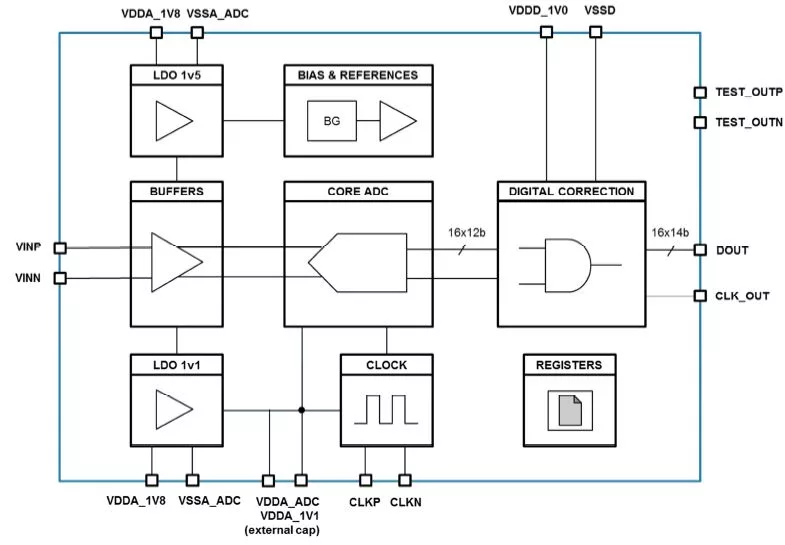
This is a wide-band Analog-to-Digital Converter based on 16 Time-Interleaved Pipeline sub-ADC followed by a digital correction algorithm for gain, offset and skew correction. The differential input is terminated by a 100 Ohms resistor (100 Ohms differential) and followed by an input buffer driving the sub-ADC. The signal amplitude is 1Vpp differential. The analog source driving the ADC shall be ac-coupled to the input pins with two external capacitors of 1nF minimum. The input common-mode is generated internally. The input clock is a differential signal with amplitude of 800mVpp differential.

The ADC includes two internal power supply regulators (LDO) for the analog part:

- A 1.1v LDO with external decoupling capacitor to reach a high power rejection ratio

- A 1.5v LDO with internal capacitor for the input buffer and biasing.

The digital part is supplied by the external 1.0V.The digital corrector receives the 16 sub-ADC 12b outputs and delivers 14b for each output. Hence, the output data are organized in 16x14b–buses clocked at 270MHz (Fs/16). Each bus gives the data coming from a specific sub-ADC in a 2’s complemented format (range is [-2N-1; 2N-1-1]). A data ready clock is provided at 270MHz (Fs/16).

Key features

  • 14-bit Time-Interleaved Pipeline ADC
  • 4.32GSps Sampling Rate
  • 60dBFS SNR (9.7 ENOB) with 54MHz<Fin<1794MHz
  • External AC coupling for the input signal
  • Two power supplies: 1.8V for analog and 1.0V for digital compensation
  • 1.0Vpp differential full-scale input
  • Buffered analog inputs
  • Input signal bandwidth: 54MHz to 1794MHz
  • Power down mode
  • 16x14bits data output at 270 MHz (4.32GHz/16)
  • Data ready output at 270MHz
  • Twos complement data format
  • Size:Under NDA
  • Power Consumption:
  • Analog: 218-460 mW on 1.8V supply
  • Digital: 276-491 mW on 1.0V supply
  • Total: 495-951 mW
  • Technology: Under NDA
  • Device types: GO1 (LVT, RVT), GO2 (31Ang, 1V8), MIM Capacitor
  • DK2.5d

Block Diagram

What’s Included?

  • Detailed Specification and Integration guide
  • LEF abstract
  • GDSII layout and Mapping files
  • LVS compatible Netlist
  • Verilog-A Model

Specifications

Identity

Part Number
Wide band 14-bit ADC
Vendor
T2M GmbH
Type
Silicon IP

Provider

T2M GmbH
T2M GmbH is the leading Global Technology Company supplying state of the art complex semiconductor connectivity IPs and KGDs, enabling the creation of complex connected devices for Mobile, IoT and Wearable markets. T2M's unique SoC White Box IPs are the design database of mass production RF connectivity chips supporting standards including Wifi, BT, BLE, Zigbee, NFC, LTE, GSM, GNS. They are available in source code as well as KGD for SIP / modules. With offices in USA, Europe, China, Taiwan, South Korea, Japan, Singapore and India, T2M’s highly experienced team provides local support, accelerating product development and Time 2 Market.

Learn more about ADC IP core

Uncertainty-Guided Live Measurement Sequencing for Fast SAR ADC Linearity Testing

This paper introduces a novel closed-loop testing methodology for efficient linearity testing of high-resolution Successive Approximation Register (SAR) Analog-to-Digital Converters (ADCs). Existing test strategies, including histogram-based approaches, sine wave testing, and model-driven reconstruction, often rely on dense data acquisition followed by offline post-processing, which increases overall test time and complexity.

Three ways of looking at a sigma-delta ADC device

The growing availability of digital ICs like microcontrollers, microprocessors, and field-programmable gate arrays (FPGAs) allows developers to use complex digital processing techniques rather than analog signal conditioning. For this reason, analog-to-digital converters (ADCs) have become a widely-used component in mixed-signal circuits.

Specifying a PLL Part 1: Calculating PLL Clock Spur Requirements from ADC or DAC SFDR

In high end RF systems, such as 5G radios, the requirements are so stringent that the source of this strongest unwanted tone can be the PLL. This article outlines how spurs in the input clock to the ADC or DAC may limit the SFDR. This in turn will set the requirements for the spurs for the input clock (from a PLL), in order to achieve a specific SFDR.

Save power in IoT SoCs by leveraging ADC characteristics

Power-sensitive applications such as Internet-of-Things (IoT) require a comprehensive power savings strategy within the system-on-chip (SoC). Techniques relying solely on the use of traditional power down modes and low supply voltage may not be enough to achieve the required power targets. The analog block is often assumed to be too sensitive and not compatible with aggressive power management techniques.

High Speed ADC Data Transfer

When continuously running a high speed ADC, it can be a challenge to deal with the firehose of raw data available at the output. To use City Semiconductor’s 2.5 GS/s 12-bit ADC, for example, 30 gigabits per second of data have to be accepted.

Frequently asked questions about ADC IP cores

What is Wide-band Analog-to-Digital Converter?

Wide-band Analog-to-Digital Converter is a ADC IP core from T2M GmbH listed on Semi IP Hub.

How should engineers evaluate this ADC?

Engineers should review the overview, key features, supported foundries and nodes, maturity, deliverables, and provider information before shortlisting this ADC IP.

Can this semiconductor IP be compared with similar products?

Yes. Buyers can compare this product with similar semiconductor IP cores or IP families based on category, provider, process options, and structured technical specifications.

×
Semiconductor IP