Vendor: Comcores Category: Single-Protocol PHY

Universal Serial 10GE Media Independent Interface (USXGMII)

The USXGMII PCS IP provides the logic required to integrate a USXGMII-M IP into any system on chip (SoC).

Overview

The USXGMII PCS IP provides the logic required to integrate a USXGMII-M IP into any system on chip (SoC). Link speeds of 5G, 10G, or 20G are supported. Compliant with the Cisco Universal SXGMII Interface for multiple Multi-Gigabit Copper Network Ports and IEEE 802.3 Clause 49 standards, the PCS IP has several optional features to customize the physical coding sublayer (PCS) for the specific needs of any application.

There are options to include support for RS-FEC forward error correction (RSFEC), as per IEEE 802.3 Clause 108, and access to control and status registers through an APB interface.

The PCS IP is engineered to be quickly and easily integrated into any SoC, and to connect seamlessly to a demultiplexed MAC through multiple XGMII (32-bit data, 4-bit control, single clock-edge interfaces). Connection to the SerDes is through a configurable 16, 20, 32, 40, or 64-bit interface. 

Key features

Delivering Performance

  • SerDes rates of 5.15625Gbps, 10.3125Gbps and 20.625Gbps with data widths of 16, 20, 32, 40, and 64 bits

Highly Configurable

  • Multispeed multi-port or single-port USXGMII interface
  • Supporting 100Mbps and 1/2.5/5/10Gbps Ethernet data rates
  • Clause 37-type auto-negotiation for link status notification
  • Scrambled idle test pattern generator and checker
  • 64b/66b encoding/decoding
  • Optional clock tolerance compensation on receive (RX) path
  • Configurable as a 5GBASE-R or 10GBASE-R PCS compliant with IEEE 802.3
  • Clauses 49 and 129
  • Data scrambling on transmit (TX) path and descrambling on RX path
  • Optional RS-FEC (Clause 108)
  • Optional APB control status register interface

Easy to use

  • ASIC proven
  • Lint/CDC optimized
  • UVM regression tested with full coverage
  • Customizable with easy integration
  • Extremely Compact
  • Connection to multiple multi Gigabit Ethernet MACs using demultiplexed
  • XGMII interfaces

Silicon Agnostic

  • Designed in Verilog and targeting both ASICs and FPGAs

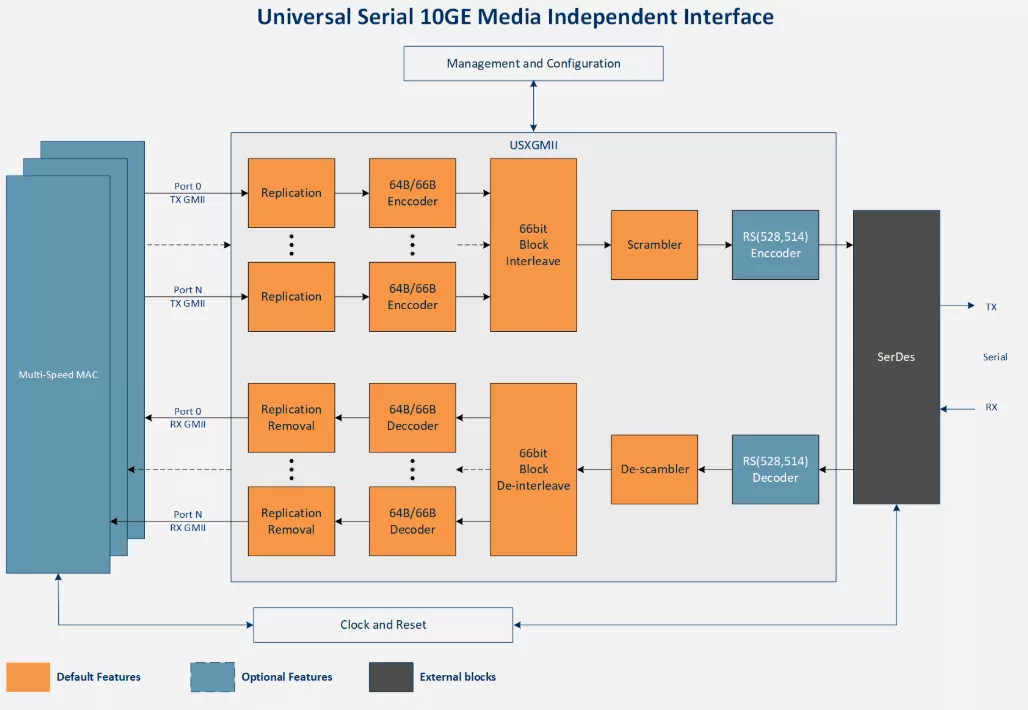
Block Diagram

What’s Included?

The IP Core can be delivered in Source code or Encrypted format. The following deliverables will be provided with the IP Core license:

  • IP in SystemVerilog, Source code or Encrypted RTL
  • Comprehensive documentation, including User Manual, Release Note and Product Brief
  • Simulation Environment, including basic test environment, test cases and test scripts
  • Software demo application, Complete Linux system with
    • Full integration into Linux
    •  Netconf for configuration & management
  • Software drivers, C code, Linux device driver, FreeRTOS driver
  • IEEE 802.1AS software stack, C code
  • Demo: Complete example design targeted AMD/Xilinx ZCU102 hardware platform, with other hardware platforms on request
  • Access to support system and direct support from Comcores Engineers
  • Timing Constraints in Synopsys SDC format (optional)
  • Synopsys Lint (optional)
  • Synopsys Lint waiver (optional)

Files

Note: some files may require an NDA depending on provider policy.

Specifications

Identity

Part Number
Universal Serial 10GE Media Independent Interface (USXGMII)
Vendor
Comcores

Provider

Comcores
HQ: Denmark
Comcores is a market leader in the development of state-of-the-art IP-cores for communication systems. The company is a leading provider of digital components for high-speed digital connectivity between wireless communication network components as well as radio functionality in existing and next-generation mobile infrastructure networks. Comcores offers leading IP cores solutions, expertise in research and development as well as custom design solutions.

Learn more about Single-Protocol PHY IP core

UFS Goes Mainstream

UniversalFlash Storage (UFS) was created for mobile applications and computer systems requiring high performance and low power consumption. These systems typically use embedded Flash based on the JEDEC standard eMMC. UFS was defined by JEDEC as the evolutionary replacement for eMMC offering significantly higher memory bandwidth. The standard builds on existing standards such as the SCSI command set, the MIPI Alliance M-PHY and UniPro as well as eMMC form factors to simplify adoption and development.

Design IP Faster: Introducing the C~ High-Level Language

In this paper, we introduce a new high-level, dataflow programming language called C~ (“C flow”) that further increases productivity by raising the level of abstraction from behavioral descriptions, while overcoming the limitations of C for hardware design. We present the syntax and semantics of this language, and the framework that provides hardware and software code generation. This paper illustrates the benefits of using C~ for hardware design of a IEEE 802.3 MAC, synthesized for FPGA and for 90nm CMOS technology.

Universal Flash Storage: Mobilize Your Data

Universal Flash Storage (UFS) was created for mobile applications and computer systems requiring high performance and low power consumption. These systems typically use embedded Flash based on the JEDEC standard eMMC. UFS was defined by JEDEC as the evolutionary replacement for eMMC offering significantly higher memory bandwidth. The standard builds on existing standards such as the SCSI command set, the MIPI Alliance M-PHY and UniProSM as well as eMMC form factors to simplify adoption and development.

Can MIPI and MDDI Co-Exist?

Since MIPI and MDDI standards both target interfaces to cameras and displays on mobile devices, are two separate standards really needed?

Frequently asked questions about Single-Protocol PHY IP

What is Universal Serial 10GE Media Independent Interface (USXGMII)?

Universal Serial 10GE Media Independent Interface (USXGMII) is a Single-Protocol PHY IP core from Comcores listed on Semi IP Hub.

How should engineers evaluate this Single-Protocol PHY?

Engineers should review the overview, key features, supported foundries and nodes, maturity, deliverables, and provider information before shortlisting this Single-Protocol PHY IP.

Can this semiconductor IP be compared with similar products?

Yes. Buyers can compare this product with similar semiconductor IP cores or IP families based on category, provider, process options, and structured technical specifications.

×
Semiconductor IP