Vendor: CSEM Category: CPU

Ultra-low-power Processor based on RISC-V Architecture

The icyflex-V processor is a new ultra-low-power core based on the RISC-V 32-bit ISA, a long-awaited addition to the CSEM icyflex…

Overview

The icyflex-V processor is a new ultra-low-power core based on the RISC-V 32-bit ISA, a long-awaited addition to the CSEM icyflex processor family, compatible with off-the-shelf open-source and/or proprietary programming tools. This new development represents a cost effective yet performing alternative to proprietary cores for next-generation ultra-low-power system-on-chip developments. The core was optimized for performance, code density and power consumption and delivers up to 3.2 CoreMark/MHz while consuming as low as 14 uA/MHz in TSMC 55 nm low-power process.

The icyflex-V is a classical 4-stage pipeline (fetch, decode, execute and write-back, Figure 1), implementing the RV32IMC ISA, i.e., a 32-bit integer core supporting the compressed instructions and multiplications. Data forwarding is implemented to avoid pipeline stalls on both ALU outputs and load-store (LSU) outputs caused by read-after-write dependencies. The main target of the core is to be embedded efficiently with a small footprint in ultra-low-power system-on-chip. The main criteria are thus an excellent code density (thanks to compressed instruction) and a limited gate-count achieving good performances. Several options were further taken to reduce the gate-count: the M extension of the ISA is implemented without hardware support for division, which would imply a significant number of gates for a feature not largely used in embedded applications. Similarly, floating-point is left as software emulation to reduce gate-count. In order to achieve state-of-the-art performance though, the 4 stage pipeline was preferred over a 2 stage pipeline that would assuredly be more compact but which would have degraded performances drastically. Similarly, the instruction prefetch buffer implements a simple yet effective branch prediction mechanism that improves the core efficiency at a reasonable gate-count cost.

With these choices, the core achieves a remarkable 3.2 CoreMark/MHz with maximum compiler optimizations, or a 2.8 CoreMark/MHz in balanced performance/code density mode, when using the open-source GCC compiler. The core also reaches a 1.36 DMIPS/MHz. Vendor specific compilers (e.g., IAR) can also be used with the icyflex-V.

Currently, the icyflex-V does not implement non-standard extensions, aiming at keeping a de-facto compatibility with off- the-shelf tools. Specific non-standard extensions might however be added in the future and be used as "intrinsic" assembly instructions to accelerate application specific systems. This could be done seamlessly, without requiring to customize standard compilers.

A debug interface based on the official specification allows to interface the system to on-chip debug tools through a 4-wire JTAG interface. Triggers can optionally be implemented to allow placing breakpoints in flash memories, or to perform data watchpoints. Both open-source software (OpenOCD, GDB, MCU Eclipse) and proprietary tools are supported (Segger Jlink/Embedded Studio, Lauterbach Trace32, IAR Embedded Workbench) by this standard debug interface.

The icyflex-V comes with several peripherals (bus controllers, serial and communication interfaces) that allow customizing systems based on customer requirements. The subsystem can be easily extended with external IP using standard peripheral busses such as APB.

The core is silicon-proven, and an evaluation FPGA-based platform is available. The core is currently being integrated in first customer products and evaluation of its performance in subthreshold libraries is ongoing, paving the way to new ultra low-power records.
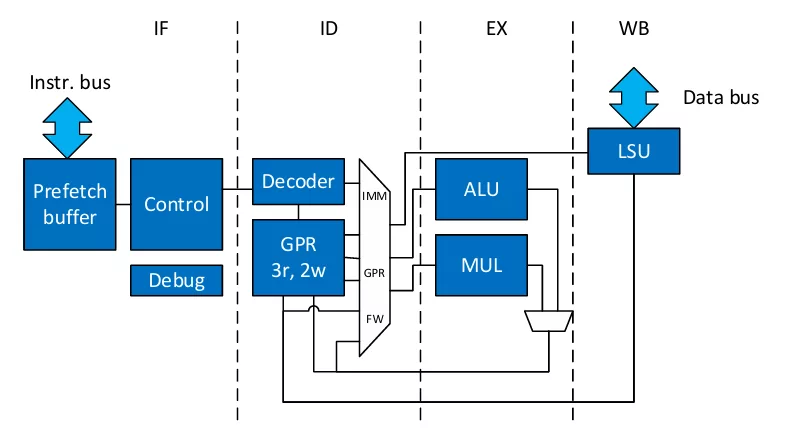

Block Diagram

Files

Note: some files may require an NDA depending on provider policy.

Specifications

Identity

Part Number
icyflex
Vendor
CSEM
Type
Silicon IP

Provider

CSEM
HQ: Switzerland
CSEM is one of Europe’s leading low power ASIC design providers. With roots in the Swiss watch industry, CSEM is today an acknowledged reference in the fields of ultra low power and low-voltage analog, digital and mixed-signal ASIC design. Our strengths include: • Low power, low voltage RF & analog IC and SoC (e.g. 2mA Rx current radio) • Ultra low power RISC cores (e.g. 6µW/MHz in 65nm) • Smart vision sensors with edge computing • System-on-Chip integration & embedded software development Our expert designers have proven experience in translating customer requirements into high-quality ASIC designs to optimize cost, performance and time-to-market in close cooperation with the customer. Our proven design flow is complemented by state of the art design tools and measurement equipment to ensure quality and on-time delivery. CSEM provides a flexible engagement model, ranging from licensing of our ultra low power IP’s (e.g. icyflexTM 32-bit MCU/DSP core, low-leakage memories, etc) and customized analog IP block design for semiconductor vendors, through to full-custom ASIC and SoC design and delivery. Our fabless production service offers industrialization, test, qualification and small series production. We work with most of the major foundries, and cover technology nodes from 0.25µm down to 22nm CMOS. Served markets include portable medical, industrial, consumer, home automation and automated meter reading.

Learn more about CPU IP core

Announcing Arm AGI CPU: The silicon foundation for the agentic AI cloud era

For the first time in our more than 35-year history, Arm is delivering its own silicon products – extending the Arm Neoverse platform beyond IP and Arm Compute Subsystems (CSS) to give customers greater choice in how they deploy Arm compute – from building custom silicon to integrating platform-level solutions or deploying Arm-designed processors.

Encarsia: Evaluating CPU Fuzzers via Automatic Bug Injection

Hardware fuzzing has recently gained momentum with many discovered bugs in open-source RISC-V CPU designs. Comparing the effectiveness of different hardware fuzzers, however, remains a challenge: each fuzzer optimizes for a different metric and is demonstrated on different CPU designs.

Pie: Pooling CPU Memory for LLM Inference

Pie maintains low computation latency, high throughput, and high elasticity. Our experimental evaluation demonstrates that Pie achieves optimal swapping policy during cache warmup and effectively balances increased memory capacity with negligible impact on computation. With its extended capacity, Pie outperforms vLLM by up to 1.9X in throughput and 2X in latency. Additionally, Pie can reduce GPU memory usage by up to 1.67X while maintaining the same performance. Compared to FlexGen, an offline profiling-based swapping solution, Pie achieves magnitudes lower latency and 9.4X higher throughput.

Frequently asked questions about CPU IP cores

What is Ultra-low-power Processor based on RISC-V Architecture?

Ultra-low-power Processor based on RISC-V Architecture is a CPU IP core from CSEM listed on Semi IP Hub.

How should engineers evaluate this CPU?

Engineers should review the overview, key features, supported foundries and nodes, maturity, deliverables, and provider information before shortlisting this CPU IP.

Can this semiconductor IP be compared with similar products?

Yes. Buyers can compare this product with similar semiconductor IP cores or IP families based on category, provider, process options, and structured technical specifications.

×
Semiconductor IP