Vendor: Weebit Nano Category: MRAM / RRAM

ReRAM NVM in SkyWater 130nm

Weebit Resistive RAM (ReRAM) is a new type of Non-Volatile Memory (NVM) that is designed to be the successor to flash memory.

SkyWater 130nm S130 Silicon Proven View all specifications

Overview

Weebit Resistive RAM (ReRAM) is a new type of Non-Volatile Memory (NVM) that is designed to be the successor to flash memory. Weebit ReRAM IP can provide a high level of differentiation for System-on-Chip (SoC) designs, with performance, power, cost, security, environmental, and a range of additional advantages compared to flash and other NVMs.

Weebit’s ReRAM IP product is available now in SkyWater Technology’s 130nm CMOS process (S130).

The technology is fully qualified, both per JEDEC and AEC-Q100, available for integration in SkyWater users’ SoCs, and ready for production.

SkyWater 130nm CMOS Process

SkyWater is a U.S. investor-owned semiconductor manufacturer and a DMEA accredited Category 1A Trusted Foundry. The company’s proven CMOS technologies have enabled novel and disruptive products across demanding automotive, industrial, medical and defense markets for decades. These technologies run in high volume and at world-class quality levels, as demonstrated by SkyWater’s numerous quality-driven certifications. With Weebit ReRAM IP, SkyWater customers can develop highly integrated SoCs at ultra-low power for a new generation of advanced products. SkyWater’s 130nm technology node is a dual-gate technology with 1.8V and 3.3V/5.0V devices. The technology supports up to five aluminum metal layers and is mixed signal enabled with native, extended drain, NPN and PNP BJTs, inductors, MIMs, etc. The technology offers a variety of thresholds to optimize for power and performance.

Getting Started

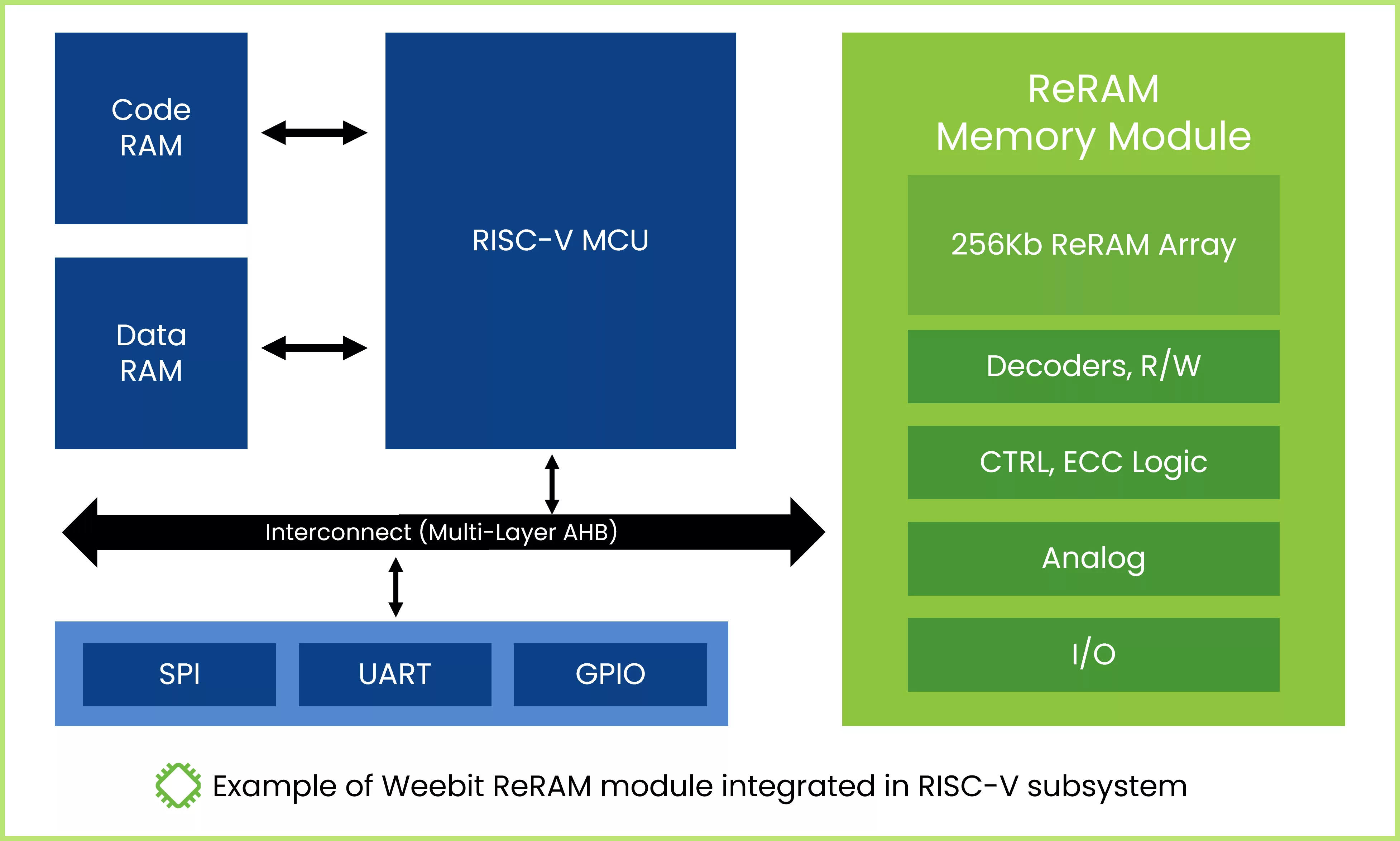
Weebit ReRAM IP is delivered as an embedded module with a complete set of collateral and EDA views to enable smooth integration by SoC architects using state-of-the-art EDA tools. Upon request, the module is available as part of a complete subsystem including a RISC-V microcontroller (MCU), system interfaces, Static Random-Access Memory (SRAM), and peripherals.

Weebit ReRAM technology is highly scalable and customizable by storage capacity, foundry, and process node. In addition to being available in SkyWater’s 130nm CMOS process, the technology is fully qualified in 130nm in CEA-Leti’s state-of-the-art fab. It has also been proven in 28nm and taped-out in an advanced 22nm FD-SOI process.

 Specifications

Technology 130nm, SkyWater S130
Mask Adder 2
Supply Voltage 1.8V Read, 1.8V+3.3/3.6V Program
Read Access Time <20nsec
Operation Temp. -40°C to 150°C
Capacity 256 Kbit (can be customized for 128Kbit - 2Mbit)
Data Bus Width (Read) 32-bit (can be customized to 16-bit to 128-bit)
System Interface APB (can be customized AHB / AXI / OBI / QSPI)
Endurance (Write cycles) 100K
Data Retention ≥10 years @150°C

Key features

  • High write endurance, supporting applications with frequent memory updates
  • Excellent data retention, including at high temperatures
  • Ultra-low power consumption, including standby power
  • Fast access time for quick boot up
  • Fast programming, byte addressable
  • Tolerant to ionizing radiation and electromagnetic interference (EMI)
  • Inherently secure technology, deeply embedded between two metal layers

Block Diagram

Applications

Weebit ReRAM IP for the SkyWater S130 process can provide advantages for a broad number of customer applications including:

  • Analog, power management, mixed-signal designs
  • IoT, industrial, medical
  • Automotive
  • Aerospace and defense; radiation tolerant designs
  • Heterogenous computing
  • Data logging applications

Files

Note: some files may require an NDA depending on provider policy.

Silicon Options

Foundry Node Process Maturity
SkyWater 130nm S130 Silicon Proven

Specifications

Identity

Part Number
WBT-SKYT-S130-v256-ReRAM
Vendor
Weebit Nano

Provider

Weebit Nano
HQ: Israel
Weebit is a leading developer of advanced semiconductor memory technology, incorporated in Israel in 2015 and publicly traded on the Australian Stock Exchange (ASX: WBT). The company’s ground-breaking Resistive Random Access Memory (ReRAM or RRAM) addresses the growing need for higher-performance, more reliable, lower-power, and more cost-effective non-volatile memory (NVM) solutions in a range of electronic products. In developing its ReRAM technology, Weebit has partnered with CEA-Leti, the French research institute recognized as a global leader in the field of micro-electronics. Starting in 2016, Leti has played a key role in advancing the development of Weebit’s industry-leading ReRAM. Weebit licenses its technologies to semiconductor companies and foundries, using a typical IP licensing model supporting license fees, royalties, and non-recurring engineering fees (NRE). The technology is ideal for both embedded SoC designs, where ease of fabrication and integration of various size arrays is required, and for discrete memory chips, where memory density and cost per bit are top priority.

Learn more about MRAM / RRAM IP core

How to Elevate RRAM and MRAM Design Experience to the Next Level

This article will explore the potential advantages of RRAM and MRAM in various applications and elucidate why such new technologies are imperative to address future memory demands, as well as some challenges designers may encounter in the implementation.

NVMe IP for Enterprise SSD

Most of SSD manufacturers jumped into this new storage market with flash-based technology. A second wave of products will come in the near future, using a new generation of non-volatile memories, delivering impressive speed performances compared to NandFlash memories. The SSD manufacturers will have to deal with low latency SSD controller design in order to benefit from the new NVM features, while keeping high reliability and low power consumption. This white paper proposes a solution based on a full hardware NVMe implementation, describing its architecture, implementation and characterization.

Assessing Design Space for the Device-Circuit Codesign of Nonvolatile Memory-Based Compute-in-Memory Accelerators

Unprecedented penetration of artificial intelligence (AI) algorithms has brought about rapid innovations in electronic hardware, including new memory devices. Nonvolatile memory (NVM) devices offer one such attractive alternative with ∼2× density and data retention after powering off. Compute-in-memory (CIM) architectures further improve energy efficiency by fusing the computation operations with AI model storage. Electronic characteristics of NVM devices, like resistance in the two resistance states, directly affect the circuit designers’ decisions and result in the varying performance of NVM-CIM chips.

Frequently asked questions about MRAM / RRAM IP cores

What is ReRAM NVM in SkyWater 130nm?

ReRAM NVM in SkyWater 130nm is a MRAM / RRAM IP core from Weebit Nano listed on Semi IP Hub. It is listed with support for skywater Silicon Proven.

How should engineers evaluate this MRAM / RRAM?

Engineers should review the overview, key features, supported foundries and nodes, maturity, deliverables, and provider information before shortlisting this MRAM / RRAM IP.

Can this semiconductor IP be compared with similar products?

Yes. Buyers can compare this product with similar semiconductor IP cores or IP families based on category, provider, process options, and structured technical specifications.

×
Semiconductor IP