Vendor: Digital Blocks, Inc. Category: I2C / I3C

I2C Controller IP- Master / Slave, Parameterized FIFO, AXI Bus

The DB-I2C-MS-AXI Controller IP Core interfaces a microprocessor via the AMBA AXI Bus to an I2C Bus in Standard-Mode (100 Kbit/s)…

Overview

The DB-I2C-MS-AXI Controller IP Core interfaces a microprocessor via the AMBA AXI Bus to an I2C Bus in Standard-Mode (100 Kbit/s) / Fast-Mode (400 Kbit/s) / Fast-Mode Plus (1 Mbit/s) / Hs-Mode (3.4+ Mb/s) / Ultra Fast-Mode (5 mbit/s).

The I2C is a two-wire bidirectional interface standard (SCL is Clock, SDA is Data) for transfer of bytes of information between two or more compliant I2C devices, typically with a microprocessor behind the master controller and one or more slave devices.

The DB-I2C-MS-AXI is a Master / Slave I2C Controller that in Master Mode controls the Transmit or Receive of data to or from slave I2C devices while in Slave Mode allows an external I2C Master device to control the Transmit or Receive of data.

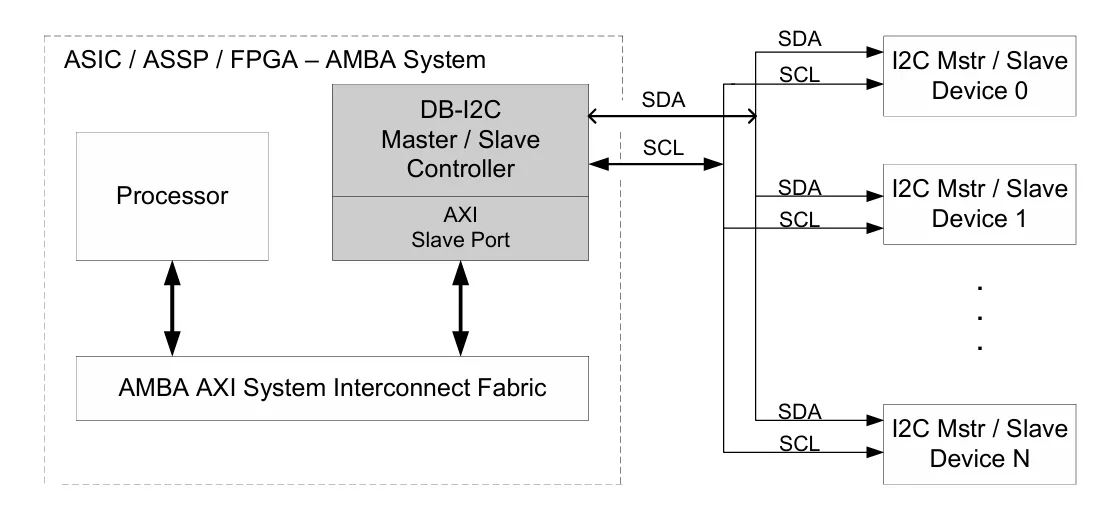
In an ASIC / ASSP / FPGA integrated circuit, typically, the microprocessor is an ARM processor, but can be any embedded processor. Figure 1 depicts the system view of the DB-I2C-MS-AXI Controller IP Core embedded within an integrated circuit device with its Microprocessor Configuration.

The DB-I2C-MS-AXI Controller IP Core targets embedded processor applications with higher performance algorithm requirements or I2C transfer requirements to a set of Registers or Memory. While most I2C controllers require high processor interaction involvement, the DB-I2C-MS-AXI contains a parameterized FIFO and Finite State Machine Control for the processor to off-load the I2C transfer to the DB-I2C-MS-AXI Controller. Thus, while the DB-I2C-MS-AXI in Master Mode is busy, independently controlling the I2C Transmit or Receive transaction of data, or in Slave Mode, allowing the external I2C Master device to control the Transmit or Receive of data, the processor can complete other tasks. All Master & Slave Mode Transmit / Receive transfers are with respect to the internal FIFO, thus fully isolating the processor from the I2C transfer of a block of data.

Key features

  • Master / Slave I2C Controller Modes:
    • Master – Transmitter
    • Master – Receiver
    • Slave – Transmitter
    • Slave – Receiver
  • Supports four I2C bus speeds:
    • Hs-Mode (3.4+ Mb/s)
    • Ultra Fast-Mode (5 mbit/s)
    • Fast Mode Plus (1 Mbit/s)
    • Fast Mode (400 Kb/s)
    • Standard Mode (100 Kb/s)
  • I2C compliant features:
    • Multi-Master, Clock Synchronization, Arbitration, SCL held low by Slave, Repeated Start, 7/10-bit addressing, & General Call Addressing
  • Parameterized FIFO memory for off-loading the I2C transfers from the processor:
    • Targets embedded processors with higher performance algorithm requirements, by the I2C Controller independently controlling theTransmit or Receive of bytes of information buffered to and from a FIFO.
  • System-level features & integration capabilities:
    • CPU Interface via parameterized FIFO with support for APB / AHB / AXI / AXI-lite / Avalon SoC Interconnect fabrics
    • Enhanced SCL / SDA spike filtering capabilities
    • Enhanced Repeated Start capabilities
  • Optional system-level features & integration capabilities:
    • DMA transfer between the I2C Bus & Memory (SDRAM / SRAM / FLASH)
    • Direct interface to user Registers within ASIC / ASSP / FPGA device, for Master/Slave transfer across the I2C Bus
    • Remote Configuration of a Digital Blocks’ I2C Slave by an I2C Master
    • SMBus Support:  SMBCLK Clock Low Timeout SMBDAT minimum data hold time
  • 13 sources of internal interrupts with masking control
  • Compliance with AMBA and I2C specifications:
    • Compliance with AMBA AXI Protocol Specification (V2.0)
    • Philips/NXP – The I2C-Bus Specification, Version 2.1, January 2000 and UM10204 Rev 7 – 1 Oct 2021
  • Fully-synchronous, synthesizable Verilog RTL core, with rising-edge clocking, no gated clocks, and no internal tri-states, for easy integration into FPGA or ASICdesign flows.

Block Diagram

Benefits

  • The DB-I2C-MS-AXI Controller IP Core targets embedded processor applications with high performance algorithm requirements. While most I2C controllers require high processor interaction involvement, the DB-I2C-MS-AXI contains a parameterized FIFO and Finite State Machine Control for the processor to off-load the I2C transfer to the DB-I2C-MS-AXI Controller. Thus, while the DB-I2C-MS-AXI is busy, independently controlling the I2C Transmit or Receive transaction of data, the processor can go off and complete other tasks.

What’s Included?

  • Verilog or VHDL RTL Source or technology-specific netlist.
  • Comprehensive testbench suite with expected results.
  • Synthesis scripts.
  • Installation & Implementation Guide.
  • Technical Reference Manual.

Specifications

Identity

Part Number
DB-I2C-MS-AXI
Vendor
Digital Blocks, Inc.
Type
Silicon IP

Files

Note: some files may require an NDA depending on provider policy.

Provider

Digital Blocks, Inc.
HQ: USA
Digital Blocks architects, designs, verifies, and markets semiconductor Intellectually Property (IP) cores to worldwide technology systems companies. The company's expertise is in Embedded Processor & Peripherals, Display Controller, Display Link Layer, 2D Graphics, Image Compression, Audio / Video Processing, and High-Speed Networking / A/V Networking & Routing / High-Frequency Trading Networking.

Learn more about I2C / I3C IP core

From I2C to I3C: Evolution of Two-Wire Communication in Embedded Systems

The I2C (Inter-Integrated Circuit) Bus invented in 1980 by Philips Semiconductors (NXP Semiconductors today) was a massive step forward in simplifying communications in embedded systems. It is a simple two-wire interface for synchronous, multi-master/multi-slave, single ended serial communication. Fast forward 45 years to today and it is still widely used for attaching low speed peripheral Integrated Circuits (ICs), processors and microcontrollers. But silicon today has changed...

Maximizing the Usability of Your Chip Development: Design with Flexibility for the Future

Early in my career selling chips for Motorola Semiconductor, the ability to spin derivative microcontroller chips for a customer’s specific requirement was relatively straightforward. If the volume looked reasonable, we would tape-out a new chip with a few added features because mask costs and wafers were relatively inexpensive at the larger process nodes. The customer won by getting an MCU tailored to their specific need, and Motorola won by gaining a more committed customer plus another SKU that could be sold to other customers – boosting ROI. With the migration to higher cost FinFET nodes, those times are long gone as the economics no longer work.

MIPI CCI over I3C: Faster Camera Control for SoC Architects

Imagine a camera subsystem that responds in microseconds, consumes less power, and offers a more straightforward route to time-to-market. For SoC architects and IP integration teams, that vision is increasingly possible with MIPI Camera Control Interface (CCI) over I3C.

Frequently asked questions about I2C / I3C IP cores

What is I2C Controller IP- Master / Slave, Parameterized FIFO, AXI Bus?

I2C Controller IP- Master / Slave, Parameterized FIFO, AXI Bus is a I2C / I3C IP core from Digital Blocks, Inc. listed on Semi IP Hub.

How should engineers evaluate this I2C / I3C?

Engineers should review the overview, key features, supported foundries and nodes, maturity, deliverables, and provider information before shortlisting this I2C / I3C IP.

Can this semiconductor IP be compared with similar products?

Yes. Buyers can compare this product with similar semiconductor IP cores or IP families based on category, provider, process options, and structured technical specifications.

×
Semiconductor IP