Overview
The GDDR7 controller IP core is designed for use in applications requiring high memory throughput including artificial intelligence/machine learning (AI/ML), graphics, high-performance computing (HPC).
It supports 160 Gigabytes per second (GB/s) throughput for a GDDR7 memory device enabling next-level performance for AI accelerators and GPUs using GDDR7 memory.
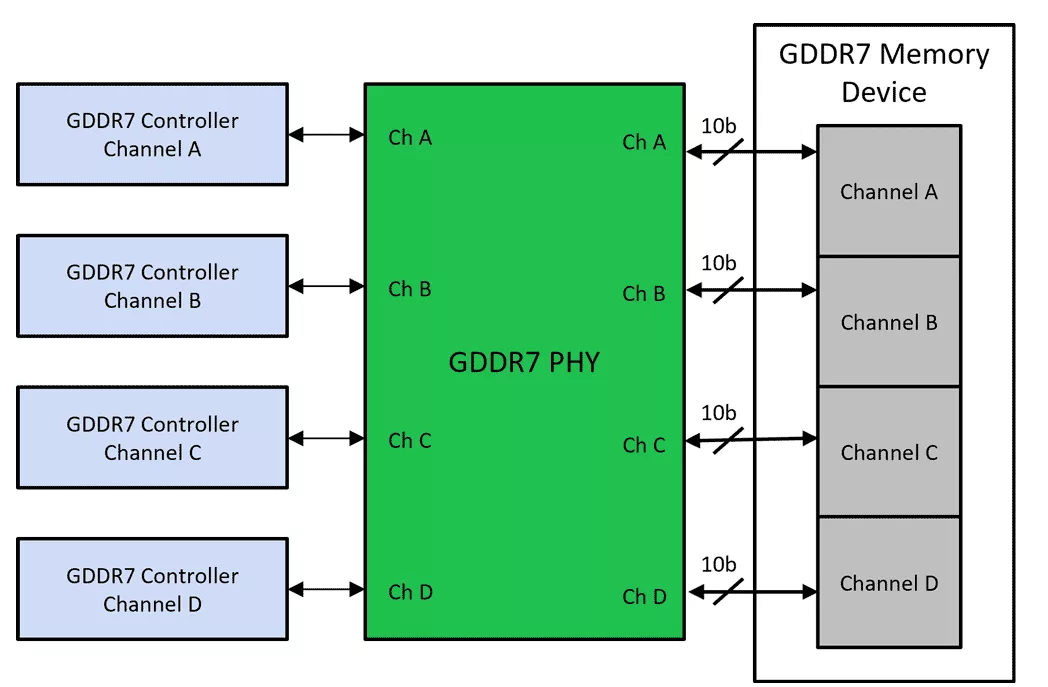
How a GDDR7 Memory Controller Implementation in a Subsystem works
The GDDR7 controller supports all GDDR7 link features including PAM3 and NRZ signaling. Optimized for high efficiency and low latency across a wide variety of traffic scenarios, it offers low-power support (self-refresh, hibernate self-refresh, dynamic frequency scaling, etc.) and Reliability, Availability and Serviceability (RAS) features such as end-to-end data path parity, parity protection for stored registers, etc. Comprehensive memory test support and integration support for third-party PHYs are available.
Learn more about GDDR IP core
The rapid evolution of artificial intelligence (AI) over the past decade has reshaped the way we interact with technology and transformed industries across the board. From early predictive models and voice assistants to today’s highly complex generative AI systems, we are witnessing the dawn of a new era: AI 2.0.
The technique of micro-threading may be applied to the core of a DRAM to reduce the row and column access granularity. This results in a significant performance benefit for those applications that deal with small data object
With 3D stacking, high bandwidth and capacity can be achieved in a small, power-efficient footprint.
This paper will include a short review of the key features of DDR, GDDR and MobileDDR memory architectures, covering power, speed and cost characteristics as well as key functionality differences that can impact overall system architecture. Using real system design experiences each of the main memory architectures will be used to address system design challenges of sustained bandwidth, reliability, access priority, power savings, and interface requirements.
Large Language Models (LLMs) have gained popularity in recent years, driving up the demand for inference. LLM inference is composed of two phases with distinct characteristics: a compute-bound prefill phase followed by a memory-bound decode phase. This paper proposes SPAD (Specialized Prefill and Decode hardware), adopting a less-is-more methodology to design specialized chips tailored to the distinct characteristics of prefill and decode phases.
HBM4 is the latest generation of the High Bandwidth Memory (HBM) that has become analogous to the Artificial Intelligence (AI) boom that is everywhere in today’s world. HBM is also increasingly being used in other applications like Data centers, autonomous driving systems, servers, cloud computing just to mention few domains where bandwidth and performance in a key requirement.