Overview
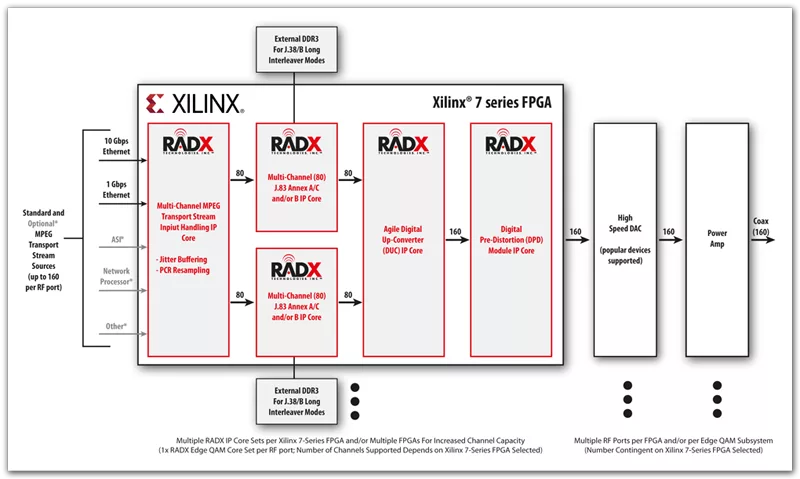
Developed in collaboration with Xilinx®, Inc., the RADX™ EdgeQAM IP Core Set is a modular, scalable set of Intellectual Property (IP) Cores that enable Cable Head-End OEMs and System Integrators (SIs) to rapidly develop and deploy high-performance, cost-effective and power-efficient J.83 Annex A/B/C EdgeQAM subsystems based on Xilinx 7 series FPGAs. For optimal compatibility and return on investment, the RADX EdgeQAM IP Core Set is designed to enable OEMs and SIs to meet CableLabs® CMAP™ and M-CMTS™ standards and to deliver up to six (6) RF ports per subsystem with up to 160 QAM Channels per RF port .
The RADX EdgeQAM IP Core Set consists of four (4) optimized IP modules which may be combined and tailored to meet a wide range of EdgeQAM CMTS requirements:
• Multi-Channel MPEG Transport Stream (MTS) Input Handling IP Core
• Multi-Channel J.83 Annex A/B/C IP Cores
• Multi-Channel Agile Digital Up Converter (DUC) IP Cores with support for Analog Devices® (ADI) and Maxim® DACs
• Digital Pre-Distortion (DPD) IP Cores for Maxim DACs (the IP Core Set is also compatible with ADI DPD IP Cores)
Provider

RADX Technologies, Inc.
HQ:
USA
Founded in 2011, RADX Technologies, Inc., is a specialized small business that develops advanced, DSP-based technologies and products for commercial wired and wireless communications. With development locations in California and Europe, RADX has an innovative and seasoned management and engineering team that has been instrumental in numerous successful high-tech companies.
With decades of experience developing advanced FPGA, multi-core and GPU-based DSP solutions for consumer, commercial, aerospace and defense customers in Software Defined Radio (SDR), Cognitive Radio (CR), High Performance Computing, Mesh Networks and similar applications, RADX is focused on providing a wide range of cost-effective, high-performance DSP-based technologies, products, solutions and services to OEMs, system integrators and service providers on a global basis.
Learn more about Modulation Demodulation IP core
This paper focuses on how direct RF sampling architecture has proved to be a felicitous approach for RF data conversion. The progress in converter technology has made it possible to increase the sampling rates and support very large bandwidth and multiple operating RF bands.
Synopsys is now shipping support for Bluetooth® 5.4, the latest specification from the Bluetooth SIG (Special Interest Group). The enhancements in Bluetooth 5.4 will open additional markets and use cases. This is one of the many inflection points in the Bluetooth Low Energy market that will be discussed in this paper.
Carriers are now deploying 5G across the globe driven by the need to keep up with relentless mobile data growth. 5G New Radio (NR) operates at higher frequencies to increase bandwidth, but at the expense of range. There will therefore be a need for a much larger number of 5G RUs to provide the same coverage. The availability of cost-effective, reliable and open 5G radio units is therefore critical.
This paper presents the design and performance of a key RF circuit necessary for the realization of a reconfigurable, integrated RF front-end: a tunable frequency, selectable bandwidth, on-chip, “SAW replacement” filter. The on-die tunable filter presented here has a tunable center frequency up to 1 GHz, a selectable bandwidth up to 40 MHz, and an adjacent channel rejection down to 60 dB.
To meet the demands for the multi-band, multi-mode wireless standards in the current market, a highly integrated wireless receiver (RX) is desired. CMOS technology has become the technology of choice for the integrated receiver design.
An efficient IP reuse strategy relies on IP blocks with wide applicability. That makes generic blocks, such as programmable processors preferable. However, in many applications such as handheld wireless terminals, additional silicon area and power consumption compared to fixed function solutions can not be accepted.