Overview
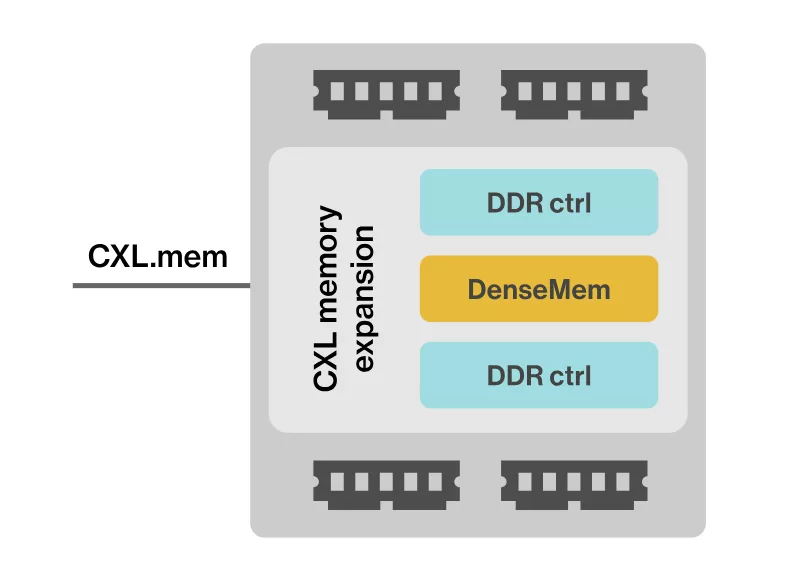
DenseMem increases effective CXL Type 3 Device memory capacity by a factor of 2x through transparent, in-line memory compression/decompression with minimal impact to latency and badwidth. DenseMem is available as an area and power efficient drag and drop IP block portable across the latest process nodes.
Applications
Data Center operators at scale regularly employ software memory compression to create an additional memory tier to conserve capacity and interconnect bandwidth. Such operations consume monetizable host node compute cycles. DenseMem offloads compression/ decompression , tranparently creating a new, dynamically adjusting compressed memory tier within the Type 3 Device. DenseMem free up host cycles to service end user workloads. DenseMem supports industry standard compression algorithms for compatibility/ interoperability and alternatively offers propreitary compression algorithms for highest performance. DenseMem AI features adapt performance by adjusting to workloads automatically.
Integration
DenseMem can be integrated into the CXL Type 3 device SoC, between the CXL controller and memory controller logic blocks, supporting both AXI4 and CHI specifications. DenseMem lightweight firmware enables communication with the device over CXL.mem commands when reading and writing pages. DenseMem exposes compressed memory region as an additional Tier in the memory hierarchy, for easy integration into existing linux and software application stacks as well as CXL fabric management software.
Benefits
2-3x effective capacity increase. New compressed memory tier instantiated automatically inside CXL Type 3 device. Turn key solution: Real-time compression/decompression coupled with compaction, and transparent memory management. Operations at main memory speed and throughput. Compatible with AXI4/CHI specifications for easy integration. Intelligent real-time analysis and tuning to adapt to diverse workloads.
Performance / KPI
| Feature |
Performance |
| Compression ratio: |
2-3x across diverse data sets |
| Frequency: |
1.6GHz (@5nm TSMC) |
| IP area: |
Starting at 0.23mm2 (@5nm TSMC) 75% is SRAM |
| Memory technologies supported: |
(LP)DDR4, (LP)DDR5 |
System integration of DenseMem
Integrated within a CXL Type 3 device
Learn more about CXL IP core
Synopsys continues to lead innovation with the industry’s first commercially available CXL 4.0 Verification IP (VIP). This comprehensive solution supports the full 128 GT/s data rate, IO throttling, and streamlined port negotiation, equipping designers to validate and optimize their products for the future.
Compute Express Link (CXL) is revolutionizing data center architecture, with power management emerging as a key area of innovation. Among its power-saving mechanisms, the L0p (Low Power) state plays a pivotal role in reducing energy consumption during periods of low link activity.
Memory interleaving is a technique that distributes memory addresses across multiple memory devices or channels. Instead of storing data sequentially in one device, the system alternates between devices at a fixed granularity. It could help improve bandwidth, reduce latency, and enhance scalability. In the context of Compute Express Link (CXL), memory interleaving is facilitated by the HDM (Host-Managed Device Memory) Decoder.
CXL 3.0 allows entire racks of servers to function as a unified, flexible AI fabric. This is especially significant for AI workloads where traditional GPU islands are constrained by memory limits.
The authors present cMPI, the first work to optimize MPI point-to-point communication (both one-sided and two-sided) using CXL memory sharing on a real CXL platform, transforming cross-node communication into memory transactions and data copies within CXL memory, bypassing traditional network protocols.
AI workloads are outpacing traditional memory architectures—but CXL®︎ offers a smarter path forward. Cadence's blog, "Boosting AI Performance with CXL," outlines how CXL enables dynamic memory expansion, memory sharing, and maintains coherency across devices to eliminate bottlenecks and boost performance for processing training and inference in large-scale AI systems.