Processor Architecture for High Performance Video Decode
Processor Architecture for High Performance Video Decode
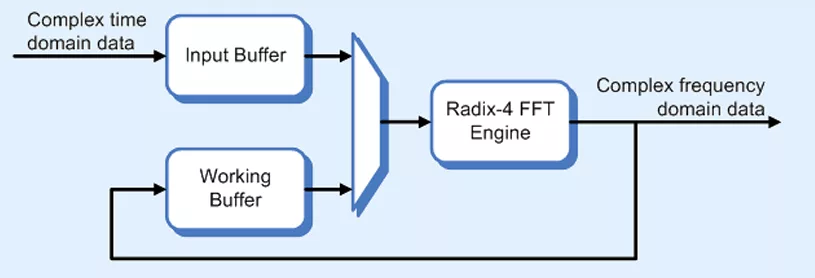
The FFT is factored into Radix-4 Butterfly operations.
The FFT is factored into Radix-4 Butterfly operations. When an odd power of two is required, a small radix-2 “follower” stage performs the final iteration. The radix-2 stage does not require a full complex rotator so its cost is minimal.
The Radix-4 Engine fetches one complex word of data each clock cycle. Four interleaved data words are collected then applied to the t0-t3 inputs. On successive clock cycles the engine calculates the four frequency domain outputs f0-f3. These are then stored back into the Working Buffer.
During the final iteration, the engine produces frequency domain outputs on successive clocks. These arrive in scrambled (digit-reversed) order.
A final pass through the data produces outputs in sorted order.
Note: some files may require an NDA depending on provider policy.

Our expertise is primarily in the gate- and power-efficient implementation of physical-layer (PHY) functions such as: modulation, demodulation, equalisation and channel coding but our experience encompasses all of the major elements of a modern baseband 'core' including the medium access control (MAC), voiceband DSP, mixed-signal interfaces, and embedded Cpu and software.
Our services are provided on a turnkey basis or as part of a support package attached to our licenced IP or tool products.
Commsonic's customers are typically semiconductor vendors and manufacturers of communications equipment that require leading-edge, Standards-based or proprietary PHY solutions but lack the internal resources or skills necessary to deliver projects against aggressive deadlines.
General-purpose FFT core is a Filters Transforms IP core from Commsonic Ltd listed on Semi IP Hub.
Engineers should review the overview, key features, supported foundries and nodes, maturity, deliverables, and provider information before shortlisting this Filters Transforms IP.
Yes. Buyers can compare this product with similar semiconductor IP cores or IP families based on category, provider, process options, and structured technical specifications.