802.11 Wi-Fi IP
Filter
Compare
18
IP
from
9
vendors
(1
-
10)
-
-
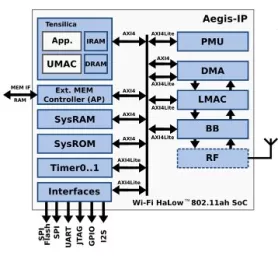
802.11 BGN Low Power WIFI RF SoC
- Tx output power: 11b 20dBm, 11g 16dBm@54Mbps, 11n 15dBm
- Rx sensitivity: -76dBm @ 54Mbps, -94dBm @ 6Mbps
- Current: 45mA @ Rx 54M, 138mA @16dBm
- Sensor support
-
Dual band WiFi N/G/B/A Digital Baseband IP
- Supports data rates upto 65Mbps
- Throughput numbers of above 50 Mbps for UDP and above 40 Mbps for TCP.
- Support for authentication methods (Cisco® LEAP, PEAP with EAP-GTC support, CCKM with EAP-FAST) depend on the host platform.
- Supports MAC enhancements including:802.11d -Regulatory domain operation,802.11e -QoSincluding WMM,802.11h –Transmit power control dynamic and frequency selection,802.11i -Security including WPA2 and WAPI compliance,802.11k -Radio resource measurement,802.11r –Roaming,802.11w -Management frame protection
-
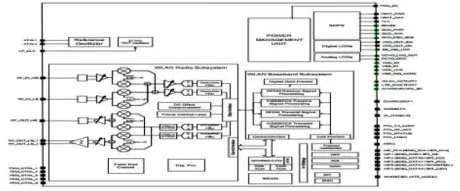
Dual band WiFi N/G/B/A 2.4/5GHz RF Transciever IP
- High Volume Silicon Proven in 55nm
- Extracted from Design Data Base of production chip
- Dual Band 2.4/5 Ghz20MHz RF transceiver with integrated PA & Balun
- Digital interface through integrated AFE (ADC/DAC)
-
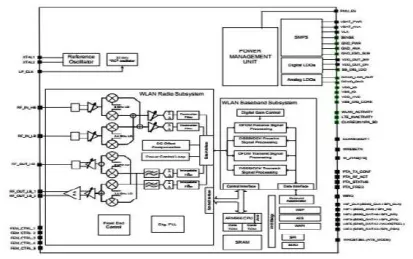
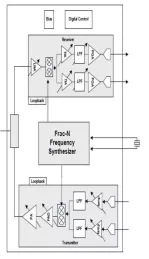
Wi-Fi 802.11 ax/Wi-Fi 6 /Bluetooth LE v5.4/15.4-2.4GHz RF Transceiver IP for IOT Application in TSMC22 ULL
- Metal Layer- 1P7M, 4X1Z1U
- BW support for 20/ 40MHz
- Supports 256 QAM (quadrature amplitude modulation)
- Max Tx output power: +20dBm
-
802.11 AX
- Increased Throughput: 802.11ax is designed to provide higher data rates compared to its predecessors, with a target throughput of at least 4 times higher than 802.11ac Wave 2
- MU-MIMO (Multi-User, Multiple Input, Multiple Output): While MU-MIMO was introduced in 802.11ac, 802.11ax takes it a step further by supporting both downlink and uplink MU-MIMO. This means that the access point can communicate with multiple devices simultaneously, improving overall network efficiency.
-
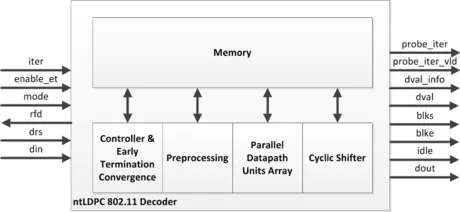
IEEE 802.11 n/ac/ax LDPC Decoder
- LDPC Decoder, support all IEEE 802.11 n/ac/ax defined block lengths (648, 1296, 1944) and code rates (1/2, 2/3, 3/4 and 5/6).
-
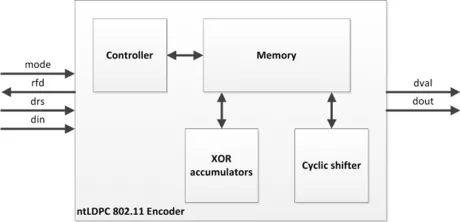
IEEE 802.11 n/ac/ax LDPC Encoder
- Encoder and decoder, support all IEEE 802.11 n/ac/ax de-fined block lengths (648, 1296, 1944) and code rates (1/2, 2/3, 3/4 and 5/6).
-
Wi-Fi WPA3 MAC
- Legacy security system
- WPA/WPA2 security system (IEEE 802.11i)
- Protection of Management Frames (IEEE 802.11w)
-
IEEE 802.11n RF/Baseband/MAC 40nm
- Supports WFA Wi-Fi Direct, Wi-Fi Aware PMF and WPS
- Frequency band: 2.4GHz
- Modulation modes: OFDM with BPSK, QPSK, 16-QAM,64-QAM, DSSS, CCK
- Supported data rates: IEEE 802.11b: 1 to 11Mbps, IEEE 802.11g: 6 to 54Mbps, IEEE 802.11n: 6.5 to 72.2Mbps