From Browser Evaluation to Tensilica HiFi DSP Silicon

A joint AIZIP–Cadence view of de-risking the Physical AI voice front end from model evaluation through silicon integration
 Voice-enabled products are judged by whether they understand the user in the environment where the product actually operates. A kitchen appliance must work over running water and fan noise. An in-cabin assistant must handle road noise, HVAC, playback, and competing talkers. A robot may need to hear commands at a distance while it is moving or speaking.
That makes the audio front end a deployment-critical part of the AI pipeline. Voice activity detection, acoustic echo cancellation, beamforming, and noise reduction determine what reaches wake-word detection, automatic speech recognition, and downstream language processing. If the front end removes a phoneme, leaves residual echo, or introduces artifacts, the downstream model receives the wrong evidence. A larger recognition or language model cannot recover speech information that never reached it correctly.
The Costly Gap Between a Good Demo and a Deployable Model
A workstation or cloud demo can show that an algorithm is promising, but it does not answer the questions an embedded product team must resolve:
- What does the model do to represent real-world audio, including low SNR, double-talk, far-field pickup, and reverberation?
- Does the embedded implementation preserve the expected functional output after quantization or fixed-point optimization?
- Can it sustain real-time processing within the product’s latency budget?
- Does it fit the target DSP’s cycle, code, model, persistent-memory, and scratch-memory budgets?
These answers often arrive only after a model has been ported, optimized, integrated into an SDK, exercised on a board, and tested in the real working environment. By then, the team has already paid much of the cost required to discover whether the model is viable.
A Web-to-HiFi DSP Evaluation Path
AIZIP’s interactive showcase moves that first feasibility decision earlier. Developers select a reference audio-AI model, upload representative audio from an expected operating scenario, and run a build targeted to a Cadence Tensilica HiFi DSP configuration. They can then listen to or inspect the result.
The current workflow covers reference capabilities such as wake-word and keyword spotting, voice activity detection, deep noise reduction, and acoustic echo cancellation with noise reduction. The models are sized and tuned for embedded use rather than presented only as workstation demonstrations.
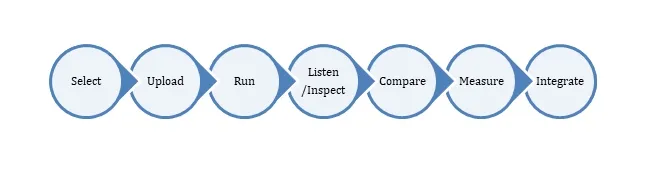
Fig. Cadence Tensilica HiFi DSPs power the audio-optimized compute path, bridging early model evaluation and production-ready SoC integration.
The evaluation flow is designed to be short and repeatable. It is an entry point to the normal embedded-development process, not a replacement for it.
What the Development Team Learns Early
The workflow provides three distinct forms of evidence. Keeping them separate is important because each supports a different engineering decision.
- Functional output. The audio or detected event is produced by the HiFi-targeted build for the selected input. Where the model and numeric format support it, the result can be compared with a defined reference implementation and carried forward as a reproducible checkpoint during integration.
- Simulator cycle estimate. The cycle-accurate Xtensa ISS reports DSP cycles for the selected configuration. Expressed as MCPS, this provides early guidance on the compute load required for real-time operation. Cadence Xtensa tools can also provide code and data-memory sizing for the same build.
- Hardware result. Final measurements still require the actual SoC or board, including its clocks, memory hierarchy, firmware, peripherals, and software stack. Hardware remains necessary for final power, end-to-end latency, and system validation.
An Early Go or No-Go Decision
The value of browser-based evaluation is not the browser itself. The value is changing the order of engineering investment. A team can first evaluate representative output and estimate the target compute and memory cost. Only models that clear that initial bar need to move into full SDK integration, board bring-up, hardware correlation, and product optimization. Below are examples of how an early decision could impact the success of the products:
|
Decision |
Hardware-first path |
Web-to-HiFi path |
|
Listen to representative output |
After initial porting |
Before board bring-up |
|
Estimate DSP cycles and MCPS |
Happens late during hardware bring-up |
During model evaluation |
|
Review code and data-memory fit |
After implementation work |
Before committing integration resources |
|
Make the first go or no-go decision |
After significant effort |
With early target-specific evidence |
This does not eliminate model porting or physical validation. It reduces the chance that teams spend that effort on a model that cannot meet the product’s quality or resource requirements.
Use Representative Audio and Report the Conditions
An early result is only useful when it is reproducible. A decision-ready evaluation should identify the model and build, sample rate, frame size, numeric format, target HiFi configuration, Xtensa tools release, compiler settings, input duration and acoustic condition, and whether the result comes from simulation or a specified hardware platform.
Match evaluation metrics to the workload:
- Noise reduction: Measure speech quality or intelligibility, along with speech-recognition word-error rate.
- Echo cancellation: Evaluate single-talk and double-talk separately.
- Wake-word detection: Measure false rejects (missed wake words) and false accepts (unintended activations) at defined operating points.
- Resource requirements: Report compute, memory, and algorithmic latency separately.
Where the Workflow Fits
The same evaluation method applies across products, but the test conditions change with the use case:
|
Product category |
Conditions to qualify |
|
Earbuds and headsets |
Double-talk, playback leakage, and a tight always-on power budget |
|
Smart speakers and appliances |
Far-field pickup, reverberation, and low or negative SNR |
|
Automotive systems |
Road noise, HVAC, playback, and multiple talkers |
|
Event-aware devices |
Reliable always-on detection at low power |
|
Robots and Physical AI systems |
Distance, reverberation, motion noise, and interaction while the device is speaking |
From Evaluation to Product Integration
AIZIP supplies the reference models, HiFi DSP builds, hosted evaluation experience, reference outputs, and model-level licensing and integration support. Cadence supplies the Tensilica HiFi DSP IP, Xtensa tools and ISS, supporting libraries and SDK environment, and SoC enablement. The SoC provider and OEM remain responsible for platform integration, memory allocation, hardware correlation, product tuning, power, and final validation.
The result is a clearer handoff. Algorithm developers can demonstrate target-oriented behavior earlier. SoC teams can assess compute and memory feasibility before committing to a platform. OEMs can qualify the voice front end sooner and focus more of the program on the product behavior, multimodal processing, and user experience that differentiate the final device.
Hear It, Size It, Then Integrate it
For embedded voice AI, the first deployment question should not be whether a model performs well on a workstation. It should be whether the target-oriented implementation preserves the required audio behavior, preserves that behavior in the required use-case setting, and fits the product’s real-time resource budget.
Together, AIZIP and Cadence Tensilica HiFi DSPs create a more efficient path from a promising voice model to a deployable edge product. AIZIP brings embedded-ready voice AI models and a practical web-based evaluation workflow, while HiFi DSPs provide the audio-optimized compute foundation, tools, and performance visibility needed for target integration. By connecting representative audio results, simulator cycle information, MCPS, and memory sizing early in model selection, the collaboration helps teams move forward with greater confidence—while preserving the need for final SoC integration and physical validation.
Explore Cadence IP:
- Tensilica HiFi 3z DSP
- Versatile, Ultra-Low-Power DSP for Audio, Voice, Vision, and AI
- Tensilica DSP IP supports efficient AI/ML processing
- Cache-Coherent HiFi 5s Symmetric Multiprocessor
Learn More
Related Semiconductor IP
- Tensilica HiFi 3z DSP
- Versatile, Ultra-Low-Power DSP for Audio, Voice, Vision, and AI
- Tensilica DSP IP supports efficient AI/ML processing
- Cache-Coherent HiFi 5s Symmetric Multiprocessor
- Highly scalable performance for classic and generative on-device and edge AI solutions
Related Blogs
- The Road to Innovation with Synopsys 224G PHY IP From Silicon to Scale: Synopsys 224G PHY Enables Next Gen Scaling Networks
- Enkl Sound Elevates Audio Tech with Tensilica HiFi DSP for Unmatched Excellence
- From "What-If" to "What-Is": Cadence IP Validation for Silicon Platform Success
- From Spec to Silicon: Accelerate SoC Integration with IP-XACT
Latest Blogs
- From Browser Evaluation to Tensilica HiFi DSP Silicon
- FiRa Core 4.1: A Step Toward Real-World UWB Deployments
- Arteris Advances RISC-V Automotive Computing Through TURANDOT Collaboration
- AI in Semiconductor Design and Verification: What Engineers Need to Know
- The Interconnect Challenge of Physical AI