FiRa Core 4.1: A Step Toward Real-World UWB Deployments
Ultra-wideband (UWB) has moved from a niche radio technology to a standard feature in the devices we carry every day. It measures distance with centimeter-level precision, it does so securely, and it is now found in smartphones, wearables, cars, and building infrastructure. ABI Research expects UWB device shipments to nearly double, from 597 million in 2026 to almost 1.18 billion in 2030 [1].
Behind that growth is the FiRa Consortium. Led by companies such as Apple, Google, and Samsung, FiRa is the UWB industry’s global hub for interoperability and certification. It defines how UWB devices from different vendors work together, and it certifies that they actually do. Beyond defining its own use cases, such as indoor navigation and finding people and things nearby, FiRa works with other standards bodies that build on UWB: the Car Connectivity Consortium (CCC) for digital car keys, and the Connectivity Standards Alliance (CSA) for Aliro, the new standard for unlocking doors with a phone [2].
From new use cases to real deployments
Until now, each FiRa release has mostly expanded what UWB can do. FiRa 1.0 focused on hands-free access control. Later releases added location services, public transport and tap-free payments, and most recently infrastructure-based asset tracking and support for Aliro in FiRa Core 4.0 [3][4].
FiRa Core 4.1, released in October 2026, takes a different focus [5]. It doesn’t add a headline use case. Instead, it closes gaps that only show up when existing use cases leave the lab and meet real buildings, real crowds, and devices from many different vendors. Its improvements come with new certification tests, which check that products from different vendors handle them the same way.
Three improvements stand out: knowing which floor you’re on, consistent accuracy across large venues, and secure experiences when several devices range at once. Let’s look at each one through real-world examples.
Indoor navigation, privately
GPS gets you to the building, but it stops working at the door. Inside, satellite signals are too weak and too distorted to tell you where you are, let alone guide you to a specific gate, store, or room.
UWB fills that gap with a method called Downlink Time Difference of Arrival (DL-TDoA). Fixed UWB beacons in the building, called anchors, broadcast short messages, and the phone works out its own position from the tiny differences in when those messages arrive. The phone only listens and never transmits, so the venue can’t use UWB to track it, and any number of phones can navigate at once. We covered this in more detail in our earlier post, From Driveway to Checkout [6].
Knowing which floor you’re on
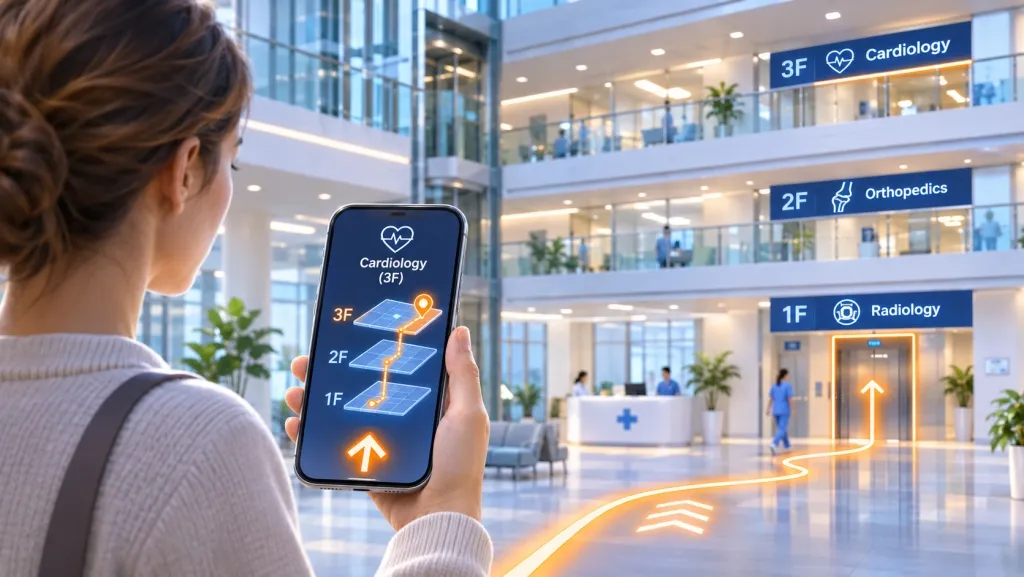
Airports, malls, and hospitals are rarely flat. Even a precise position is of little use if it puts you on the wrong level, and directions to a gate, store, or clinic that start on the wrong floor send people the wrong way.
Before Core 4.1, there was no single, certified way to carry floor information from the building’s anchors all the way to the navigation app on the phone. A venue and an app developer couldn’t simply assume that anchors and phones from different vendors would describe and report floors the same way.
FiRa Core 4.1 closes that gap. It defines one consistent way for anchors to broadcast their floor together with their location, and for the phone to pass it on to the app in a form the app can rely on. New certification tests check that anchors broadcast this information correctly and that phones report it correctly.
The result is multi-level navigation that works regardless of who made the anchors or the phone. A traveler can be guided from parking level −2 to a departure gate, or a patient from the hospital entrance to a clinic on the third floor.
Consistent accuracy across large venues
In a large venue, positioning accuracy can dip exactly where people move from one area to another. The reason is how the anchors are organized. A big space needs many anchors, so they are split into groups called clusters, and anchors within a cluster keep their timing closely aligned so a phone can compare their messages. Messages from different clusters don’t share that timing, so a phone near the boundary between two clusters can only use part of the anchors around it.
FiRa’s specifications already describe a remedy, cross-cluster synchronization, which gives neighboring clusters a shared clock accurate to under a billionth of a second. Until now, however, it wasn’t covered by certification. Venue operators couldn’t count on anchors and phones from different vendors keeping and using that shared clock in the same way.
FiRa Core 4.1 adds certification tests for cross-cluster synchronization. The tests check that anchors keep the shared clock correctly, that anchors not taking part in it correctly ignore the extra information, and that phones report the cross-cluster information to the app.
With that in place, a phone near a boundary can combine anchors from both clusters into a single, more accurate position. In large open spaces such as exhibition halls, this means consistent accuracy from one end of the venue to the other, and the confidence to grow a deployment with anchors from more than one vendor.
Distance you can trust
What sets UWB apart from other short-range radios is that its distance measurements can be secured. Secure UWB ranging messages carry a cryptographic code called the Scrambled Timestamp Sequence (STS). Only devices that hold the right security key can generate or verify it, which prevents attackers from faking how close a device is. This is why UWB is used to unlock cars and doors, as we described in One Key for Every Door [7].
Secure multi-device experiences
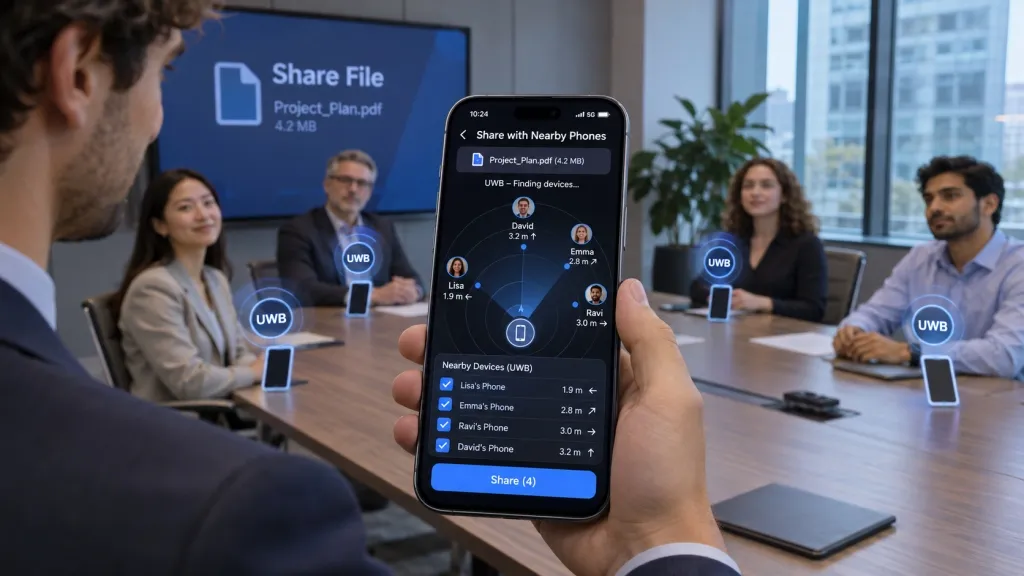
Picture a meeting where you want to share a file with the people in the room. Your phone uses UWB to find their phones and shows each one by distance and direction, so you can simply point at the right person. To do that, your phone measures distance to several phones at once, and traditionally all of them share one security key. That protects the group from outsiders, but not the participants from each other: anyone in the session holds the same key as everyone else.
This is exactly the problem responder-specific sub-session keys were designed to solve: they give each participant its own key. But certification didn’t cover them before 4.1, so they couldn’t be relied on beyond a single brand’s devices.
FiRa Core 4.1 adds certification tests for exactly this case. Your phone still coordinates the whole session, but each person’s responses are protected with their own key, and the tests check that this works the same way on devices from different vendors.
As a result, no participant can impersonate another or read the others’ responses. Each person’s exchange stays private from the rest of the room, which matters more and more as UWB moves into shared, multi-user settings.
How Ceva helps
For chipmakers, every FiRa release raises the same question: how quickly can our silicon support it, and how confident can we be that it will pass certification? Ceva-Waves UWB fully supports FiRa Core 4.1, including all of its optional features and every capability described above. That gives SoC teams a ready path to Core 4.1 products and certification.
Ceva-Waves UWB is a complete UWB IP platform that chipmakers license and build into their own chips. It combines the radio (PHY) and MAC hardware with a portable MAC software stack that supports FiRa, CCC Digital Key, and CSA Aliro [8]. That lets SoC teams bring the real-world deployments described here to market with less integration risk, and build on the same foundation as the standards keep evolving.
Ceva-Waves UWB is also ready for what comes next. Its hardware is compatible with both IEEE 802.15.4z, the foundation of today’s UWB devices, and IEEE 802.15.4ab, the next generation of UWB, which FiRa has begun building into its future specifications to improve range, reliability, and data performance [8][9].
Explore Ceva IP:
References
- ABI Research, IoT Connectivity Market Rebounds as Bluetooth Shipments March Toward 8.1 Billion by 2030 and Wi-Fi 8 Enters the Spotlight (Wireless Connectivity Market Data Overview: 2Q 2026), July 15, 2026
- FiRa Consortium, Annual Report 2025, January 2026
- Samsung Research, FiRa Consortium Release 3.0 UWB Core Specification and Certification Program Launch
- FiRa Consortium, FiRa Consortium Unveils FiRa Core 4.0 Specifications and Certification Program, Business Wire, December 3, 2025
- FiRa Consortium, FiRa Consortium Launches Core 4.1 Specifications and Enhanced Certification Program, Business Wire, October 20, 2026
- Ceva, From Driveway to Checkout: Seamless Indoor Navigation Powered by UWB, March 6, 2026
- Ceva, One Key for Every Door: How Aliro Extends the UWB Digital Key Beyond the Car, July 20, 2026
- Ceva, Ceva-Waves UWB product page
FiRa Consortium, FiRa Consortium to Integrate IEEE 802.15.4ab Advancements Into Future FiRa Specifications, Business Wire, October 21
Related Semiconductor IP
- Low Power Ultra-wideband (UWB) IP
- Open RAN Platform for Base Station and Radio
- Scalable 5G modem platform
- AI SDK for Ceva-NeuPro NPUs
- High-accuracy Sensor Fusion
Related Blogs
- FiRa 3.0 Use Cases: Expanding the Future of UWB Technology
- The silicon behind Android
- Nice Core ARM; Pity About Intel MDF
- ARM Cortex-A15 - does this processor IP core need a new category ... Superstar IP?
Latest Blogs
- From Browser Evaluation to Tensilica HiFi DSP Silicon
- FiRa Core 4.1: A Step Toward Real-World UWB Deployments
- Arteris Advances RISC-V Automotive Computing Through TURANDOT Collaboration
- AI in Semiconductor Design and Verification: What Engineers Need to Know
- The Interconnect Challenge of Physical AI