Arteris Advances RISC-V Automotive Computing Through TURANDOT Collaboration

As vehicles become more software-defined, connected, and intelligent, the computing platforms behind them must support increasingly demanding workloads, while meeting stringent performance and safety requirements. Developing these platforms requires advances in semiconductor architecture, interconnect technology, and system integration as well as close collaboration across the semiconductor ecosystem.
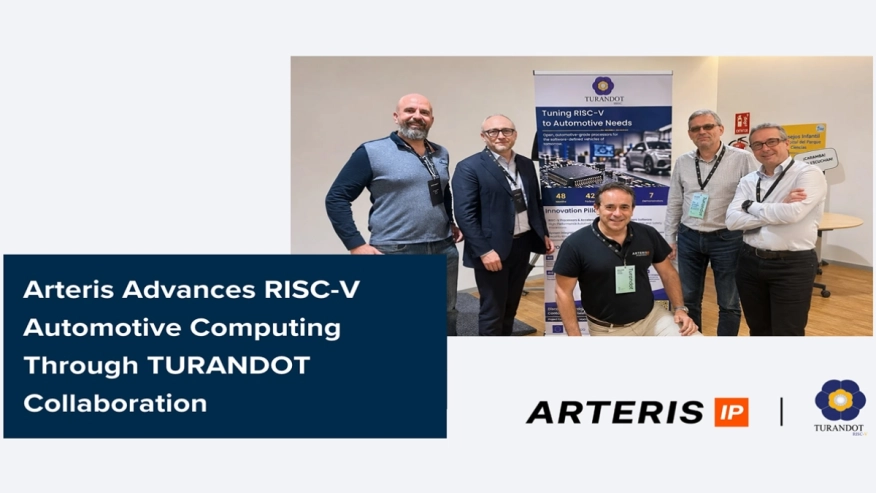 That collaborative approach is at the heart of TURANDOT, a European research and development project focused on advancing RISC-V technologies for next-generation automotive applications. Arteris is proud to participate in this project by contributing its expertise in system IP and SoC design automation to support the development of open, secure, and high-performance automotive computing platforms.
In early November 2026, project partners gathered in Granada, Spain, for the TURANDOT kick-off meeting, hosted by Quintauris. The meeting brought the members of the consortium together to align technical objectives, system architecture, work packages, and priorities for the first six months.
Over the next four years, 42 partners from 12 countries will collaborate to develop open, secure, and high-performance computing solutions for future vehicles. Their work will encompass RISC-V-based systems, advanced semiconductor IP, and design tools, to address the needs of increasingly complex automotive platforms.
Bringing system IP and integration expertise to automotive computing
The Arteris contribution to TURANDOT builds on its experience helping engineering teams design and integrate complex systems-on-chip (SoCs), and focuses on several critical aspects of automotive semiconductor design, including interconnect architecture, design automation, heterogeneous system integration, and demonstrator development.
A key area is the development of a cacheable, low-latency network-on-chip (NoC) for automotive microcontrollers. Arteris will also contribute expertise in coherent and non-coherent interconnects to support efficient communication between processors, memory, and other components.
As automotive SoCs bring together more diverse processing and hardware resources, efficient integration becomes increasingly important. Arteris will contribute to electronic design automation (EDA) methods and tools, including IP-XACT-based approaches, to help configure and integrate RISC-V components and complex systems more efficiently.
Working alongside project partners, Arteris will also contribute to the architecture and integration of heterogeneous automotive SoCs, considering requirements such as performance, quality of service (QoS), and functional safety. Its NoC technology and integration expertise will support project demonstrators targeting automotive applications, including advanced driver assistance and AI.
"As automotive computing architectures become more heterogeneous, the challenge extends beyond individual processors or IP blocks to how the entire system operates together. Interconnect architecture, predictable data movement, and efficient integration are fundamental to meeting automotive performance and safety requirements. TURANDOT gives us an opportunity to address these challenges alongside leading European research and industry partners while advancing the RISC-V ecosystem for automotive applications." said Emmanuel Vaumorin, Director of Strategic Research & Development Programs, Arteris
Strengthening Europe’s automotive semiconductor ecosystem
Beyond its technical contributions, Arteris will coordinate French participation in TURANDOT and support collaboration around reusable IP, tools, and design methodologies.
The initiative builds on Arteris’ ongoing engagement with the European semiconductor ecosystem and its commitment to addressing the architectural challenges of increasingly complex SoCs. By combining expertise across processor IP, interconnect technology, design automation, and automotive system development, TURANDOT aims to translate collaborative research into practical technologies that lay the foundations for the next generation of software-defined vehicles.
Learn more about the project at www.turandotproject.eu.
Explore Arteris IP:
- FlexNoC Interconnect IP
- CodaCache Last-Level Cache IP
- FlexGen Smart Network-on-Chip (NoC) IP
- FlexWay Interconnect IP
Related Semiconductor IP
- FlexNoC Interconnect IP
- CodaCache Last-Level Cache IP
- FlexGen Smart Network-on-Chip (NoC) IP
- FlexWay Interconnect IP
- FlexGen Multi-Die Smart Network-on-Chip (NoC) IP
Related Blogs
- RT-Europa: The Foundation for RISC-V Automotive Real-Time Computing
- Experts Talk: RISC-V CEO Calista Redmond and Maven Silicon CEO Sivakumar P R on RISC-V Open Era of Computing
- Collaboration leading the way for broad RISC-V adoption
- RISC-V: An Open Standard - Backed by a Global Community - to Enable Open Computing for All
Latest Blogs
- From Browser Evaluation to Tensilica HiFi DSP Silicon
- FiRa Core 4.1: A Step Toward Real-World UWB Deployments
- Arteris Advances RISC-V Automotive Computing Through TURANDOT Collaboration
- AI in Semiconductor Design and Verification: What Engineers Need to Know
- The Interconnect Challenge of Physical AI