Overview
Ultra-low-power always-on audio, voice, imaging, and AI inferencing
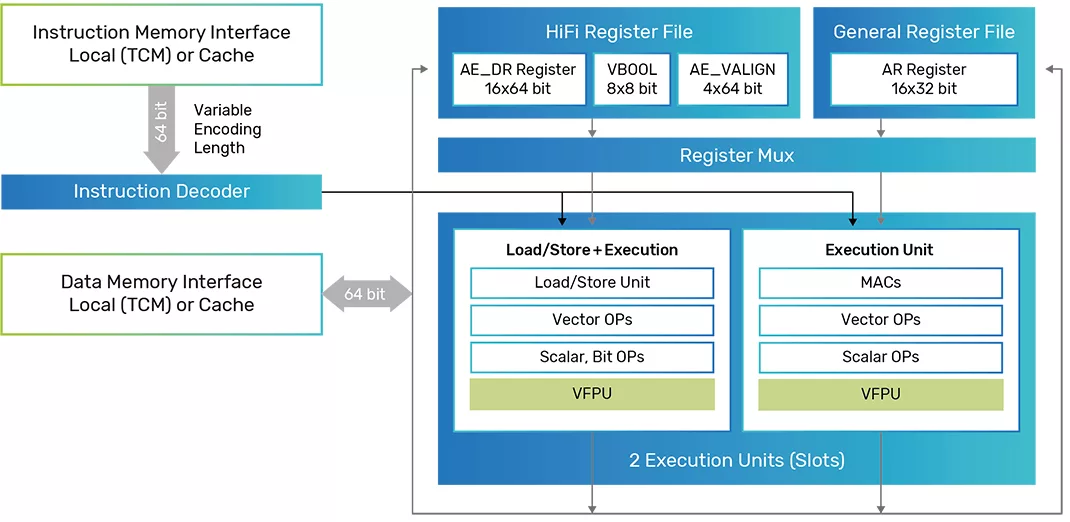
The Cadence Tensilica HiFi 1s DSP provides three benefits. First, it supports auto-vectorization by compiler to eliminate the need for hand-optimization, thereby opening it to every embedded programmer. Second, it enhances the always-on AI capability to allow higher-performance ML algorithms to run on an ultra-low power DSP. Third, it adds imaging ISA to support lightweight always-on vision processing.
Auto-vectorization support unburdens the programmer from expert-level hand-optimization, opening the HiFi 1s DSP to a vast pool of non-DSP programmers, lowering development costs, and accelerating time to market. The expanded AI and imaging ISA allow lightweight vision and machine learning applications to run at ultra-low power levels. Double-precision ISA helps modern audio programs run efficiently.
|
Feature
|
HiFi 1s
|
|
Load Units
|
1
|
|
VLIW Slots
|
2
|
|
Scalar Operations
|
2 slots
|
|
Accumulator Width
|
64-bit
|
|
Auto-Vectorization
|
Yes
|
|
Fixed Pt MACs per Cycle
|
32x32
|
1
|
|
32x16
|
2
|
|
16x16
|
4
|
|
8x16
|
8
|
|
8x8
|
8
|
|
SP/HP FPU (integrated, optional)
|
2x4-way/2x8-way
|
|
DP FPU (integrated, optional)
|
Scalar
|
|
Imaging/Vision ISA
|
Yes
|
|
Expanded Instructions for NN
|
Yes
|
|
Arithmetic decoding
|
Yes
|
|
AVS (Huffman and bitstream operation)
|
Yes
|
|
Coremark
|
5.25
|
Benefits
Auto-Vectorization
Enables the compiler to automatically vectorize data arrays to utilize the SIMD structure of HiFi 1s DSP, eliminates the need for hand-optimization
Expanded AI and Base Platform Performance
Dedicated MACs and ISA enhancing ML/AI and upgraded base platform to LX8, allowing richer applications to run at ultra-low power levels
Lightweight Imaging and Vision
Imaging targeted ISA and MACs for always-on lightweight vision applications to run standalone or in conjunction with a Vision DSP
Double-Precision Floating-Point
Greatly accelerates double-precision math functions found in audio and voice code, obviating the need to tradeoff precision with range
Learn more about DSP Core IP core
SemiDrive, an automotive semiconductor company building SoCs and MCUs for the software-defined vehicle, has licensed and integrated Cadence Tensilica HiFi 5s DSPs into its X10 next-generation AI cockpit SoC, where they form the audio and voice subsystem. X10 has secured production collaborations with several leading automakers.
Cadence AI Super Agents bring engineering trusted autonomy to semiconductor workflows, enabled by NVIDIA Open Agent Safety Platform.
Expanded partnership spans TSMC A14 certification, silicon-proven IP on TSMC N3P/N2P, wafer-scale 3D-IC for hundreds of chiplets, and agentic AI flows
New AI agent leverages core EDA technologies to both create RTL from specifications and upgrade RTL with signoff‑grade quality and performance, validated in early trials with Honda
The joint effort brings Cadence’s highly optimized Tensilica DSP architecture into the next-generation ADSP product family from ADI, enabling richer audio experiences, enhanced voice interactions, and greater system intelligence for future automotive platforms.
Complete x8 subsystem solution in TSMC N3 process demonstrates industry readiness for mass production and de-risks adoption for AI/HPC customers