AI in Semiconductor Design and Verification: What Engineers Need to Know

A practical look at where AI can help chip design teams today, and why it still needs a human in the loop.
Why now
 Every chip engineer has heard “AI will change EDA” before. What is different today comes down to two pressures meeting one maturing technology.
Design complexity keeps climbing. Modern SoCs integrate dozens of IP blocks, multiple clock and power domains, and layers of coherency, security, and safety requirements. Specifications run to hundreds or thousands of pages and change throughout the project. No single design team has the whole picture anymore.
Schedules haven’t relaxed. Time to market pressures are mounting day by day. Verification already consumes half or more of project effort on many teams, and a re-spin is brutally expensive. Teams are asked to deliver more functionality, in less time, with head count that has not grown at the same pace.
AI capabilities have matured. Large language models can now read long technical documents, follow structured instructions, and write plausible code in languages like SystemVerilog, Python, and UVM. Just as important, they can be wrapped in workflows that check their work against tools such as simulators, linters, and formal engines.
The current state of technology is what separates the real from the hype. Useful AI-based applications share a pattern: the task is text-heavy or boilerplate-heavy, the output can be checked mechanically, and a human remains accountable for the result. Over-hyped tools tend to share a different pattern: claims of “push-button chip design,” or demos on toy blocks that never meet the messy reality of a production specification, legacy code, and corner-case-laden protocols. If a pitch skips over how results are validated, treat it as marketing only.
Where AI helps today
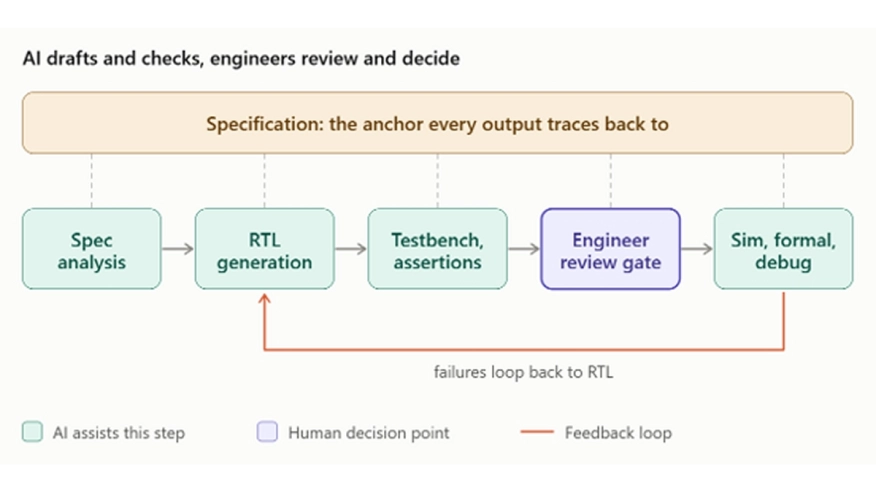
The diagram below shows how AI fits across the design and verification flow, with the human review gate and the design specification as the anchor for everything.
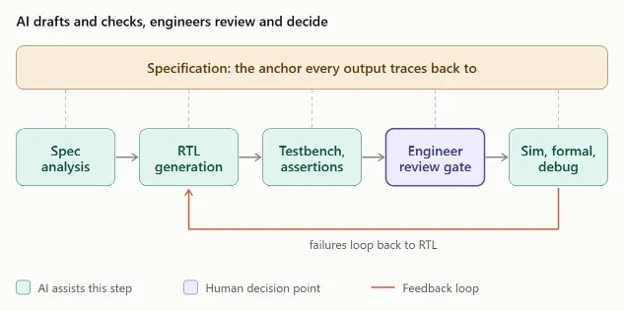
AI helps draft and check at each stage, but nothing moves on until an engineer reviews it, and every output stays tied to the spec.
Specification analysis
Design specifications are the source of truth, yet they are long, written in natural language, and full of tables, waveforms, and cross-references. Also, the specifications can be at different design levels – system, block, or registers – and there can be inconsistency among them. AI can extract structured information from long, unstructured specifications and flag statements that look incomplete, vague, or incorrect. This is tedious work for humans that is easy to get wrong, which makes it a good first target for AI.
RTL generation
Much of RTL is repetitive: register blocks, bus wrappers, FIFOs, glue logic, interface adapters, and parameterized variants of design components that already exist. Manually creating RTL is slow and error-prone, and the cost of a typo shows up much later in the flow when it is already very costly to fix. AI can produce first drafts of RTL code, translate between styles or languages, and refactor existing modules. Also, AI can help with assembly of multiple block/IP level RTL into a full SoC design – this is a novel application of AI becoming better day by day.
Verification environment creation
Creating a verification environment means writing drivers, monitors, scoreboards, sequences, coverage models, and the wiring that connects them. Much of this effort follows templates from previous design experience, yet it still takes weeks or months of careful implementation and integration. AI can scaffold UVM components from an interface description, generate sequence variations, and propose coverage points based on the specification. Verification engineers can then spend their time on intent rather than boilerplate tasks.
Assertion generation
SystemVerilog Assertions (SVA) are powerful but subtle, and it can be challenging to write them effectively. Turning a sentence like “the grant must follow a request within four cycles unless reset is asserted” into correct temporal logic is slow, and a slightly wrong assertion can either miss bugs or fire constantly. AI can draft assertions from design specifications or RTL behavior and explain them in plain language, which helps reviewers confirm that the assertions match the design intent and hence are effective.
Debug
Debugging the design issues is often the largest hidden cost. Design simulation produces gigabytes of logs and waveforms, and the engineer must trace a failing result back to a root cause across many signals and many cycles. AI can cluster similar failures, summarize simulation logs, point to the first suspicious divergence, and suggest likely causes. This saves significant bandwidth for both the verification and design engineers.
Nowadays, AI is being deployed in a loop whereby it iteratively analyzes each simulation failure, root causes it and identifies the bug that caused the failure, explores possible fixes, and fixes the bug automatically.
What engineers should watch for
The same qualities that make AI fast also make it risky if used carelessly and trusted blindly. This is where the engineer review gate comes into the picture. Key questions that are worth asking of any Abased design tool or workflow include:
Is the output correct, and how do you know? AI generated RTL, assertions, or testbenches can look perfectly reasonable and still be subtly wrong. Good workflows put generated artifacts through lint, simulation, formal checks, and coverage analysis, rather than simly trusting the AI model.
Can every result be traced back to the specification? In chip design, a feature or a check that cannot be tied to a requirement is a liability. Look for tools that link each generated assertion, testbench, or RTL code block to the specific specification section it came from, and that make it obvious when a requirement has no coverage. Traceability is also what lets you audit the work later, which matters for safety-critical and regulated domains that place requirements on the chip design.
Who reviews, and who decides? Human review should be a designed step and a gate in AI design workflows, not an afterthought. Engineers should be able to inspect, edit, and reject output, and the tool should make that easy rather than burying changes. Be explicit about what is allowed to change automatically by AI and what always needs human sign-off.
What happens to your data? Specifications and RTL are among a company’s most sensitive assets. Understand where AI models run, what is retained, and whether your IP could be used for AI model training without your knowledge.
The takeaway
Chip design and verification demand correctness, repeatability, traceability, and explain-ability. Today’s AI is becoming remarkably good at ingesting and analyzing specs, generating RTL code, verification environments, and assertions, and sifting through failures/debugging. However, experienced engineers are still essential for making architectural decisions, validating results, and ensuring functional correctness. Judgment about architecture, trade-offs, risk, and what “correct” means still sits with humans.
Design teams that benefit most will treat AI as a fast, tireless junior colleague: useful and worth supervising, but one which needs your guidance and is never the final authority. Design projects that are successful with AI are the ones that start with tasks that are easy to check, insist on traceability to the spec and keep humans in control. At the end of the day, let the results, not the pitch, decide how far to go with AI in semiconductor design and verification.
Explore Agnisys IP
Related Semiconductor IP
Related Blogs
- AI in Design Verification: Where It Works and Where It Doesn’t
- Analog Design and Layout Migration automation in the AI era
- EDA AI Agents: Intelligent Automation in Semiconductor & PCB Design
- Verification Sanity in Chiplets & Edge AI: Avoid the “Second Design” Trap
Latest Blogs
- From Browser Evaluation to Tensilica HiFi DSP Silicon
- FiRa Core 4.1: A Step Toward Real-World UWB Deployments
- Arteris Advances RISC-V Automotive Computing Through TURANDOT Collaboration
- AI in Semiconductor Design and Verification: What Engineers Need to Know
- The Interconnect Challenge of Physical AI