Overview
The demand for higher bandwidth in the car is growing quickly. On one side, all the entertainment and connectivity elements, and on the other, all the control related electronics.
As a result, the automotive manufacturers are adding a plethora of computer-based systems that need interconnection. Ethernet, with the latest innovations, is the best candidate to face this challenge from the technical and economical point of view.
Historically, the use of packet-switched networks has been avoided by automotive manufacturers for multimedia applications due to their non-deterministic nature. However, deterministic Ethernet solutions, like AVB, deliver streams with guaranteed bandwidth and deterministic latency for highly reliable and low-latency applications like those found within an automobile.
Audio Video Bridging (AVB) is a common name for the set of technical standards that allow time-synchronized low latency streaming services through Ethernet networks. They have been developed by the Institute of Electrical and Electronics Engineers (IEEE) Audio Video Bridging Task Group. These consist of:
•IEEE 802.1BA: Audio Video Bridging (AVB) Systems
•IEEE 802.1AS: Timing and Synchronization for Time-Sensitive Applications (gPTP)
•IEEE 802.1Qat: Stream Reservation Protocol (SRP)
•IEEE 802.1Qav: Forwarding and Queuing for Time-Sensitive Streams (FQTSS)
AVB works by reserving a fraction of the available Ethernet bandwidth for AVB traffic and those type of packets are sent regularly in the allocated slots. As the bandwidth is reserved, there will be no collisions.
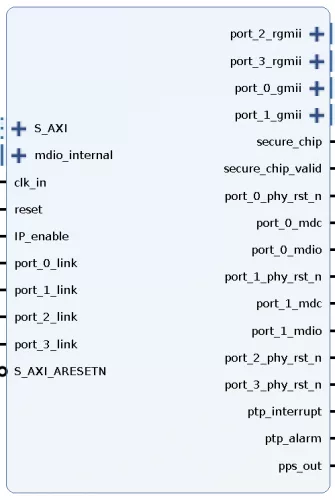
AVB/Automotive Ethernet Switch (AVBES) IP Core implements an Ethernet switch which supports all AVB conforming standards. It can be implemented optimally depending on the application, from a simple 2-ports end-point to a complex multiport switch.
Learn more about Ethernet IP core
Through a live demonstration featuring different aircraft systems, visitors will discover how Time-Sensitive Networking (TSN) capabilities can support robust and reliable communications in critical aerospace environments
Crius uses SOC-E’s PreciseTimeBasic (PTB) IP core to implement the IEEE 1588 slave function, with a hardware timestamping unit inserted between the MAC and PHY layers so that PTP event messages are timestamped in logic rather than in software.
SOC-E had the privilege to be selected among a variety of other relevant companies to demonstrate the newest progress around deterministic ethernet in the context of the NGWS/FCAS Remote Carrier (pillar 3).
SOC-E and SafeCore Devices are preparing the launch of a new TSN End Point IP Core designed to bring deterministic Ethernet communications closer to the needs of next-generation Aerospace, Defence and Space systems.
For the Kronos 3R, NovaTech selected SOC-E solutions to implement two critical capabilities: IEEE 1588 PTP grandmaster functionality and IEC 62439-3 PRP Ethernet redundancy. Both are implemented directly in the FPGA programmable logic of the platform via the SOC-E SMARTzynq System-on-Module, built on the AMD Xilinx Zynq-7000 SoC.
For DRAGO-3, the IAC selected a SOC-E solution to implement communication between the camera and external systems through SpaceWire, a standard widely used in space systems for high-speed onboard data links in satellites and spacecraft.