Enabling Precision Timing for IEC 61850 Digital Substations: SOC-E Technology Inside NovaTech’s Kronos Series 3R
June 22, 2026 -- NovaTech Automation continues to advance precision timing for electric utility infrastructure with the Kronos Series 3R, the latest generation of GNSS satellite clocks designed for substation automation and grid protection applications. The Kronos 3R builds on a proven product line that has established a track record of reliable time distribution across investor-owned utilities, municipal cooperatives, transmission system operators, and renewable energy installations worldwide.
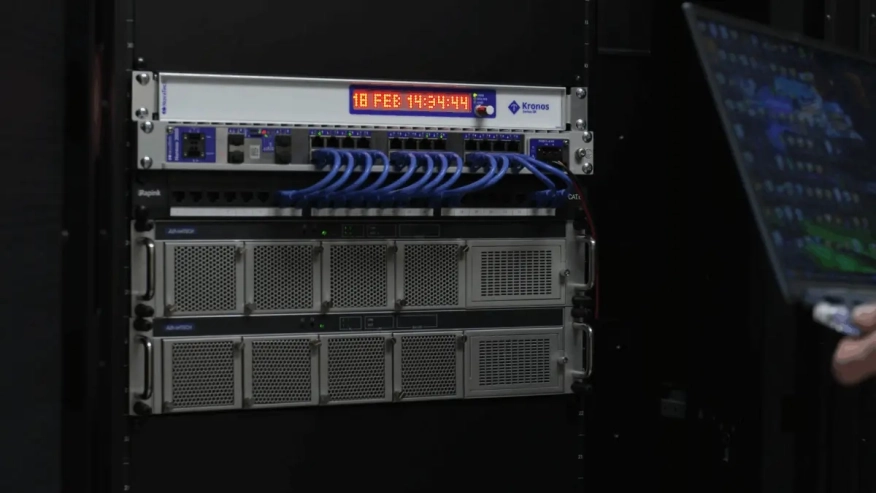 Kronos clocks distribute time to the full range of devices found in a modern substation: protective relays, RTUs, merging units, phasor measurement units, and Ethernet switches. Accurate, traceable time is fundamental to grid protection, disturbance recording, synchrophasor measurement, and IEC 61850 process bus operation. In each of these applications, the integrity of the timing source directly affects the reliability of protection decisions and the quality of operational data.
A Clock Designed for the IEC 61850 Digital Substation
The Kronos 3R has been developed to provide a compact, high-performance timing solution for 1U rack installation in substation control houses and relay panels. Its development forms part of NovaTech’s broader strategy to deliver tightly integrated timing, automation, and communications products that address the evolving needs of electric utilities globally.
The experience gained across previous Kronos generations enabled the team to progress toward a more capable instrument adapted to the requirements of IEC 61850 digital substation deployments. In this environment, a GNSS clock must do more than distribute IRIG-B signals to legacy devices. It must operate as an IEEE 1588 grandmaster on a redundant Ethernet network, serve PTP to protection IEDs and merging units using the IEC 61850-9-3 power profile, and continue distributing accurate time through network failures and GNSS signal loss.
These requirements place particular demands on both timing accuracy and network resilience. IEC 61850 process bus architectures depend on a continuously available, high-accuracy PTP grandmaster to discipline sampled value streams between merging units and protection IEDs. A grandmaster that loses availability during a network event, even briefly, can compromise the integrity of protection functions that depend on synchronized sampling across the substation. Instruments of this type must therefore not only maintain traceability to UTC but deliver time across network segments that cannot tolerate any recovery gap.
SOC-E’s Contribution: PTP Grandmaster and PRP Redundancy for the Kronos 3R
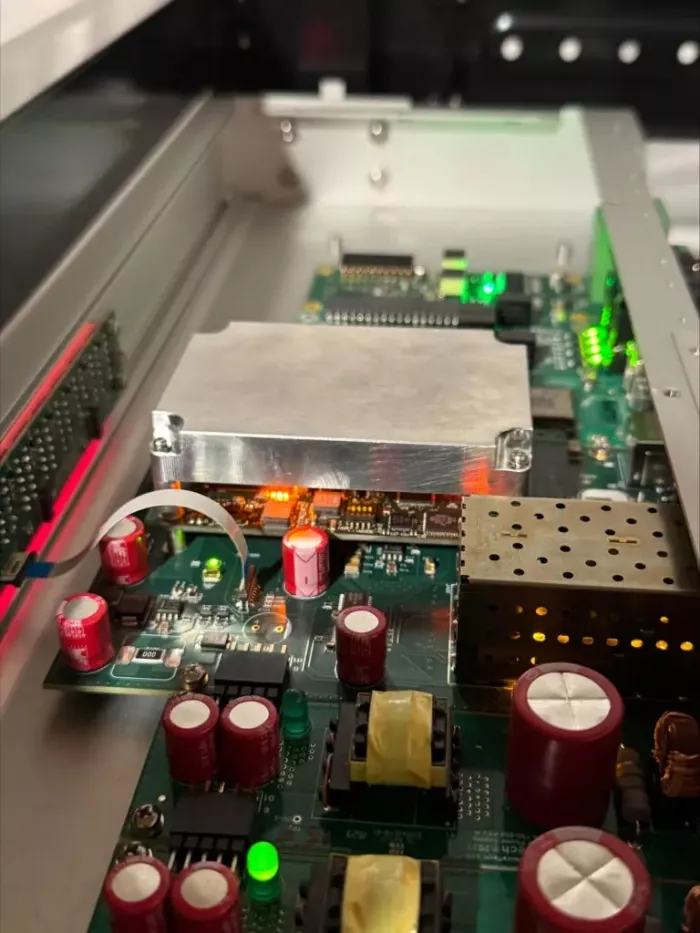
For the Kronos 3R, NovaTech selected SOC-E solutions to implement two critical capabilities: IEEE 1588 PTP grandmaster functionality and IEC 62439-3 PRP Ethernet redundancy. Both are implemented directly in the FPGA programmable logic of the platform via the SOC-E SMARTzynq System-on-Module, built on the AMD Xilinx Zynq-7000 SoC.
The selected solutions are SOC-E’s PreciseTimeBasic (PTB) IP core for IEEE 1588 hardware timestamping and the HSR-PRP Switch (HPS) IP core for zero-recovery-time network redundancy. Unlike software-based timing and switching approaches, these are logical solutions implemented directly in programmable hardware, operating independently of the Linux processing system running on the same device. In plain terms, they perform their functions in silicon rather than in software, which is what makes the nanosecond-level accuracy and zero-recovery-time redundancy achievable in a product intended for protection-grade applications.
The PTB IP core implements a hardware timestamping unit inserted between the MAC and PHY layers, capturing PTP event message timestamps with nanosecond resolution. This enables the Kronos 3R to operate as a grandmaster across power utility PTP profiles including IEEE C37.238-2011, IEEE C37.238-2016, and IEC 61850-9-3:2016. The HPS IP core implements IEC 62439-3 Edition 4.0 Parallel Redundancy Protocol entirely in hardware, with cut-through forwarding on ring ports for minimum latency. In a substation where a cable fault or switch failure cannot be permitted to interrupt time distribution to merging units and protection IEDs, this approach is essential for maintaining continuous grandmaster availability without recovery delay.
Explore SOC-E IP:
- PreciseTimeBasic (PTB) IP core
- 100M/1G/10G TSN Endpoint IP
- Hardware-only (VHDL) PTP slave clock
- 10M/100M/1G/10G Managed/Unmanaged (TSN) Ethernet Switch IP Core
Precision Timing for Critical Infrastructure
The incorporation of SOC-E IP technology into the Kronos 3R combines the GNSS expertise accumulated across the Kronos product line with communication and synchronization technologies specifically developed for the demands of industrial Ethernet and precision timing in IEC 61850 environments. NovaTech’s ability to integrate these capabilities into a compact 1U instrument reflects the depth of the collaboration between the two companies.
With the Kronos 3R, NovaTech continues a product line focused on delivering accurate, reliable, and operationally simple timing to the substation environment worldwide. The Series 3R represents a step forward in network integration, redundancy, and protocol breadth, serving both conventional substation architectures and the more demanding requirements of fully digital IEC 61850 deployments.
Supporting the Next Generation of Substation Deployments
SOC-E‘s participation in the Kronos 3R reflects its ongoing commitment to delivering high-performance FPGA IP for demanding industrial and infrastructure applications. By providing solutions aligned with established standards such as IEEE 1588 and IEC 62439-3, SOC-E contributes to enabling more capable, resilient, and interoperable substation timing systems worldwide.
Collaborations with companies such as NovaTech Automation highlight the value of combining domain expertise in electric utility products with specialized IP development capability. As IEC 61850 digital substation deployments continue to expand across global transmission and distribution networks, SOC-E remains focused on developing the underlying technology that makes those deployments possible.
Related Semiconductor IP
- PreciseTimeBasic (PTB) IP core
- 100M/1G/10G TSN Endpoint IP
- Hardware-only (VHDL) PTP slave clock
- 10M/100M/1G/10G Managed/Unmanaged (TSN) Ethernet Switch IP Core
- IEC 61850/62351 Substation Automation Systems Cryptographic IP Core
Related News
- SOC-E and SafeCore Devices to unveil a new TSN End Point IP Core: AeroTSN-EP
- VeriSilicon Expands DSP Portfolio with Silicon-Proven ZSP5000 Vision Core Series for Edge Intelligence
- Intel Core Ultra Series 3 Debuts as First Built on Intel 18A
- CAST Introduces 400 Gbps UDP/IP Hardware Stack IP Core for High-Performance ASIC Designs
Latest News
- GF unveils roadmap to deliver the world’s most advanced FD-SOI platform for Physical AI
- GlobalFoundries marks Dresden expansion milestone, announces next-generation platform for Physical AI
- TSMC September 2026 Revenue Report
- Lattice Collaborates with Arm to Advance Secure, Adaptable AI Data Center Infrastructure
- ZLG Selects CAST CAN XL and TSN IP for Next-Generation Vehicle-Network Development and Test Tools