NovaTech Automation Crius PIU: Bringing Conventional Instrument Transformers onto the IEC 61850 Process Bus

NovaTech Automation is extending its substation automation portfolio with Crius, a Process Interface Unit (PIU) that connects conventional current and voltage transformers to the IEC 61850 process bus. Crius acquires AC current and voltage signals from existing CTs and PTs and converts them into time-synchronized digital Sampled Values in accordance with IEC 61850-9-2 and IEC 61869-9. The product is currently in beta production.
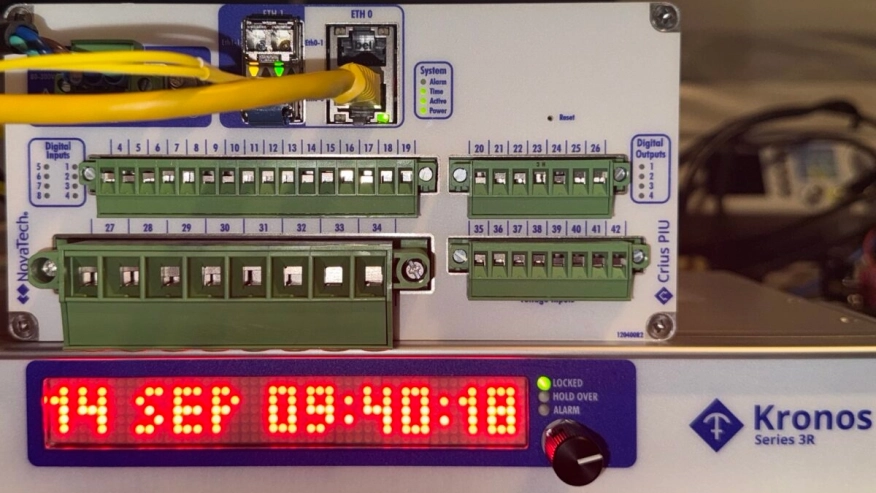 The Crius PIU addresses one of the practical realities of digital substation adoption. Utilities are not replacing their installed base of conventional instrument transformers, and the great majority of existing substations will continue to rely on them for many years. A process interface unit is the component that allows those assets to participate in a digital architecture, digitizing analog measurements at the point of acquisition and delivering them over Ethernet to protection and control IEDs. Alongside the analog acquisition function, Crius monitors eight discrete inputs and drives four relay outputs using IEC 61850-8-1 GOOSE messaging, supporting tripping, interlocking, and status indication between peer devices. Measured values and diagnostic information are available through IEC 61850 MMS Edition 2 for integration with substation automation systems and SCADA.
A Process Interface Unit Designed for Protection-Grade Service
Crius was developed for installation in relay panels and marshalling cabinets in substation environments, with an operating temperature range of -40 degrees C to +70 degrees C and a compact form factor that can be surface, DIN rail, or 19 inch rack mounted. Its development is part of NovaTech’s broader strategy of delivering tightly integrated measurement, automation, timing, and communications products for electric utilities worldwide.
Designing a device of this type places two demands on the underlying platform that dominate every other engineering consideration. The first is synchronization. A sampled value stream is only useful to a protection function if every sample carries an accurate, traceable timestamp and if samples taken by different devices across the substation correspond to the same instants in time. Differential protection, distance protection, and synchrophasor measurement all depend on that common time reference. A merging unit or process interface unit is therefore, in engineering terms, as much a precision timing instrument as it is a measurement device.
The second demand is network availability. Sampled values are published continuously as multicast Ethernet traffic, and the protection functions subscribing to those streams cannot tolerate an interruption. A cable fault, a switch failure, or a topology reconvergence event that takes even a short time to recover is a loss of the protection function itself for that duration. Conventional Ethernet redundancy mechanisms that rely on reconvergence are not adequate for this class of traffic.
SOC-E’s Contribution: IEEE 1588 Synchronization and HSR/PRP Redundancy
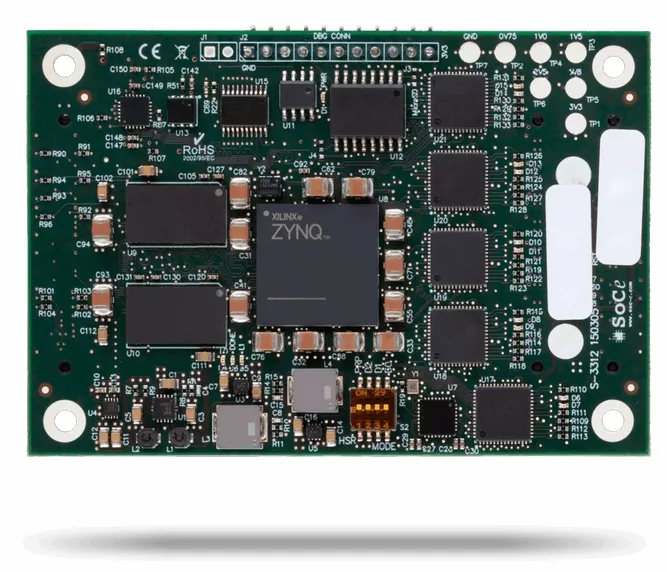
For Crius, NovaTech selected SOC-E solutions to address both requirements, implemented in the FPGA programmable logic of the SOC-E SMARTzynq System-on-Module, built on the AMD Xilinx Zynq-7000 SoC. This is the same platform NovaTech uses in the Kronos Series 3R GNSS clock, and the reuse of a proven module and IP set across two products in the portfolio has been a significant benefit to both programs.
Crius uses SOC-E’s PreciseTimeBasic (PTB) IP core to implement the IEEE 1588 slave function, with a hardware timestamping unit inserted between the MAC and PHY layers so that PTP event messages are timestamped in logic rather than in software. The recovered time reference from the PTP slave is then used by NovaTech’s own digital phase-locked loop, developed in house, to discipline the analog-to-digital conversion sampling clock. This division of responsibility has worked well in practice. SOC-E’s IP delivers a clean, hardware-timestamped time reference across the power utility PTP profiles the product supports, including IEEE C37.238-2011, IEEE C37.238-2017, and IEC 61850-9-3:2016, and NovaTech’s DPLL design uses that reference to place samples where they belong in time.
Explore SOC-E IP:
For network resilience, Crius uses SOC-E’s HSR-PRP Switch (HPS) IP core to implement IEC 62439-3 redundancy, giving zero recovery time in the event of a single network failure. As with the timing function, this is a logical solution implemented directly in programmable hardware, operating independently of the Linux processing system running on the same device. It performs its function in silicon rather than in software, which is what makes zero-recovery-time redundancy achievable in a device intended to carry protection-grade sampled value traffic. Crius provides dual SFP and dual copper RJ45 Ethernet ports, each pair configurable for HSR or PRP operation, allowing the product to be deployed into either redundancy architecture without hardware change.
A Synchronized Chain from Grandmaster to Process Bus
Taken together, Crius and the Kronos Series 3R form a complete timing and measurement chain built on common technology. The Kronos 3R uses the PTB IP core to serve as an IEEE 1588 grandmaster, traceable to GNSS, distributing time over a PRP network. Crius sits at the other end of that chain as a PTP slave, using the same core to recover time from the grandmaster and using it to timestamp and synchronize the sampled values it publishes onto the process bus. Both products use the HPS core so that the timing path and the measurement path carry the same redundancy properties end to end.
For a utility, this consistency has a straightforward operational value. The timing architecture of the substation does not change character between the clock and the measurement device, the same standards and the same redundancy protocol apply throughout, and the two products are engineered against a shared understanding of how time behaves on the network. For NovaTech as a developer, building both products on the SMARTzynq module with a common IP set has allowed engineering effort to be concentrated on the application layers that differentiate each product rather than on re-solving synchronization and redundancy separately for each one.
Supporting the Next Generation of Substation Deployments
SOC-E’s participation in the Crius program reflects its ongoing commitment to delivering high-performance FPGA IP for demanding industrial and infrastructure applications. By providing solutions aligned with established standards such as IEEE 1588 and IEC 62439-3, SOC-E contributes to enabling more capable, resilient, and interoperable digital substation systems worldwide.
Collaborations with companies such as NovaTech Automation highlight the value of combining domain expertise in electric utility products with specialized IP development capability. As IEC 61850 process bus deployments continue to expand across global transmission and distribution networks, and as utilities look for ways to bring their existing instrument transformer assets into digital architectures, SOC-E remains focused on developing the underlying technology that makes those deployments possible.
Related Semiconductor IP
- PreciseTimeBasic (PTB) IP core
- IEC 61850/62351 Substation Automation Systems Cryptographic IP Core
- 10G Unmanaged Ethernet Switch
- 10M/100M/1G Managed Ethernet Switch IP Core
- Configuration-over-Ethernet (COE) IP Core
Related Blogs
- Unveiling Ultra-Compact MACsec IP Core with optimized Flexible Crypto Block for 5X Size Reduction and Unmatched Efficiency from Comcores
- Keep Legacy Systems Running with a DO-254 HDLC & SDLC Part Replacement IP Core
- Beyond design automation: How we manage processor IP variants with Codasip Studio
- Tech Note: Use this Flexible and Efficient AC’97 IP Core for Simple Audio Interfaces and Legacy System Upgrades
Latest Blogs
- Tape-Out Readiness Checklist: Engineering Decisions That Prevent Costly Respins
- How Cadence DSPs Put In-Cabin AI Audio On-Chip in SemiDrive's X10
- The Fastest Path to Scalable Photonic Systems: Using Proven IP for both PIC and EIC designs
- Building Trusted AI Agents from the Silicon Root of Trust
- Heterogeneous Computing in Space