Verify the Verifier: Specification-Grounded LLM Cross-Checking for Bugs That Escape UVM Scoreboards
By Ana E. Sanchez Villalobos, Michael D. Quinn, Aakash Tyagi, Minh D. Luu, David Kebo Houngninou
Texas A&M University, College Station, TX, USA
Abstract
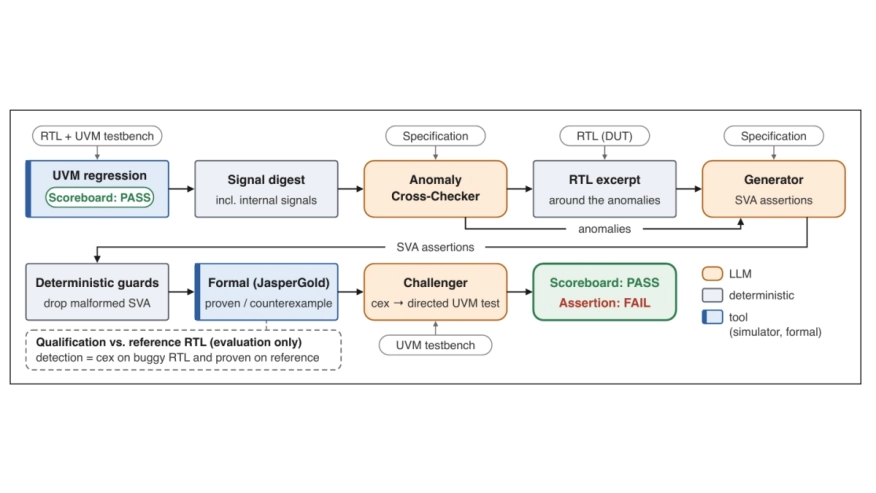
A passing UVM regression shows the design agrees with the reference model on what the scoreboard checks, not that it meets the specification. Bugs that pass every test yet violate the specification, termed scoreboard escapes, survive mature testbenches. We present Verify the Verifier, to our knowledge the first framework whose LLM-based Anomaly Cross-Checker examines a passing regression's traces against the specification. Of 564 bugs inserted into four OpenTitan IPs, 68 are candidate scoreboard escapes: non-equivalent, exercised by the tests, yet passing. The framework confirmed 41 as scoreboard escapes with assertions failing on the buggy design and proven on the original.
To read the full article, click here
Related Semiconductor IP
- MACsec Engine optimized for 10Base-T1S/T1L applications
- Dual Port, Voltage Scaling Register File Compiler on GF22FDX+
- Single Port, Voltage Scaling, High Speed SRAM Memory Compiler on GF22FDX+
- I3C Full Controller / Target
- I3C HCI Host Controller
Related Articles
- An Agentic Python Framework for LLM-Driven UVM Testbench Synthesis with Closed-Loop Compiler Feedback
- CD-PIM: A High-Bandwidth and Compute-Efficient LPDDR5-Based PIM for Low-Batch LLM Acceleration on Edge-Device
- FlexLLM: Composable HLS Library for Flexible Hybrid LLM Accelerator Design
- ChipBench: A Next-Step Benchmark for Evaluating LLM Performance in AI-Aided Chip Design
Latest Articles
- Verify the Verifier: Specification-Grounded LLM Cross-Checking for Bugs That Escape UVM Scoreboards
- PULSAR-V: I/O-Aware Post-Update Attestation for RISC-V
- PVTSizing 2.0: A Fast and Reliable Analog Circuit Sizing Operator for Agentic EDA Workflows
- An Agentic Python Framework for LLM-Driven UVM Testbench Synthesis with Closed-Loop Compiler Feedback
- Reconfiguring System-Level Protection Through Bounded Delegation in RISC-V MCUs