Dual Port, Voltage Scaling Register File Compiler on GF22FDX+
2 Port Register File w/dedicated Standby mode and “precharge” bit line to enable ultra Low Leakage - Bit Cell: TP185SL - Power Supply (V): 0.5V to 0.8V
Overview
2 Port Register File w/dedicated Standby mode and “precharge” bit line to enable ultra Low Leakage
- Bit Cell: TP185SL
- Power Supply (V): 0.5V to 0.8V
| Technology | GF 22nm FDX-PLUS |
| Bit Cell | 8T TP185SL, 0.185 µm² |
| Periphery VDD | 0.5 - 0.8 V nominal |
| Array VDM | 0.8 V nominal |
| Temperature | -40°C to +125°C |
| Power | Mesh |
| # Metal Layers | 4 |
| Modes | Functional / BIST / Scan / Sleep |
| Interface | Command line |
| Ports | 1 read-only / 1 write-only |
| Max Instance | 32 Kb |
| Min Instance | 128 b |
| Word Width | 4 - 64 bits |
| Word Depth | 16 - 1024 words |
| Column Fold | 4 / 8 |
| Write Enable | Optional bit or byte |
| Error Correction | SECDED |
| EDA Views (Partial List) | |
|---|---|
| GDSII Layout | LEF |
| LVS SPICE Netlist | Liberty: NLDM / CCS / LVF |
| Behavioral Verilog + Testbench | Structural Verilog |
| UPF / CPF Power Models | ATPG: generic / Tessent |
| Tessent MBIST Control | PDF / Text Datasheets |
| Bitmap (x,y) | APL PWL Power Model |
| Voltus Power Grid Scripts | Hierarchical LVS cell list |
Key features
- Dual-Port Architecture: Independent read-only and write-only ports support separate RCLK/WCLK, addresses, chip enables, and synchronous or asynchronous operation.
- Voltage Scaling: Periphery VDD supports 0.5 V to 0.8 V nominal operation while the register-file array operates at 0.8 V (VDM); level translation is internal to the macro.
- Low-Leakage Retention: Dedicated standby mode uses array source biasing and isolated array/periphery supplies so VDD can be powered off while memory contents are retained.
- Bit Cell: Uses GLOBALFOUNDRIES 22FDX-PLUS 8T TP185SL bit cells with a drawn area of approximately 0.185 µm². Compiler enables "pre-charge" of bit line which reduces primary source of leakage in this bit cell.
- Bit / Byte Write: Optional bit write enables independent writes to any subset of a word; programmable byte-wide write enable reduces control-pin count.
- Error Protection: Optional SECDED logic provides single-bit correction and dual-bit detection, including support for multiple correctable units within a word.
- Body Bias & Power Modes: Optional RBB control adjusts periphery speed/leakage. Five power states support fully on, periphery standby, full standby, retention, and power off.
- Test & DFT Support: Optional soft BIST muxing, scan bypass, generic/Tessent ATPG views, and Tessent MBIST control simplify production test integration.
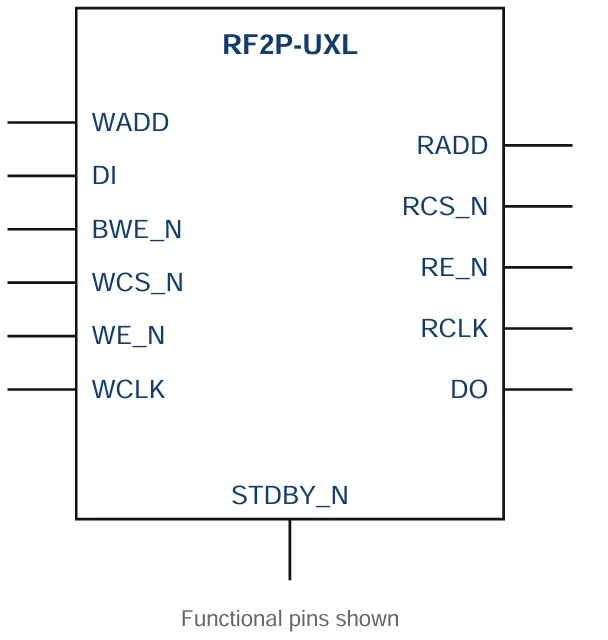
Block Diagram
Silicon Options
| Foundry | Node | Process | Maturity |
|---|---|---|---|
| GlobalFoundries | 22nm | FDX+ | Available on request |
Specifications
Identity
Files
Note: some files may require an NDA depending on provider policy.
Provider
Learn more about Register File IP core
SkyWater Announces Availability of SRAM Memory Compiler for 90 nm Strategic Rad Hard by Process Offering
Mobile Semiconductor's 22FDX Register File Memory Compiler Receives Globalfoundries Platinum Status
Mobile Semiconductor's Enhanced Memory Compilers Dramatically Improve Power On Edge AI Devices
Mobile Semiconductor Licenses memory compilers to Sandia National Laboratories
Mobile Semiconductor Introduces a 22nm FDX (FDSOI) ULP Memory Compiler with Market Leading Features
Frequently asked questions about Register File IP cores
What is Dual Port, Voltage Scaling Register File Compiler on GF22FDX+?
Dual Port, Voltage Scaling Register File Compiler on GF22FDX+ is a Register File IP core from Nordic Semiconductor Seattle listed on Semi IP Hub. It is listed with support for globalfoundries Available on request.
How should engineers evaluate this Register File?
Engineers should review the overview, key features, supported foundries and nodes, maturity, deliverables, and provider information before shortlisting this Register File IP.
Can this semiconductor IP be compared with similar products?
Yes. Buyers can compare this product with similar semiconductor IP cores or IP families based on category, provider, process options, and structured technical specifications.