An Agentic Python Framework for LLM-Driven UVM Testbench Synthesis with Closed-Loop Compiler Feedback
By Vikash Kumar, Arm
Abstract
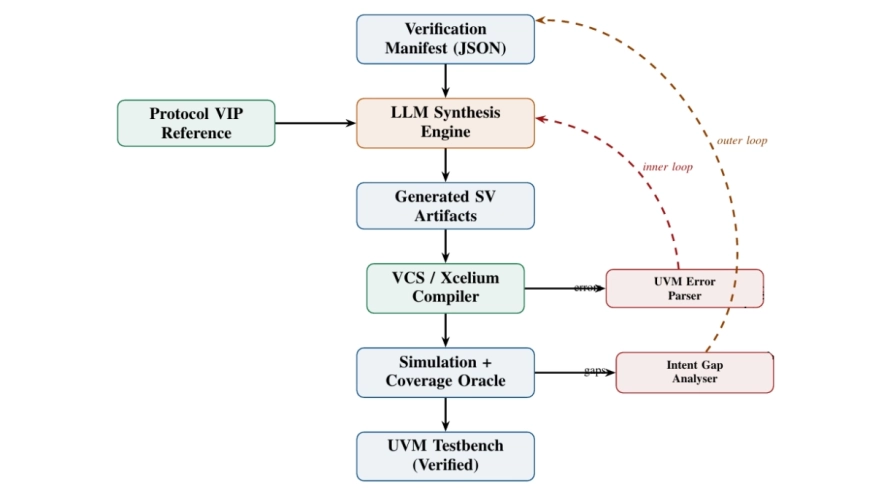
Protocol bridge verification is a persistent bottleneck in SoC development: for every new bridge instance, engineers hand-craft a full UVM testbench from scratch, consuming 40-100 engineering hours of bring-up effort. We present an agentic Python framework that generates complete, protocol-aware UVM testbenches for arbitrary IP and subsystem configurations from a structured Verification Manifest—a JSON specification encoding interface topology, protocol semantics, and coverage intent. The framework employs a dual closed-loop architecture: an inner compiler feedback loop that injects categorised UVM diagnostics rather than raw tool output, and an outer coverage loop driven by intent-gap analysis against the Manifest. Validated on the AMBA AHB-to-APB bridge—a representative production protocol bridge with a 7-state control FSM, two-phase APB handshake, and non-trivial burst serialisation logic—the framework achieves 96.8% functional coverage, a 4.7× bring-up speedup, and a Protocol Verification Completeness score of 0.87, with only 2.1% of the generated 4,623-line testbench requiring human correction. The generated scoreboard independently identified a critical RTL functional fault that the manual baseline missed entirely. Generalisation across four protocol families confirms that speedup increases with protocol complexity, ranging from 3.1× (APB Subordinate) to 6.1× (CHI Subordinate).
Index Terms—UVM, testbench automation, agentic AI, large language models, closed-loop compiler feedback, protocol verification, verification manifest, chiplet, subsystem verification
To read the full article, click here
Related Semiconductor IP
- AMBA LPI Verification IP
- AMBA CXS Verification IP
- AMBA 5 CHI Verification IP
- AMBA AXI5-Lite Interconnect Verification IP
- AMBA AXI5-Lite Verification IP
Related Articles
- Unveiling Efficient UVM Register Modeling with IDesignSpec™ GDI by Agnisys®
- OmniSim: Simulating Hardware with C Speed and RTL Accuracy for High-Level Synthesis Designs
- Automated Pre-Silicon Verification of High-Speed DDR5 and LPDDR5/6 Memory Controllers: Closed-Loop Timing, Mode Register, and PHY Synchronization in UVM
- Opto-electronics -> Architectural synthesis provides flexibilty in optical network design
Latest Articles
- An Agentic Python Framework for LLM-Driven UVM Testbench Synthesis with Closed-Loop Compiler Feedback
- Reconfiguring System-Level Protection Through Bounded Delegation in RISC-V MCUs
- SkipLane: Write-Once, Conflict-Free Accumulation for Zero-Skipping CNN Engines on FPGAs
- Priority-Aware Deficit Round Robin for AXI4 Bandwidth Fairness in ASAP-7nm Process
- Atik: A Shared-Mesh Transformer Accelerator for RISC-V