CD-PIM: A High-Bandwidth and Compute-Efficient LPDDR5-Based PIM for Low-Batch LLM Acceleration on Edge-Device
By Ye Lin 1, Chao Fang 1, Xiaoyong Song 2, Qi Wu 1, Anying Jiang 1, Yichuan Bai 1, Li Du 1
1 School of Electronic Science and Engineering, Nanjing University, China
2 China Mobile Research Institute, China
Abstract
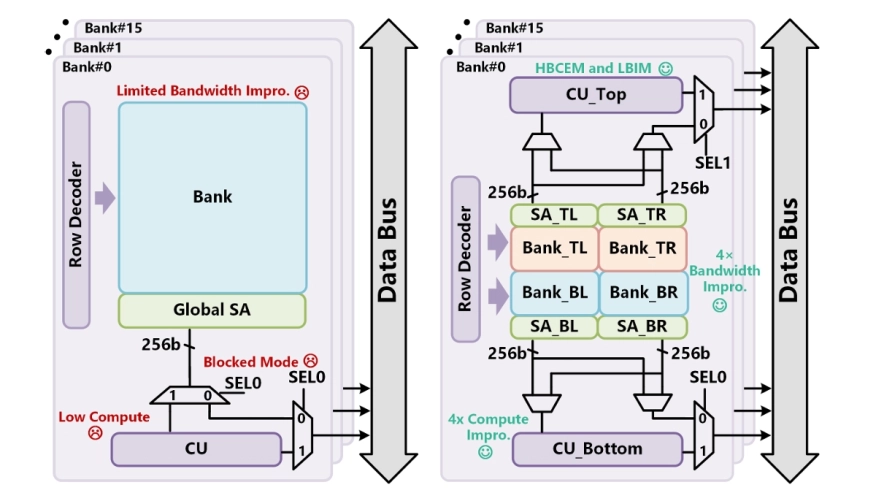
Edge deployment of low-batch large language models (LLMs) faces critical memory bandwidth bottlenecks when executing memory-intensive general matrix-vector multiplications (GEMV) operations. While digital processing-in-memory (PIM) architectures promise to accelerate GEMV operations, existing PIM-equipped edge devices still suffer from three key limitations: limited bandwidth improvement, component under-utilization in mixed workloads, and low compute capacity of computing units (CUs). In this paper, we propose CD-PIM to address these challenges through three key innovations. First, we introduce a high-bandwidth compute-efficient mode (HBCEM) that enhances bandwidth by dividing each bank into four pseudo-banks through segmented global bitlines. Second, we propose a low-batch interleaving mode (LBIM) to improve component utilization by overlapping GEMV operations with GEMM operations. Third, we design a compute-efficient CU that performs enhanced GEMV operations in a pipelined manner by serially feeding weight data into the computing core. Forth, we adopt a column-wise mapping for the key-cache matrix and row-wise mapping for the value-cache matrix, which fully utilizes CU resources. Our evaluation shows that compared to a GPU-only baseline and state-of-the-art PIM designs, our CD-PIM achieves 11.42x and 4.25x speedup on average within a single batch in HBCEM mode, respectively. Moreover, for low-batch sizes, the CD-PIM achieves an average speedup of 1.12x in LBIM compared to HBCEM.
To read the full article, click here
Related Semiconductor IP
- NPU IP
- JPEG XL Encoder
- I2C Master/Slave Controller Core
- NVMe Validation Test Suite
- Hybrid Memory Cube Verification IP
Related Articles
Latest Articles
- Anechoic: Onsager-Corrected Parallel Annealing for Sub-0.1 ms Dense Max-Cut on an FPGA
- Power, Performance, and Area of HPC-Based Malware Detectors: An FPGA and Open-PDK ASIC Study
- Terracotta: Enabling the Adoption of New DRAM Techniques via a Flexible DRAM Interface and Memory Controller
- A Framework for Accelerating Transformer Inference on RISC-V for Edge AI
- An Interleaved Parallel Dependent Quantization Hardware Architecture for H.266/VVC