Reconfiguring System-Level Protection Through Bounded Delegation in RISC-V MCUs
By Luís Cunha 1, José Martins 2, Manuel Rodríguez 1, Tiago Gomes 1, Uwe Moslehner 3, Kai Dieffenbach 3, Georg Schmalz 3, Kajetan Nuernberger 3, Thomas Roecker 3, Sandro Pinto 1
1 ALGORITMI Research Centre/LASI, University of Minho, Braga, Portugal
2 OSYX Technologies, Guimarães, Portugal
3 Infineon Technologies AG, Munich, Germany
Abstract
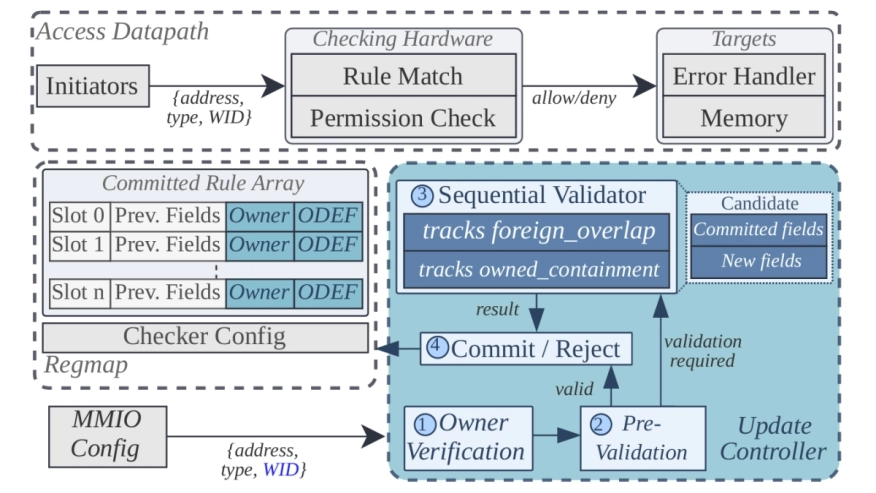
MCU-based embedded and cyber-physical systems increasingly require protection policies to change at runtime as resources, software, and system composition evolve. Yet widely used COTS MCU protection mechanisms are still largely designed around statically established policies. While they can restrict which domains modify protection primitives, they generally do not constrain what policy an authorized domain may create. As a result, domains may expand protection rules beyond their intended scope or interfere with boundaries established by other domains. We identify bounded configuration authority as a missing primitive for secure dynamic policy evolution and introduce an ownership-aware model in which explicit ownership and rule containment bound both configuration authority and recursive delegation. Changes to active protection-rule ranges are validated before commit, preserving protection boundaries without extending the normal access-checking datapath. We implement the model in an open-source RISC-V World Checker integrated into a CVA6-based SoC. Our FPGA evaluation shows no degradation in access latency or operating frequency, with 7.1% LUT and 1.2% FF overhead for eight rules. In an OTA update case study, direct reconfiguration under delegated authority reduces policy-transition latency by 89.5% over hypervisor mediation and 94.6% over trusted firmware mediation, while preserving established authority boundaries. All artifacts will be open-sourced to support the evolution of RISC-V specifications and system-level protection designs.
To read the full article, click here
Related Semiconductor IP
- RISC-V Debug & Trace IP
- RISC-V IOPMP IP
- Gen#2 of 64-bit RISC-V core with out-of-order pipeline based complex
- 64-bit RISC-V core with in-order single issue pipeline. Tiny Linux-capable processor for IoT applications.
- Multi-core capable RISC-V processor with vector extensions
Related Articles
- Enabling RISC-V Vector Code Generation in MLIR through Custom xDSL Lowerings
- RISC-V in 2025: Progress, Challenges,and What’s Next for Automotive & OpenHardware
- HIPR: Hardware IP Protection through Low-Overhead Fine-Grain Redaction
- Hardware vs. Software Implementation of Warp-Level Features in Vortex RISC-V GPU
Latest Articles
- Reconfiguring System-Level Protection Through Bounded Delegation in RISC-V MCUs
- SkipLane: Write-Once, Conflict-Free Accumulation for Zero-Skipping CNN Engines on FPGAs
- Priority-Aware Deficit Round Robin for AXI4 Bandwidth Fairness in ASAP-7nm Process
- Atik: A Shared-Mesh Transformer Accelerator for RISC-V
- GSPIM: A Temporal-Locality-Aware 4D Gaussian Splatting Accelerator with Polymorphic PIM and Multi-Frame Rendering Dataflow