PULSAR-V: I/O-Aware Post-Update Attestation for RISC-V
By Niccolò Lentini, Stefano Di Carlo, Alessandro Savino
Control and Computer Engineering Department, Politecnico di Torino, Turin, Italy
Absract
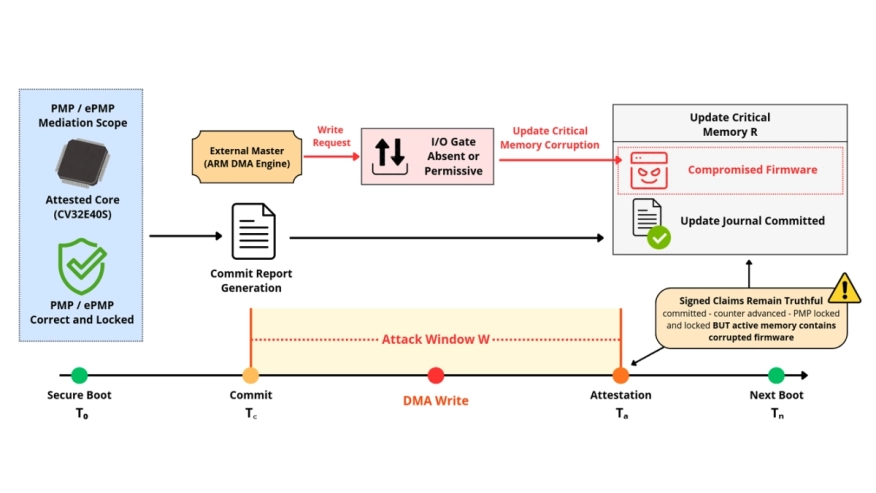
Post-update attestation proves that a device installed the intended firmware, not that the image stayed protected until the report was signed. In a multi-master SoC, a master outside the attested processor can corrupt update-critical memory. In contrast, the firmware identity, lifecycle state, and the CPU's protection evidence remain byte-identical to a healthy device's. We present PULSAR-V, a post-update attestation architecture which binds the authenticated update commit to the effective permissions and immutability of both gates (PMP/EPMP on the CPU, the I/O policy mediating DMA), sampled at the commit and at attestation, the I/O gate latching its own commit-time state in hardware. In a RISC-V SoC prototyped on a ZCU102 FPGA (CV32E40S core with 16 PMP regions, IOPMP-style unit, AXI write guard), a 256-byte write from the board's Arm DMA engine bypasses PMP and corrupts the committed image: every conventional claim stays true, and PULSAR-V rejects the device on its I/O-policy evidence alone. It also rejects an intact device whose policy left the image writable, a verdict no integrity check can reach. The gate and its commit latch cost 436 LUTs, 4.6% of the SoC, and evidence collection takes 43.1k cycles independent of image size, 41x less than re-hashing 16 KiB.
Index Terms—remote attestation, firmware update, RISC-V, PMP, IOPMP, DMA, FPGA
To read the full article, click here
Related Semiconductor IP
- RISC-V Debug & Trace IP
- RISC-V IOPMP IP
- Gen#2 of 64-bit RISC-V core with out-of-order pipeline based complex
- 64-bit RISC-V core with in-order single issue pipeline. Tiny Linux-capable processor for IoT applications.
- Multi-core capable RISC-V processor with vector extensions
Related Articles
- Bio-RV: Low-Power Resource-Efficient RISC-V Processor for Biomedical Applications
- Crypto-RV: High-Efficiency FPGA-Based RISC-V Cryptographic Co-Processor for IoT Security
- System-Level Isolation for Mixed-Criticality RISC-V SoCs: A "World" Reality Check
- VMXDOTP: A RISC-V Vector ISA Extension for Efficient Microscaling (MX) Format Acceleration
Latest Articles
- PULSAR-V: I/O-Aware Post-Update Attestation for RISC-V
- PVTSizing 2.0: A Fast and Reliable Analog Circuit Sizing Operator for Agentic EDA Workflows
- An Agentic Python Framework for LLM-Driven UVM Testbench Synthesis with Closed-Loop Compiler Feedback
- Reconfiguring System-Level Protection Through Bounded Delegation in RISC-V MCUs
- SkipLane: Write-Once, Conflict-Free Accumulation for Zero-Skipping CNN Engines on FPGAs