Vendor: Digital Blocks, Inc. Category: I2C / I3C

I3C HCI Host Controller

AMBA MIPI I3C HCI v1.2 Host Controller

Compliant Controller I3C View all specifications

Overview

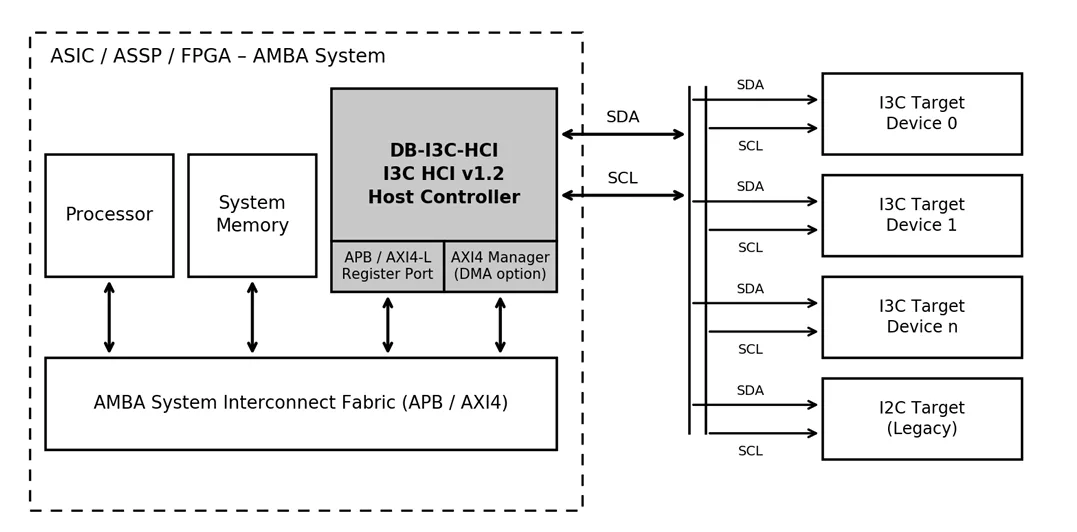
The Digital Blocks DB-I3C-HCI-APB IP Core is an I3C Controller with the MIPI I3C Host Controller Interface (HCI) v1.2 register model. Because the register model is standard, the core runs under standard HCI software, such as the Linux mipi-i3c-hci driver, with no custom driver.

Command descriptors written by software are turned into I3C transfers by the Digital Blocks I3C Controller engine, compliant with MIPI I3C Basic v1.2: SDR up to 12.5 Mbps, HDR-DDR at 25 Mbps, and legacy I2C. Address assignment, In-Band Interrupts, Hot Join, Target Reset and bus recovery run in hardware.

Release 1 moves data by programmed I/O (PIO) through an APB or AXI4-Lite register port. Release 2 adds DMA through an AXI4 manager.

Verification Method

The test suite drives the core through a model of the HCI software flows – PIO queues and, for DMA, rings in a host-memory model – and checks every bus frame, response and IBI against expected results. The I3C bus side uses the Digital Blocks I3C Target, third-party Target models, and commercial MIPI I3C Verification IP as Targets and protocol checker.

Hardware validation runs the upstream Linux mipi-i3c-hci driver on an FPGA platform with real I3C devices and a protocol analyzer.

Key features

  • MIPI I3C HCI v1.2 Host Controller:
    • Standard capability, operation and interrupt registers; Device Address Table and Device Characteristics Table
    • PIO data transfer: command, response, TX / RX data and IBI queues
    • DMA option (Release 2): command / response rings, scatter-gather data buffers and IBI rings through a 64-bit AXI4 manager
  • I3C bus: SDR at all speed modes, HDR-DDR, and legacy I2C devices
  • Bus management in hardware:
    • Dynamic address assignment (ENTDAA) and SETDASA from the Device Address Table
    • In-Band Interrupts with payload; Hot-Join; automatic reject and disable of unwanted requests
    • CCCs with defining bytes, and automatic retry after a NACK
    • Target Reset, and bus recovery: stuck-SDA recovery, forced STOP, HDR Exit
    • Auto-Command: reads issued automatically on Pending Read notifications
  • Error handling: halt on error and resume, abort, and command-sequence timeout detection
  • Planned options: IBI time stamping and credit counting; combined and scheduled commands; Standby Controller Mode and Dead Bus Recovery
  • Digital Blocks extended capability for HDR-BT and Multi-Lane x2 / x4, outside the standard HCI driver
  • Parameterized queues and tables: command / response 16 entries, TX / RX data and IBI 64 DWORDs, Device Address Table 32 and Device Characteristics Table 8 entries by default
  • Integration:
    • APB with byte strobes, or AXI4-Lite, register port; AXI4 manager for DMA
    • Single interrupt
    • Synthesizable SystemVerilog; DFT scan-mode reset control
  • Software:
    • Linux: the upstream mipi-i3c-hci driver in the Linux I3C subsystem, with a device-tree fragment
    • Bare-metal C driver
  • Compliance:
    • MIPI I3C HCI v1.2 and MIPI I3C TCRI v1.0
    • MIPI I3C Basic v1.2 bus behavior; NXP I2C-bus specification UM10204
    • AMBA APB, AXI4-Lite and AXI4

Block Diagram

What’s Included?

The DB-I3C-HCI-APB is available as synthesizable SystemVerilog RTL or an FPGA netlist, with Synopsys Design Constraints, the simulation test bench with expected results, a bare-metal C driver, a Linux device-tree fragment and integration note, and documentation: datasheet, Technical Reference Manual, Integration Guide and coverage report.

Specifications

Identity

Part Number
DB-I3C-HCI-APB
Vendor
Digital Blocks, Inc.
Type
Silicon IP
Controller / PHY
Controller

Standards & Interfaces

Compliance Status
Compliant
Protocol Support
I3C

Files

Note: some files may require an NDA depending on provider policy.

Provider

Learn more about I2C / I3C IP core

From I2C to I3C: Evolution of Two-Wire Communication in Embedded Systems

The I2C (Inter-Integrated Circuit) Bus invented in 1980 by Philips Semiconductors (NXP Semiconductors today) was a massive step forward in simplifying communications in embedded systems. It is a simple two-wire interface for synchronous, multi-master/multi-slave, single ended serial communication. Fast forward 45 years to today and it is still widely used for attaching low speed peripheral Integrated Circuits (ICs), processors and microcontrollers. But silicon today has changed...

Maximizing the Usability of Your Chip Development: Design with Flexibility for the Future

Early in my career selling chips for Motorola Semiconductor, the ability to spin derivative microcontroller chips for a customer’s specific requirement was relatively straightforward. If the volume looked reasonable, we would tape-out a new chip with a few added features because mask costs and wafers were relatively inexpensive at the larger process nodes. The customer won by getting an MCU tailored to their specific need, and Motorola won by gaining a more committed customer plus another SKU that could be sold to other customers – boosting ROI. With the migration to higher cost FinFET nodes, those times are long gone as the economics no longer work.

MIPI CCI over I3C: Faster Camera Control for SoC Architects

Imagine a camera subsystem that responds in microseconds, consumes less power, and offers a more straightforward route to time-to-market. For SoC architects and IP integration teams, that vision is increasingly possible with MIPI Camera Control Interface (CCI) over I3C.

Frequently asked questions about I2C / I3C IP cores

What is I3C HCI Host Controller?

I3C HCI Host Controller is a I2C / I3C IP core from Digital Blocks, Inc. listed on Semi IP Hub.

How should engineers evaluate this I2C / I3C?

Engineers should review the overview, key features, supported foundries and nodes, maturity, deliverables, and provider information before shortlisting this I2C / I3C IP.

Can this semiconductor IP be compared with similar products?

Yes. Buyers can compare this product with similar semiconductor IP cores or IP families based on category, provider, process options, and structured technical specifications.

×
Semiconductor IP