Secure Multi-Path Routing with All-or-Nothing Transform for Network-on-Chip Architectures
By Hansika Weerasena, Matthew Randall and Prabhat Mishra
University of Florida, Gainesville, Florida, USA
Abstract
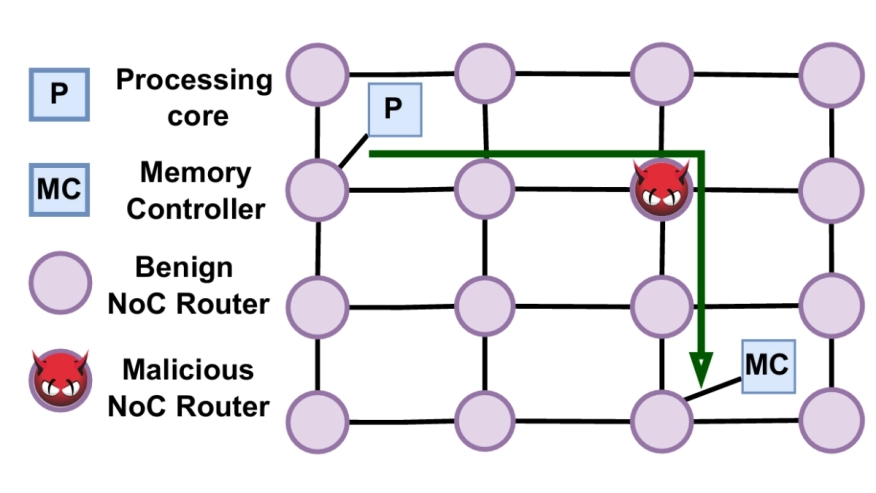
Ensuring Network-on-Chip (NoC) security is crucial to design trustworthy NoC-based System-on-Chip (SoC) architectures. While there are various threats that exploit on-chip communication vulnerabilities, eavesdropping attacks via malicious nodes are among the most common and stealthy. Although encryption can secure packets for confidentiality, it may introduce unacceptable overhead for resource-constrained SoCs. In this paper, we propose a lightweight confidentiality-preserving framework that utilizes a quasi-group based All-Or-Nothing Transform (AONT) combined with secure multi-path routing in NoC-based SoCs. By applying AONT to each packet and distributing its transformed blocks across multiple non-overlapping routes, we ensure that no intermediate router can reconstruct the original data without all blocks. Extensive experimental evaluation demonstrates that our method effectively mitigates eavesdropping attacks by malicious routers with negligible area and performance overhead. Our results also reveal that AONT-based multi-path routing can provide 7.3x reduction in overhead compared to traditional encryption for securing against eavesdropping attacks.
To read the full article, click here
Related Semiconductor IP
- FlexGen Multi-Die Smart Network-on-Chip (NoC) IP
- NoC Interconnect IP Generator
- NoC Silicon IP for RISC-V based chips supporting the TileLink protocol
- NoC Verification IP
- FlexGen Smart Network-on-Chip (NoC) IP
Related Articles
- MeshKV: A Network-on-Chip KV Cache Fabric for Scalable Transformer Decoding Accelerators
- A Methodology for Performance Analysis of Network-on-Chip Architectures for Video SoC
- Configure, Confirm, Ship: Build Secure Processor-Based Systems with Faster Time-to-Market
- Optimize SoC Design with a Network-on-Chip Strategy
Latest Articles
- Terracotta: Enabling the Adoption of New DRAM Techniques via a Flexible DRAM Interface and Memory Controller
- A Framework for Accelerating Transformer Inference on RISC-V for Edge AI
- An Interleaved Parallel Dependent Quantization Hardware Architecture for H.266/VVC
- A Formal Security Analysis of CAN XL
- A Secure dToF LiDAR SoC with Dual-Domain Fingerprinting and Event-Driven AFE Circuit Achieving Sensor-Level Attack Resilience