Memory Prefetching Evaluation of Scientific Applications on a Modern HPC Arm-Based Processor
By Nam Ho 1; Carlos Falquez 1; Antoni Portero 1; Estela Suarez 1,2,3; Dirk Pleiter 4,5
1 Jülich Supercomputing Centre, Institute for Advanced Simulation, Forschungszentrum Jülich GmbH, 52428 Jülich, Germany
2 Computer Science Department, Rhenish Friedrich Wilhelm University of Bonn, 53113 Bonn, Germany
3 SiPearl, 78600 Maisons-Laffitte, France
4 Division of Computational Science and Technology, EECS, KTH Royal Institute of Technology, 114 28 Stockholm, Sweden
5 Department of Computer Science, Bernoulli Institute, FSE, University of Groningen, 9712 CP Groningen, The Netherlands
Abstract
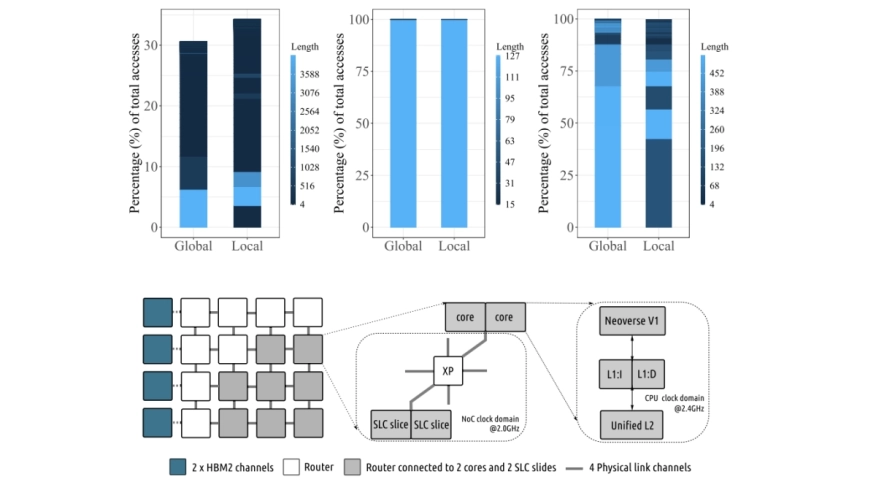
Memory prefetching is a well-known technique for mitigating the negative impact of memory access latencies on memory bandwidth. This problem has become more pressing as improvements in memory bandwidth have not kept pace with increases in computational power. While much existing work has been devoted to finding appropriate prefetching techniques for specific workloads, few provide insight into the behavior of scientific applications to better understand the impact of prefetchers. This paper investigates the impact of hardware prefetchers on the latest Arm-based high-end processor architectures. In this work, we investigate memory access patterns by analyzing locality properties and visualizing delta and repetitive address patterns. A deeper understanding of memory access patterns allows the use of the appropriate prefetcher and reaching a better correlation between access pattern properties and prefetcher performance. This can guide future co-design efforts. We evaluated traditional and innovative prefetchers using a gem5-based model of Arm Neoverse V1 cores. The model features a 16-core architecture, using Amazon’s Graviton 3 processor as a hardware reference, but substituting DDR5 by high bandwidth memory (HBM2). We performed a detailed prefetching evaluation focusing on stencil, sparse matrix-vector multiplication, and Breadth-First Search kernels. These kernels represent a broad range of the applications running on today’s High-Performance Computing (HPC) systems, which are sensitive to memory performance.
To read the full article, click here
Related Semiconductor IP
- NPU IP
- JPEG XL Encoder
- I2C Master/Slave Controller Core
- NVMe Validation Test Suite
- Hybrid Memory Cube Verification IP
Related Articles
- Interstellar: Fully Partitioned and Efficient Security Monitoring Hardware Near a Processor Core for Protecting Systems against Attacks on Privileged Software
- A Survey on the Design, Detection, and Prevention of Pre-Silicon Hardware Trojans
- Memory Safety Features Impact on Ibex based processor area
- Physical Design Exploration of a Wire-Friendly Domain-Specific Processor for Angstrom-Era Nodes
Latest Articles
- Terracotta: Enabling the Adoption of New DRAM Techniques via a Flexible DRAM Interface and Memory Controller
- A Framework for Accelerating Transformer Inference on RISC-V for Edge AI
- An Interleaved Parallel Dependent Quantization Hardware Architecture for H.266/VVC
- A Formal Security Analysis of CAN XL
- A Secure dToF LiDAR SoC with Dual-Domain Fingerprinting and Event-Driven AFE Circuit Achieving Sensor-Level Attack Resilience