BARE-AI: Bit-Flip Attack Resilience in AI Hardware through Built-in Performance Monitors
By Habibur Rahaman 1, Swastik Bhattacharya 2, Sanjay Das 2, Kanad Basu 3, Swarup Bhunia 1
1 University of Florida
2 University of Texas at Dallas
3 Rensselaer Polytechnic Institute
Abstract
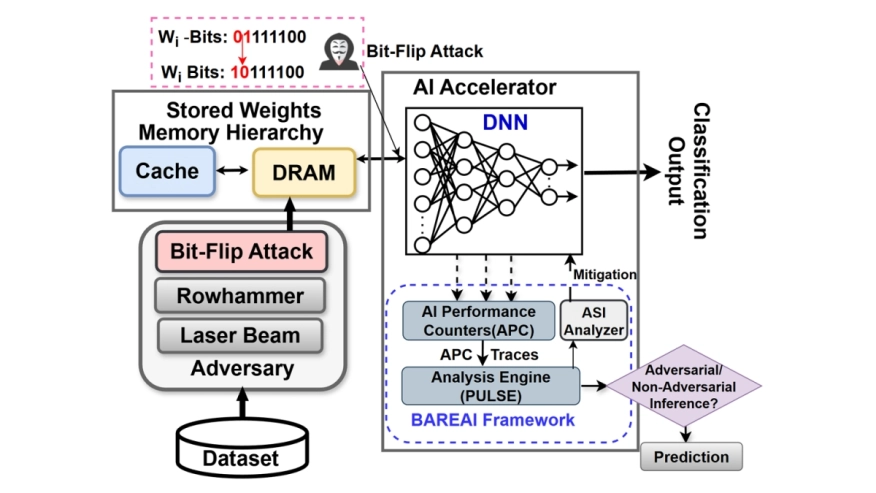
Deep Neural Networks (DNNs) are integral to many safety critical systems, yet they remain highly vulnerable to bit-flip attacks (BFAs), where a few memory level perturbations can drastically degrade accuracy. Existing defenses incur significant hardware overhead, depend on retraining, or fail against targeted flips. We propose BARE-AI, a runtime framework that detects, localizes, and mitigates BFAs during inference. BARE-AI introduces AI Performance Counters (APCs), lightweight hardware monitors in the accelerator datapath that capture per-layer activation statistics such as sparsity, entropy, kurtosis, and spectral shift. These are analyzed by the Predictive Unit for Layer Security Evaluation (PULSE), a compact detector trained offline as an ensemble of classifiers and realized on-chip as a small neural engine. For explainability and recovery, BARE-AI introduces an Activation Shift Index (ASI) for layer level fault localization and a z-score based repair that resets anomalous weights toward clean layer statistics. Across CNNs, Vision Transformers, and Large Language Models under random, targeted, adaptive, and magnitude based BFAs, BARE-AI achieves up to 98% detection accuracy on vision models and 74% to 95% on language models, restores near clean accuracy for CNNs and ViTs, and provides partial recovery for LLMs. Synthesized at 28nm, the monitoring infrastructure incurs under 3% energy, under 4% area, and about 10% latency overhead, with a configurable operating point that reduces latency overhead to about 6%. Unlike error correcting codes, whose redundancy grows with the number of tolerated flips, BARE-AI's overhead remains constant regardless of attack strength, making it attractive for resource constrained, safety critical edge applications such as autonomous systems, energy, and healthcare.
Index Terms — DNN, AI Performance Counters, Bit-Flip Attack, AI Safety, AI accelerators, hardware security, runtime monitoring.
To read the full article, click here
Related Semiconductor IP
Related Articles
- Input-Triggered Hardware Trojan Attack on Spiking Neural Networks
- All-in-One Analog AI Hardware: On-Chip Training and Inference with Conductive-Metal-Oxide/HfOx ReRAM Devices
- David vs. Goliath: Can Small Models Win Big with Agentic AI in Hardware Design?
- Hardware Mechanisms to Dynamically Throttle AI Performance
Latest Articles
- BARE-AI: Bit-Flip Attack Resilience in AI Hardware through Built-in Performance Monitors
- RFChipAgent: Multi-Agentic AI Flow for Analog/RF Chip Design
- Anechoic: Onsager-Corrected Parallel Annealing for Sub-0.1 ms Dense Max-Cut on an FPGA
- Power, Performance, and Area of HPC-Based Malware Detectors: An FPGA and Open-PDK ASIC Study
- Terracotta: Enabling the Adoption of New DRAM Techniques via a Flexible DRAM Interface and Memory Controller