A Cross-Domain Matrix Engine for Signal Processing and Deep Neural Net Inference
By Mehdi Safarpour, University of Oulu
Abstract
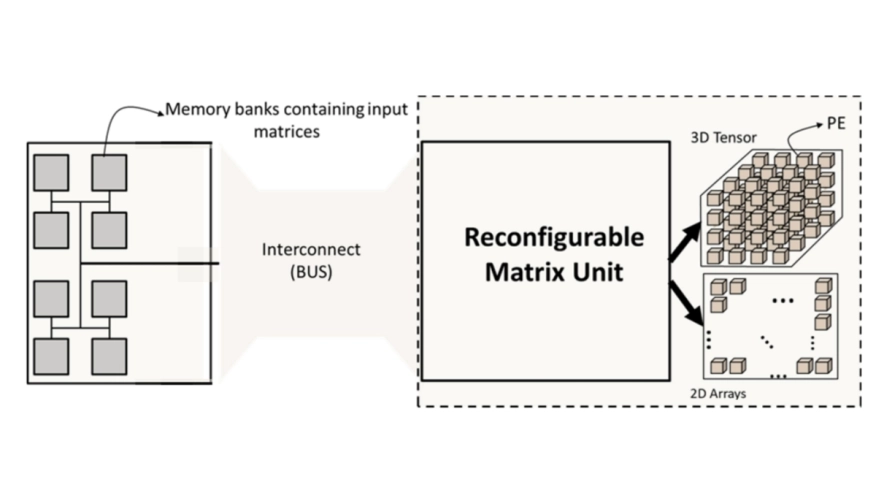
Matrix multiplication dominates both PHY signal processing and Deep Neural Network (DNN) inference, yet these domains place opposing demands on the matrix engine. Signal processing requires low-latency execution of relatively small matrix operations, whereas DNN inference, particularly at large batch sizes, prioritizes high throughput and energy efficiency for large matrix multiplications. While offering efficient memory access profile, a Systolic Array (SA) adds fill and drain delays per matrix. Those can be amortized for large matrices but not for small matrices. Conversely, a tensor unit completes the kernel in few cycles but would require repeated reads of same operand tiles over large matrices. This makes SA too slow for signal processing and tensor too inefficient for AI. We show that this need not be a choice between systolic and tensor structuring of Multiply-Accumulate (MAC) units. We propose a single engine that operates primarily as a SA and, through low-cost reconfiguration, transforms into a tensor-style engine on a per-operation basis. MUXes create both the spatial reduction adder tree and temporal reduction accumulators from the existing MACs and registers within the systolic array. The proposed reconfigurable SA simulated using modified SCALESim simulator, verified on an Zynq 702 FPGA and synthesized using ASAP 7nm FinFET library. SCALE-Sim simulations shows up to 7.5x lower latency for small complex value PHY kernels. Even on DNN workloads, it achieves up to 1.65x speedups over vanilla SA execution with trivial increase of memory accesses, retaining the systolic array's memory access advantage. Synthesis results estimate reconfigurable fabric costs only 8% power and 13.6% area overheads.
Index Terms — memory access, matrix engine, AI accelerator.
To read the full article, click here
Related Semiconductor IP
- Configurable Multi-Channel DMA Controller
- Samsung Foundry 4nm 1V8 GPIO I3C
- Root-of-Trust IP - High-Assurance Security for Advanced and Regulated Applications
- Root-of-Trust IP - Enhanced-Assurance, Configurable Security for Scalable Semiconductor Designs
- Root-of-Trust IP - Compact, Configurable Security for Flexible Semiconductor Designs
Related Articles
- AceleradorSNN: A Neuromorphic Cognitive System Integrating Spiking Neural Networks and Dynamic Image Signal Processing on FPGA
- A Heterogeneous Neural Network Accelerator for End-to-End Multitask RF Signal Recognition
- SynapticCore-X: A Modular Neural Processing Architecture for Low-Cost FPGA Acceleration
- VitaLLM: A Versatile and Tiny Accelerator for Mixed-Precision LLM Inference on Edge Devices
Latest Articles
- A Cross-Domain Matrix Engine for Signal Processing and Deep Neural Net Inference
- LLM Agent-Based Design of RISC-V CPUs with FPGA-in-the-Loop Evaluation
- Automated Multi-Line Bug Repair Using Model Checker Aided LLMs: A Case Study on RISC-V Processors
- Cryogenic Recharacterization of a Commercial 22 nm FD-SOI Foundry Standard-Cell Library
- A 105 MS/s 4.18 nJ/inference 0.765 mm² Mixed-Signal Streaming ML Engine for Wireless Baseband in 12LP+ FinFET