Hardware Mechanisms to Dynamically Throttle AI Performance
By Haiyue Ma, Lauren Malek, Joseph Forzani, David Wentzlaff
Princeton University, USA
Abstract
As more capable AI models are increasingly integrated into critical computer systems, the lack of control over AI intent motivates safety mechanisms. Existing software safeguards impose only behavioral constraints that can potentially be bypassed by sufficiently intelligent models. While hardware-level safety enforcement has been recognized as an essential last line of defense, few mechanisms have been proposed beyond policy regulations on unauthorized accesses or coarse full-chip shutdown. What is missing is a fine-grained, dynamic intervention mechanism at the architecture level.
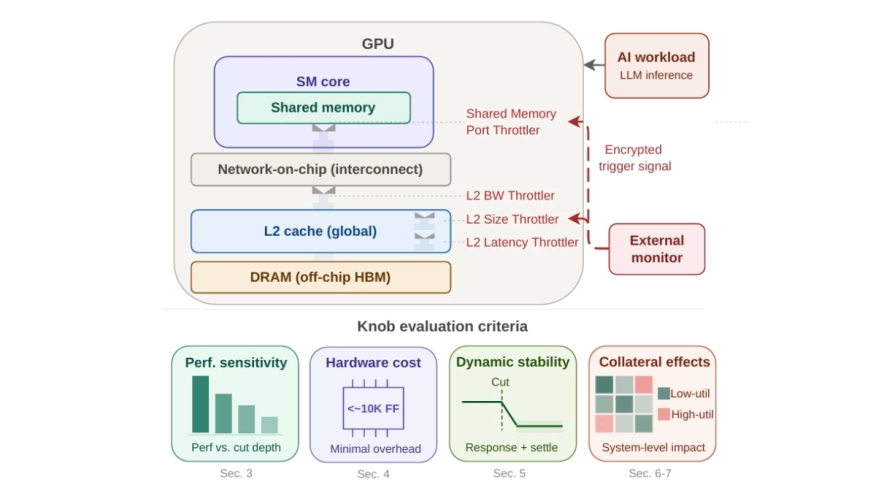
In this paper, we introduce a set of microarchitecture knobs which dynamically control the available hardware resources to limit AI performance at runtime. We evaluate candidate knobs spanning the GPU memory subsystem, across capacity, bandwidth, latency and frequency dimensions, and narrow down to four strong candidates: L2 size, L2 latency, L2 bandwidth, and shared memory port access rate. To minimize new logic and extra design cost, we build all four mechanisms from well-established microarchitectural primitives: cache way masking, credit-based rate limiting, latency insertion, and bank arbitration. We show that these knobs achieve high performance sensitivity (up to 80% performance cut at 1/8 resource availability), negligible implementation cost (<~10K flip flops), fast stabilization after dynamic throttling (5-80K cycles), and minimal collateral impact on the rest of the chip. Further, multi-knob analysis reveals combinations of knobs that amplify the performance degradation beyond the effect of each knob individually, which enables a broader range of performance targets.
To read the full article, click here
Related Semiconductor IP
- GPU
- B-Series GPU IP
- Arm’s flagship GPU providing ultimate mobile gaming experiences
- Real-Time GPU IP for Path Tracing
- A-Series GPU IP
Related Articles
- Using edge AI processors to boost embedded AI performance
- Performance Evaluation of Inter-Processor Communication Mechanisms on the Multi-Core Processors using a Reconfigurable Device
- Performance Measurements of Synchronization Mechanisms on 16PE NOC Based Multi-Core with Dedicated Synchronization and Data NOC
- AI Edge Inference is Totally Different to Data Center
Latest Articles
- Terracotta: Enabling the Adoption of New DRAM Techniques via a Flexible DRAM Interface and Memory Controller
- A Framework for Accelerating Transformer Inference on RISC-V for Edge AI
- An Interleaved Parallel Dependent Quantization Hardware Architecture for H.266/VVC
- A Formal Security Analysis of CAN XL
- A Secure dToF LiDAR SoC with Dual-Domain Fingerprinting and Event-Driven AFE Circuit Achieving Sensor-Level Attack Resilience