LLM Agent-Based Design of RISC-V CPUs with FPGA-in-the-Loop Evaluation
By Leo Itoh, Junichiro Kadomoto
The University of Tokyo, Japan
Abstract
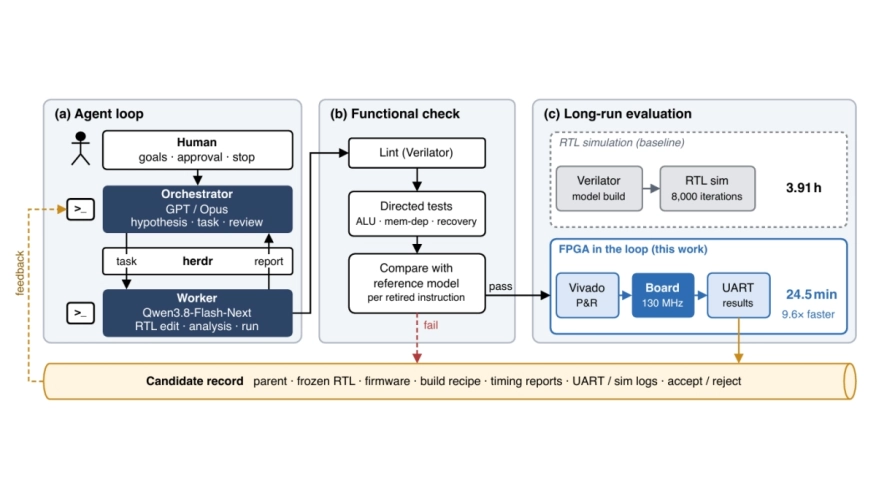
Long-run RTL simulation of CPU candidates can take hours, while short diagnostic runs may miss performance degradation that emerges later in execution. This evaluation cost can delay design decisions in LLM-agent-based CPU development. We present a development environment in which LLM agents implement CPU candidates on an FPGA and use on-board performance measurements to guide design decisions. We applied it to the human-supervised development of a single-cycle RV32I core into a three-wide out-of-order RV32IM core. The final design reaches 5.61 CoreMark/MHz at 130 MHz on a Artix-7 FPGA. For the same CPU candidate running 8,000 CoreMark iterations, FPGA evaluation, including implementation, was 9.6x faster than single-threaded RTL simulation. In one case, board measurements revealed long-run performance degradation in a candidate that improved in a short diagnostic run. The result guided candidate selection and led to RTL-based root-cause analysis and a fix.
To read the full article, click here
Related Semiconductor IP
- RISC-V Debug & Trace IP
- RISC-V IOPMP IP
- Gen#2 of 64-bit RISC-V core with out-of-order pipeline based complex
- 64-bit RISC-V core with in-order single issue pipeline. Tiny Linux-capable processor for IoT applications.
- Multi-core capable RISC-V processor with vector extensions
Related Articles
- LLM Inference with Codebook-based Q4X Quantization using the Llama.cpp Framework on RISC-V Vector CPUs
- Design and implementation of a hardened cryptographic coprocessor for a RISC-V 128-bit core
- RISCover: Automatic Discovery of User-exploitable Architectural Security Vulnerabilities in Closed-Source RISC-V CPUs
- TeraPool: A Physical Design Aware, 1024 RISC-V Cores Shared-L1-Memory Scaled-up Cluster Design with High Bandwidth Main Memory Link
Latest Articles
- LLM Agent-Based Design of RISC-V CPUs with FPGA-in-the-Loop Evaluation
- Automated Multi-Line Bug Repair Using Model Checker Aided LLMs: A Case Study on RISC-V Processors
- Cryogenic Recharacterization of a Commercial 22 nm FD-SOI Foundry Standard-Cell Library
- A 105 MS/s 4.18 nJ/inference 0.765 mm² Mixed-Signal Streaming ML Engine for Wireless Baseband in 12LP+ FinFET
- Agentic AI for Heterogeneous System Design Across Chip, Scale-Up, and Scale-Out Domains